


Antique Pet Portrait Canvas
An antique pet portrait canvas captures the distinct character of valued animals through historical painting traditions.
Antique Pet Portrait Canvas
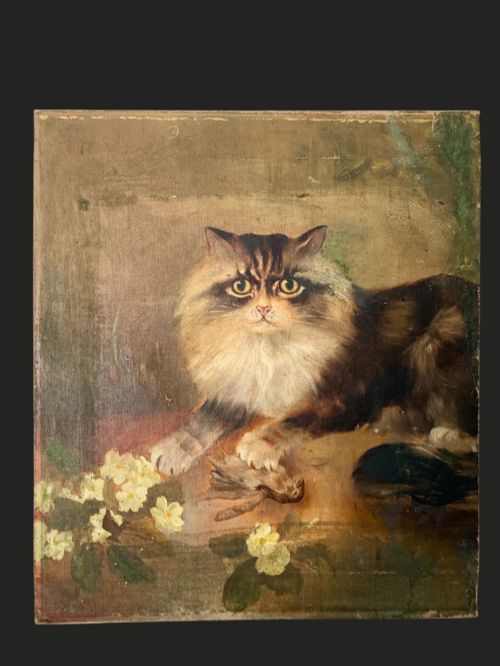
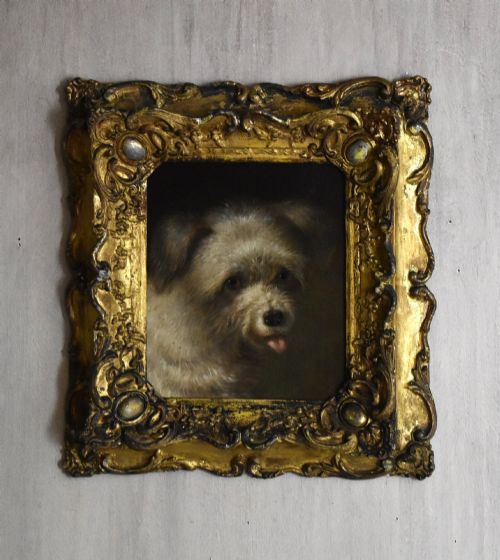
An antique pet portrait canvas represents animals ranging from prized greyhounds and spaniels to cats and rabbits, captured in oil paint by artists across centuries. When searching for an antique pet portrait canvas, buyers encounter works executed in oil on canvas, often housed within original giltwood and gesso frames.
The selections span the 18th century, Regency period, Victorian era, and the early 20th century. Forms include individual studies of dogs and cats, group compositions, and animal subjects accompanying their owners in interiors or landscapes.
Pieces originate from various European traditions, including British schools, French schools, and provincial works. Buyers most frequently meet 19th-century oil paintings depicting domestic pets with considerable charm and directness.
How they were made
These works rely on oil paint applied to woven canvas stretched over wooden supports. Artists utilised rich pigments to render fur texture, light, and shadow, working within established academic or naive traditions.
Finished canvases found placement within carved wooden frames, frequently enhanced with gesso and gilt finishes that complement the painterly subjects.
Listings feature works spanning the eighteenth, nineteenth, and early twentieth centuries, executed in oil on canvas with wood and giltwood frames.
What varies in quality
Quality rests in the anatomical accuracy, handling of light, and the psychological presence the artist achieves in rendering the animal. Finer examples display confident brushwork and nuanced understanding of bone structure and expression, whereas simpler naive works prioritize direct charm over academic proportion.
The integrity of the original canvas and the survival of matching period frames contribute significantly to the standing of a piece.
Martin Theodore Ward·William Barraud·Agnes Augusta Talboys·Christian Lindner·John Henry Dell·Valentine Thomas Garland·Florence Mabel Hollams·Philip Eustace Stretton·Francisco Jose Domingo y Marques·Samuel John Carter·Frank Owen Salisbury·Jules Le Roy·Sir Peter Lely·Mary Beale·Robert Surtees Snr
The Antique Pet Portrait Canvas Glossary
- Oil on Canvas
- A painting medium where pigments suspended in drying oils are applied to a stretched woven fabric support. This method allowed artists to achieve rich colour depth and lasting durability.
- Giltwood
- Wood that has been covered with a thin layer of gold leaf or gold paint. Frames utilising this finish were designed to highlight the artwork.
- Gesso
- A plaster-like mixture applied to wooden frames to provide a smooth surface for gilding. It allows intricate moulded ornamentation around the painting.
- Naive School
- An art movement or classification characterised by a childlike simplicity in perspective and proportion. These works offer direct emotional honesty rather than strict academic realism.
- Victorian Genre
- A style focusing on scenes of everyday life and domestic animals popular during the 19th century. These paintings often tell a gentle narrative about household companions.
Antique Pet Portrait Canvas: Frequently Asked Questions
How do I clean an antique canvas?
Surface dust may be gently removed with a soft, dry artist's brush, taking care near areas of old paint shrinkage or cracking. Professional conservators should handle any deeper cleaning involving liquids or solvents.
Avoid household cleaning products entirely, as chemical agents can strip delicate oil layers and damage the underlying weave of the canvas.
Were these paintings always framed?
Most works were paired with suitable frames from their period, often featuring carved wood and gilt ornamentation that reflected contemporary interior tastes. Frames serve both a protective function and a framing role for the composition.
Some canvases retain their original frames, while others have been matched with period-appropriate alternatives over the course of their history.
How can I tell the period?
Stylistic clues within the brushwork, clothing styles of any human subjects, and framing construction help establish the date of execution. Pigment analysis and canvas preparation techniques also offer clues to the era.
Signatures, dates inscribed on the reverse, and artist attribution provide direct documentation where available.
Where should I hang these portraits?
These works suit traditional living spaces, libraries, or studies where their domestic subjects can be appreciated at eye level. Direct sunlight and high humidity should be avoided to protect the oil paint and canvas.
Stable indoor temperatures help prevent the wood stretcher and canvas from expanding and contracting.