
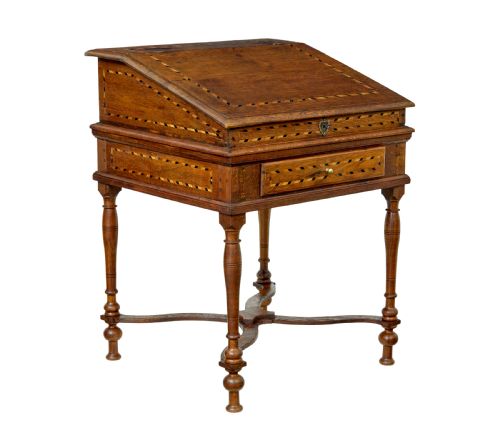


Antique Oak Davenport
These antique oak davenport desks are compact pedestal writing tables offering a sloping top and concealed storage, prized for both practical study and decorative presence.
Antique Oak Davenport
An antique oak davenport desk is a compact pedestal writing desk combining a sloping writing surface with a set of drawers accessed from the side. These pieces suit studies and drawing rooms alike, offering fitted compartments for correspondence within a manageable footprint.
The examples recorded here span several distinct periods, including the Georgian era, the Victorian period, and the Edwardian years. Buyers encounter early nineteenth-century Dutch inlaid slopes alongside mid-nineteenth-century pollard oak variants and late Victorian carved desks.
Most pieces on this page utilise oak as the primary timber, often enhanced by decorative veneers such as pollard oak or burr oak. Functional variations include slide and turn-top mechanisms, drawers fitted to both sides, and interiors lined with burr maple.
How they were made
Cabinet makers constructed these desks using solid oak and specialised decorative veneers like pollard oak and burr oak. The timber surfaces were frequently paired with secondary woods such as fruitwood, while structural and decorative details incorporated brass and metal hardware.
Writing surfaces were typically inset with tooled leather to provide a durable and traditional platform for correspondence. Interior compartments often featured contrasting timbers like burr maple, showcasing precise joinery and cabinet-making skill within the enclosed stationery wells.
Period styles represented across the inventory include George III, Victorian, Edwardian, and Arts and Crafts forms.
What varies in quality
Quality in these desks rests upon the choice of timber and the sophistication of the decorative veneers. Selected pollard oak and burr oak displays complex, swirling grain patterns that elevate standard oak construction into higher tiers of cabinet work.
Design complexity and hardware also distinguish the pieces. Desks featuring carved ornamentation such as green man motifs, turn-top mechanisms, or functional drawers positioned on both sides demonstrate greater ambition in their making than simpler baseline models.
Thomas Turner
The Antique Oak Davenport Glossary
- Davenport
- A compact pedestal writing desk featuring a sloped, hinged writing surface above a set of side drawers. The form became popular during the nineteenth century for domestic study use.
- Pollard Oak
- Timber taken from trees that have been pollarded, producing dense, highly figured growth rings with a distinctive speckled pattern. Cabinet makers valued this wood for high-status surface veneers.
- Burr Oak
- Timber harvested from tree growths or burls, yielding an intricate, swirling grain. It provides a highly decorative finish on writing slopes and drawer fronts.
- Writing Slope
- A portable or stationary desk featuring an angled writing surface that often lifts to reveal storage space for paper and ink. Early nineteenth-century examples frequently incorporated marquetry or inlay.
Antique Oak Davenport: Frequently Asked Questions
What is an antique oak davenport?
An antique oak davenport is a small pedestal desk featuring a sloping writing top and a pedestal of drawers opening to the side. They were designed for letter writing and compact study.
These pieces combine enclosed storage with a small footprint, making them suitable for domestic interiors where space is at a premium.
What are pollard oak and burr oak?
Pollard oak and burr oak are decorative timber veneers prized for their textured grain patterns. Pollard oak comes from trees pruned to encourage dense, speckled growth.
Burr oak derives from tree burls, creating swirling patterns that cabinet makers used on prominent exterior surfaces.
Were these desks used for writing?
Yes, the sloping top provided an ergonomic angle for handwriting, often lined with tooled leather to create a smooth surface. Internal compartments held inkwells and stationery.
The side drawers stored letters, documents, and writing implements securely beneath the desk top.