

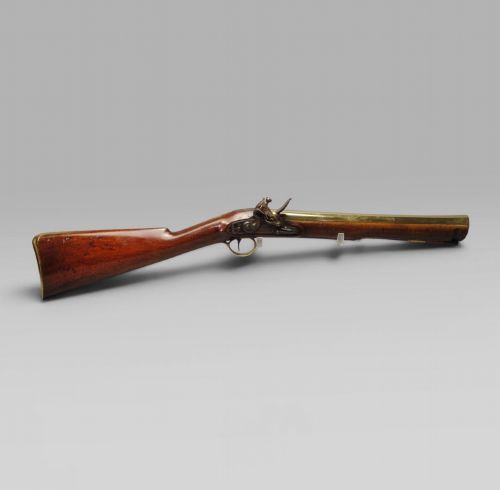


Antique Muzzle Loading Gun
An antique muzzle loading gun brings tangible history to your desk or cabinet, uniting traditional craftsmanship with mechanical evolution.
Antique Muzzle Loading Gun
When you search for an antique muzzle loading gun, you enter a field spanning the eighteenth and nineteenth centuries, taking in flintlocks, percussion systems and matchlocks. These items range from pocket pistols and blunderbusses to heavy muskets and sporting rifles.
The pieces on this page draw from Georgian and Victorian periods, including military issues and civilian arms. You will encounter English, Scottish and Indo-Persian examples alongside desk ornaments and boxed revolvers.
Originating as practical weaponry for officers, sportsmen and soldiers, these arms now survive as historical artefacts. Their forms reflect the technological shifts from early ignition mechanisms to mid-nineteenth-century percussion designs.
Construction and materials
Makers shaped stocks from dense hardwoods such as walnut and oak, pairing them with barrels forged from steel and iron. Brass and silver mounts often provide structural reinforcement and decorative contrast.
Finishes incorporate materials like velvet for display cases, whilst metal components undergo surface treatment ranging from plain polish to engraved detailing. Mechanisms rely on precise metalworking to form functioning locks and triggers.
Antique Muzzle Loading Gun Retail Price Guide 2026
Typical asking prices for muzzle loading gun among the pieces listed under this phrase on Sellingantiques today, from the lower quarter to the upper quarter. They describe what is for sale here now, not the wider market.
The listings span the eighteenth and nineteenth centuries, featuring walnut, steel, brass, silver and oak across military and civilian forms.
Judging quality and execution
Quality rests upon the crispness of metal engraving and the snugness of wood-to-metal fit. Superior pieces demonstrate purposeful balance and harmonious proportions between stock and barrel.
The integrity of maker signatures and the survival of original components elevate a piece. Evidence of careful hand-finishing marks the distinction between standard military issue and bespoke civilian work.
Harrison of London·Sargant and Son·John Manton·Meyer and Mortimer
The Antique Muzzle Loading Gun Glossary
- Flintlock
- An ignition mechanism utilising a piece of flint struck against a steel frizzen to create sparks. This system dominated firearms technology throughout the eighteenth century.
- Percussion cap
- A small metal cup containing a priming compound placed on a nipple, detonated by the fall of the hammer. It replaced the flintlock system in the nineteenth century.
- Blunderbuss
- A firearm with a flared muzzle designed to scatter shot at close range. These were widely carried by guards and coachmen.
- Matchlock
- An early firearm mechanism where a slow-burning match is lowered into the priming pan. This represents one of the earliest methods of igniting gunpowder.
- Musket
- A long gun intended for infantry use, fired from the shoulder. These form a major component of military surplus from the Georgian and Victorian eras.
Antique Muzzle Loading Gun: Frequently Asked Questions
How do I display an antique muzzle loading gun?
Mount these pieces securely on a wall rack or place them within a glass-fronted cabinet to protect the wood and metal from moisture.
Ensure the display area avoids direct sunlight and dramatic temperature shifts to preserve the original finishes and prevent timber warping.
Were these guns used in combat?
Many examples on this page served military and naval forces during the Napoleonic period and mid-nineteenth-century campaigns.
Others were built for civilian self-defence, sporting pursuits or carried as officer sidearms during colonial expansion.
How do I tell flintlocks and percussion guns apart?
Flintlock mechanisms use a vertical cock holding a stone and a hinged steel plate to generate sparks over a priming pan.
Percussion systems feature a simpler spring-loaded hammer that strikes a small explosive cap fitted directly onto a hollow nipple.
What maintenance do these metal and wood parts need?
Apply a light coat of specialist museum wax or preservative oil to metal surfaces to prevent oxidation and stabilise the steel.
Treat wooden stocks periodically with appropriate conservation oils to nourish the grain without leaving a sticky residue.