





Antique Music Storage Rack
An antique music storage rack is a practical period stand for organising sheets, scores and periodicals.
Antique Music Storage Rack
When you search for an antique music storage rack, you encounter functional division stands built to hold paper, folios and scores in period rooms. These pieces appear in forms such as canterburys, music cabinets and magazine racks, originating across the Georgian, Regency and Victorian eras.
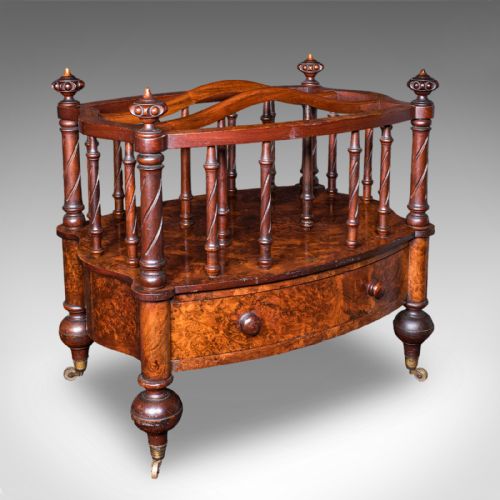
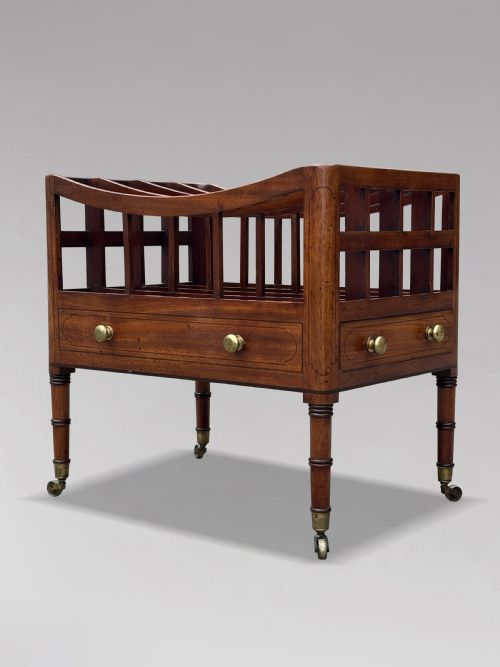
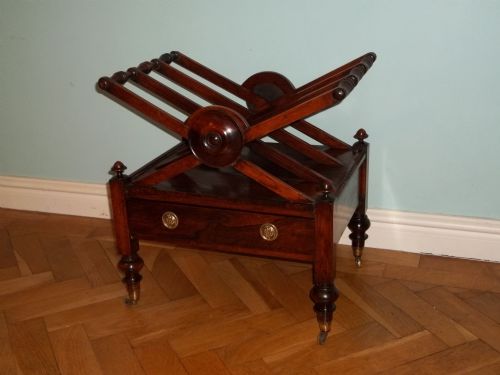
The version you are most likely to meet on this page is the wooden canterbury, typically featuring slatted or divided partitions above a low drawer or castor-mounted base. Makers designed these pieces from mahogany, rosewood and burr walnut to sit beside pianofortes and seating areas for everyday retrieval of sheet music.
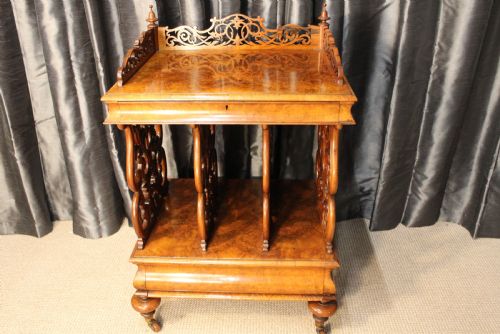
Examples range from early George III mahogany designs to late Victorian walnut and brass music cabinets. Each piece reflects the domestic musical habits of its period, combining compartmentalised storage with mobility or compact proportions.
Materials and construction
Cabinet makers constructed these racks predominantly from dense hardwoods, utilising mahogany, rosewood and burr walnut for durability and rich grain figuring. Workshops occasionally incorporated Cuban mahogany, ebony banding, brass fittings, ceramic castors and glass panels to elevate the finish.
Joinery techniques focused on creating sturdy upright divisions, spindle galleries and under-tier drawers capable of supporting heavy paper collections. Stands often feature turned carrying handles, upright slats and low frames supported on castors for ease of movement across floor coverings.
Listings feature music storage racks spanning the 18th century, Georgian, Regency and Victorian periods, constructed from mahogany, rosewood, walnut and burr walnut.
Quality variations in storage racks
The distinction between standard and superior pieces lies in the selection of timber veneers, such as finely figured burr walnut or dense Cuban mahogany, alongside crispness in turned spindles and carved details. Finer examples display precise cabinet work like ebony banding and integrated drawers.
Proportion and structural integrity also separate workshop standards, with better examples maintaining rigid divisions and balanced forms without clumsy repairs. The refinement of brass handles, castors and structural joints indicates the original maker's skill and investment of time.
The Antique Music Storage Rack Glossary
- Canterbury
- A low stand with partitioned sections for holding sheet music, newspapers or magazines, often fitted with a drawer below. Originating in the late eighteenth century, the form bears a name linked to the Archbishop of Canterbury.
- Mahogany
- A durable, reddish-brown tropical hardwood favoured by period cabinet makers for its stability and fine grain. Variations include Cuban mahogany, known for its exceptional density and rich figuring.
- Rosewood
- A heavy, dark timber featuring pronounced grain patterns and deep colour tones, widely utilised during the Regency and Victorian eras. This material appears frequently on refined canterburys and music stands.
- Regency
- A British design period spanning the early nineteenth century, characterised by classical restraint, architectural lines and exotic timbers. Pieces from this era often exhibit clean geometry and brass embellishments.
Antique Music Storage Rack: Frequently Asked Questions
What is an antique music storage rack used for?
These stands served primarily to hold sheet music, scores and folios near a piano or seating area in a nineteenth-century drawing room. They kept paper collections tidy and accessible for musicians.
Today, owners utilise them similarly for contemporary magazines, vinyl records, journals and newspapers alongside modern seating arrangements.
How do I tell a Georgian canterbury from a Victorian one?
Georgian and George III pieces generally display cleaner architectural lines, straight or slightly tapering legs, and solid mahogany construction with understated detailing. They often rely on proportion rather than heavy ornamentation.
Victorian examples frequently introduce richer veneers like burr walnut, heavier carved elements, brass music cabinets, and more ornate turnings or ceramic castors reflecting changing domestic tastes.
Did all music racks include drawers?
No, many traditional canterburys consist solely of partitioned vertical racks above a simple plinth or castors without enclosed storage. The inclusion of a low drawer underneath the divisions varied according to the specific model and period.
When present, the drawer provided supplementary space for smaller musical accessories, manuscript books or loose paper leaves.
How do I care for a wood music rack?
Keep wooden stands away from direct heat sources, radiators and strong sunlight to prevent timber splitting, veneer lifting or fading in rosewood and mahogany. Regular dusting with a soft, dry cloth preserves the polished surface.
Apply occasional traditional wax polish sparingly to nourish hardwoods and maintain the natural lustre of the grain without building up heavy residue.
What woods were used for these racks?
Cabinet makers utilised dense hardwoods including mahogany, Cuban mahogany, rosewood and walnut, frequently selecting burr walnut for decorative effect. These timbers provided the structural strength needed for upright divisions.
Accents of ebony banding, brass rods, carrying handles and ceramic castors often accompanied the primary woods to enhance both function and appearance.