
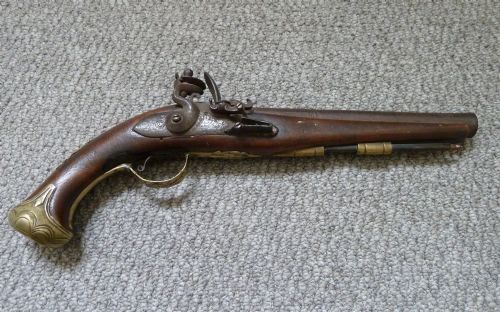
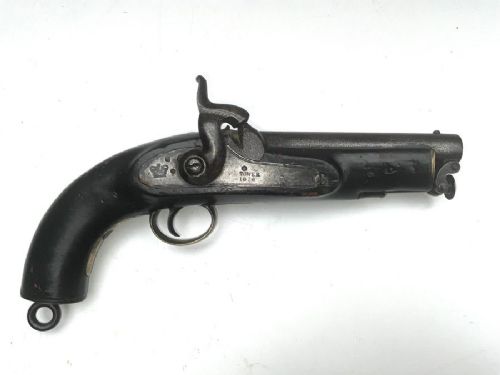

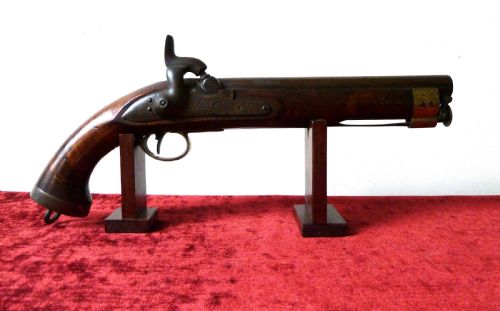


Antique Military Horse Pistol
An antique military horse pistol is a heavy service arm designed for mounted troopers, combining steel and walnut in robust utility.
Antique Military Horse Pistol
When you search for an antique military horse pistol, you encounter heavy service arms issued to cavalry and mounted troops across the eighteenth and nineteenth centuries. These pieces span Georgian, Victorian military, and Napoleonic eras, reflecting the shifting demands of armed service on horseback.
You are most likely to meet flintlock and percussion ignition systems housed in robust wooden stocks with brass or iron furniture. The forms range from standard British Tower service models and East India Company issues to continental European holster and dragoon pistols.
Many examples bear official government acceptance marks, crown stamps, or maker names on the lockplates, confirming their active military pedigree. The typical survival shows period wear on the walnut stock and patinated steel barrels that mark decades of handling and service.
Materials and construction
Gunmakers built these service arms around forged steel barrels and lock mechanisms designed to withstand the rigours of military campaigns. Barrels were smoothbore to fire lead balls, often secured to the stock with brass sideplates, trigger guards, and butt caps.
Stocks were carved from dense walnut to absorb the shock of discharge, shaped with full lengths extending toward the muzzle. Iron and brass furniture reinforced the wood at high-stress points, while ramrods sat in under-barrel channels for reloading in the field.
Listings feature eighteenth and nineteenth-century pieces incorporating steel, walnut, brass, and iron across Georgian and Napoleonic military styles.
Distinctions in quality and survival
The division between standard ordnance and superior quality often rests on the crispness of government inspection stamps and the original finish of the metal components. Maker-signed locks by established gunsmiths command greater interest than unmarked contract pieces.
Survival of original stock geometry, clear barrel proofs, and a fully functional lock mechanism elevate an example above heavily cleaned or restored specimens. The degree of honest service wear balanced against structural integrity defines the standing of each piece.
T. Potts·Brasher·Wilson
The Antique Military Horse Pistol Glossary
- Flintlock
- An ignition mechanism where a flint strikes a steel frizzen to produce sparks that ignite priming powder. This system dominated military arms until the mid-nineteenth century.
- Percussion
- A later ignition system using a hammer striking a fulminate-filled cap on a nipple. It replaced the flintlock for greater reliability in wet weather.
- Holster pistol
- A large sidearm carried in a saddle holster by mounted troopers. These arms possessed longer barrels than belt pistols.
- Tower
- A designation for weapons manufactured or inspected at the Tower of London. It signifies official British government ordnance production.
- Brass furniture
- The trigger guards, butt caps, and sideplates cast in brass rather than iron. This metal resisted rust from sweat and horse contact.
Antique Military Horse Pistol: Frequently Asked Questions
What is a military horse pistol?
A military horse pistol is a large-calibre firearm issued to cavalrymen for use on horseback during the eighteenth and nineteenth centuries.
These arms were built for rugged service, featuring robust walnut stocks and dependable ignition systems to withstand active campaign conditions.
How do flintlock and percussion differ?
Flintlocks rely on a piece of flint striking steel to create sparks that ignite gunpowder in a pan. This method requires dry priming powder to function effectively.
Percussion pistols use an external hammer that strikes a small percussion cap placed on a nipple, channelling flame directly into the breech. This system offered superior weather resistance.
Why are some marked Tower?
Tower markings indicate that the piece was produced for or inspected by the British Board of Ordnance at the Tower of London. These stamps guarantee official military issue status.
Such marks usually include a crown over the reigning monarch's initials, such as GR for George Rex.
How should I display one?
These pieces require a stable environment away from direct sunlight and damp conditions to preserve the walnut stock and steel surfaces. Wall mounting brackets or desk stands must support the heavy barrel and stock securely.
Maintenance involves light oiling of metal parts to prevent active corrosion while maintaining the historical patina.