
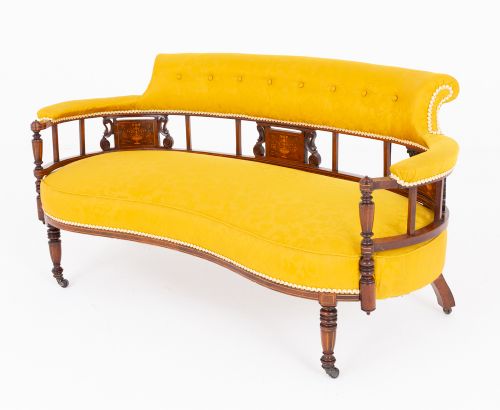


Antique Marquetry Settee
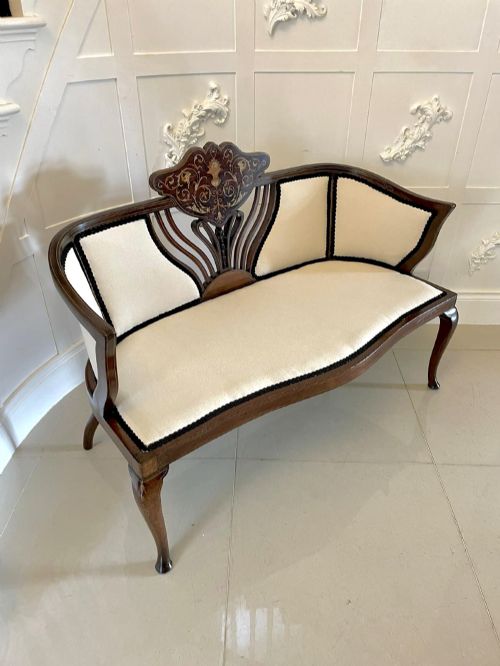
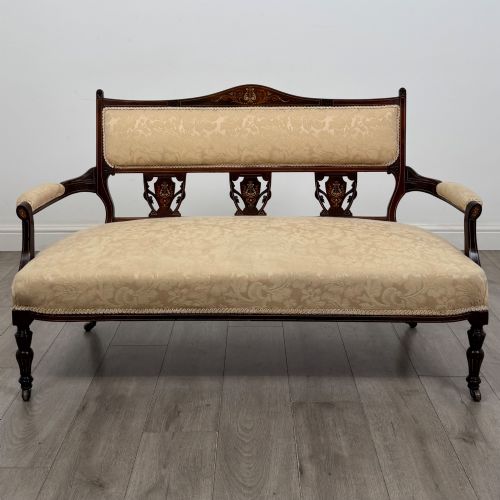
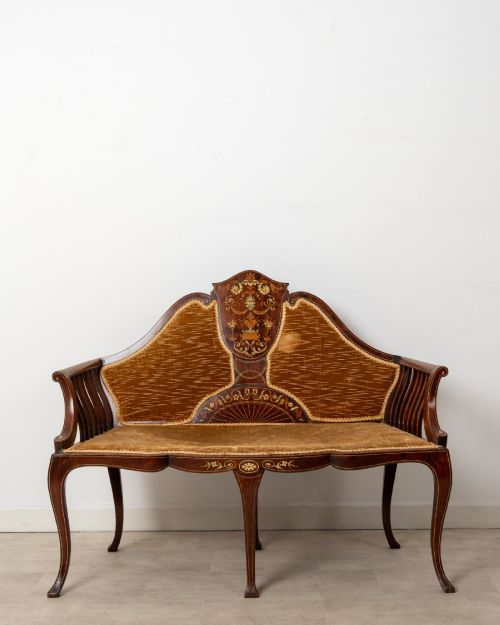
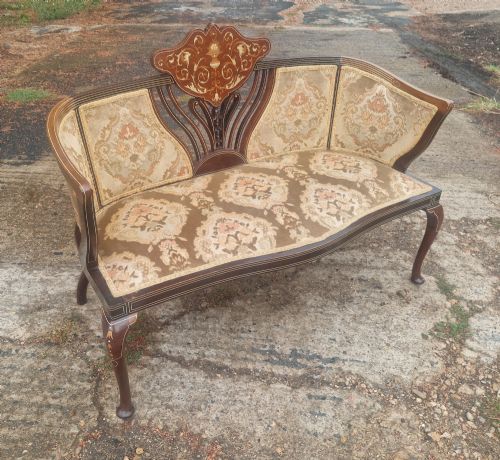
An antique marquetry settee brings intricate floral and geometric wood imagery into a formal sitting room.
Antique Marquetry Settee
An antique marquetry settee is an upholstered seat for two or more persons, constructed with detailed wood veneers. The forms span the Victorian, Edwardian, and late nineteenth-century periods, capturing the revival of classical and artistic styles.
Buyers will encounter two-seater salon settees, end-of-bed sofas, and window seats finished with marquetry, satinwood inlay, or boulle work. Most examples on this page date from the Edwardian era and the Victorian period, utilising dark timbers like mahogany and rosewood.
The corpus includes individual parlour couches as well as parts of larger salon suites that incorporate matching armchairs. These seats served in formal reception spaces and drawing rooms to display wealth and taste.
How they were made
Cabinet makers constructed the frames primarily from solid mahogany and rosewood, applying contrasting veneers of satinwood and various fruitwoods to form pictorial marquetry panels. The decorative schemes often combine marquetry with stringing in light woods and occasional bone details.
Upholstery techniques relied on webbing, springs, and horsehair stuffing, covered in velvet or contemporary fabric. Many pieces integrate brass mounts or castors to facilitate movement across carpeted drawing rooms.
Mahogany and rosewood dominate the frame materials, paired with satinwood inlay and detailed marquetry across Victorian and Edwardian examples.
What varies in quality
The standard of a piece rests upon the crispness of the marquetry cutting and the integration of the contrasting veneers into the primary timber ground. Finer examples display meticulous grain selection and minimal lifting across the inlaid sections.
Structural integrity of the mahogany or rosewood frame separates standard production from superior cabinet work, particularly around the joinery of the back rails and legs. The depth of the carving and the fidelity of revival styles, such as Islamic or Dutch Neo-Classical, dictate the grade of the work.
Jas James Shoolbred
The Antique Marquetry Settee Glossary
- Marquetry
- Decorative veneer work forming pictures or patterns by assembling small pieces of different coloured woods. It differs from inlay by covering the entire surface of the ground timber rather than sitting within carved recesses.
- Satinwood
- A hard, yellow timber native to Ceylon and India, prized for its lustrous grain. Cabinet makers used it extensively for contrasting stringing and marquetry panels.
- Boulle inlay
- An elaborate marquetry technique using tortoiseshell and brass, named after the French cabinet maker André-Charles Boulle. It appeared on revival pieces in the late nineteenth and early twentieth centuries.
- Salon suite
- A matched set of seating furniture comprising a settee and several armchairs or side chairs. These suites unified the decorative scheme of a formal Victorian or Edwardian drawing room.
- Stringing
- Thin lines of contrasting wood inlaid into the surface of furniture to frame panels or edges. It is a defining feature of Sheraton Revival pieces.
Antique Marquetry Settee: Frequently Asked Questions
How do I identify an Edwardian settee?
Edwardian examples typically feature lighter mahogany frames with delicate satinwood inlay and Sheraton Revival motifs. They often present slender tapered legs and understated floral marquetry.
Victorian pieces, by contrast, tend to use heavier rosewood or dark mahogany with dense carving and robust proportions.
Were these settees used in bedrooms?
Certain compact variants served as end-of-bed sofas or window seats in large townhouses. Their modest scale suited private dressing rooms and upper chambers.
The larger salon suites remained in the formal ground-floor reception rooms for entertaining guests.
What is the difference between marquetry and inlay?
Marquetry assembles veneer pieces together to form an entire pictorial surface before applying it to the carcase wood. Inlay involves cutting recesses into solid wood and inserting pieces to fit.
Both techniques appear frequently across nineteenth-century seating furniture.
Can I use an antique settee daily?
These pieces function well in modern interiors provided they are treated with care and placed away from direct heat sources. Many survive with stable frames suitable for everyday seating.
Some examples require reupholstery to match modern fabric preferences while preserving the historic wood frame.