



Antique Marble Writing Accessory
An antique marble writing accessory brings weight and classical order to a desk through polished stone and cast metal.
Antique Marble Writing Accessory
An antique marble writing accessory comprises heavy desk pieces designed to hold ink, pens, and blotting paper for correspondence. When searching for an antique marble writing accessory, buyers encounter desk stands, inkwells, and encriers formed from solid stone mounted with metal fittings.
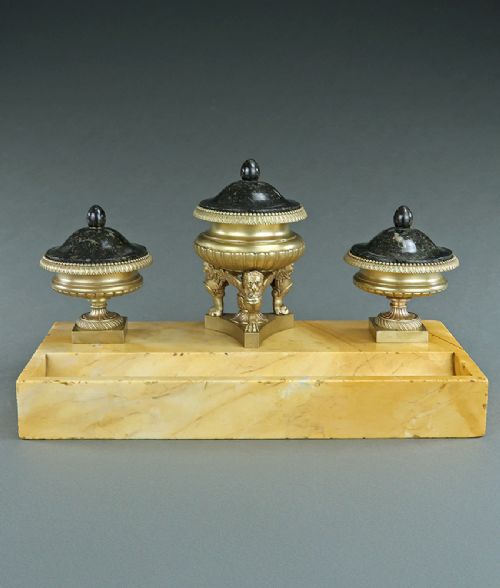
The pieces on this page span the nineteenth century into the early twentieth century, taking forms such as French Empire, Art Nouveau, and Neoclassical designs. Most examples pair a carved marble base with gilt bronze, brass, or ormolu mounts to create a formal desktop centrepiece.
Makers and foundries from Belgium, France, and Britain produced these items using regional stones including Sienna marble, Ashford black marble, and green marble. Inkstands and desk sets dominate the selection, often incorporating lidded glass ink pots fitted within the stone housing.
How they were made
Masons cut and polished blocks of natural marble and onyx into rectangular or shaped bases to serve as the foundation for each desk accessory. Artisans then drilled recesses into the stone to accommodate lidded inkwells and pen grooves.
Foundries cast decorative mounts in bronze, brass, or ormolu using traditional techniques, applying fire gilding or chemical patination to the metal surfaces. These cast elements, including paw feet, foliate handles, and portrait busts, were then fixed directly to the marble bases.
Antique Marble Writing Accessory Retail Price Guide 2026
Typical asking prices for marble writing accessory among the pieces listed under this phrase on Sellingantiques today, from the lower quarter to the upper quarter. They describe what is for sale here now, not the wider market.
What varies in quality
The quality of an antique marble writing accessory depends upon the selection of the stone and the crispness of the metal casting. Dense marbles with rich natural veining and finely chased bronze or ormolu mounts indicate superior craftsmanship.
Weight and proportion distinguish finer pieces from simpler workshop productions, alongside the presence of signed metalwork or hardstone inlay. Well-integrated components, where metal mounts follow the exact contours of the stone, separate high-grade items from utilitarian office wares.
Lefebvre of Belgium·Albert Marionnet·Zimmermann
The Antique Marble Writing Accessory Glossary
- Encrier
- A French term for an inkstand or inkwell fitted to hold writing implements. These desk accessories often include one or two ink pots alongside a pen tray.
- Ormolu
- Gilded bronze produced by applying an amalgam of gold and mercury to a cast bronze object and heating it to drive off the mercury. This technique creates a durable, luminous golden finish characteristic of nineteenth-century decorative metalwork.
- Ashford Black Marble
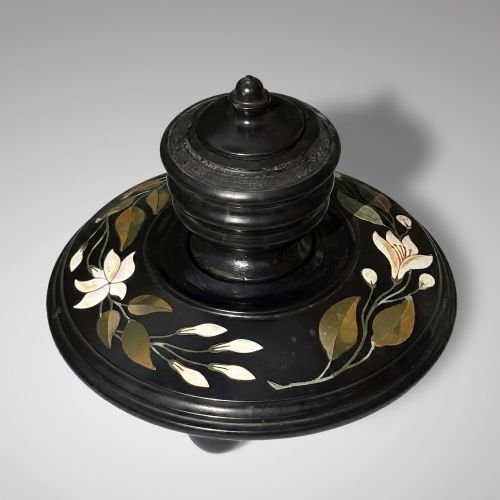
- A dark limestone from Derbyshire, England, used for ornamental objects and inlaid with coloured mineral specimens in pietra dura style. It provides a dense, jet-black background that contrasts sharply with inlaid botanical or geometric designs.
- Sienna Marble
- A decorative Italian marble known for its rich yellow ground marked with deep purple and brown veins. It was widely utilised in neoclassical and nineteenth-century decorative objects for its striking warmth and colour.
Antique Marble Writing Accessory: Frequently Asked Questions
What is an encrier?
An encrier is the French term for an inkstand or inkwell designed for a desktop. It typically holds glass ink inserts and provides a resting place for quill or steel pens.
These pieces served as functional writing equipment for correspondence and record-keeping in nineteenth-century studies and offices.
How do I clean antique marble?
Marble requires gentle dusting with a soft, dry cloth to prevent surface scratching. Avoid acidic cleaners, water, or abrasive polishes that can damage the polished stone or corrode adjacent metal mounts.
Metal components should be dusted carefully without disturbing the original patination or gilding applied during manufacture.
How do I identify the period?
Stylistic indicators such as neoclassical motifs, Art Nouveau botanical lines, or heavy Empire ormolu mounts help date these desk accessories. The materials used, including specific marbles and cast bronze techniques, also point towards nineteenth or early twentieth-century production.
Signatures or foundry marks stamped onto the bronze mounts provide definitive makers and workshop attributions.
Were these used in offices?
These pieces were primarily utilised in private libraries, drawing rooms, and executive offices for personal correspondence and document signing. Their substantial weight kept them stable on wooden desks while writing.
Wealthy households and public figures commissioned elaborate desk sets in bronze and marble to display status and refinement.