
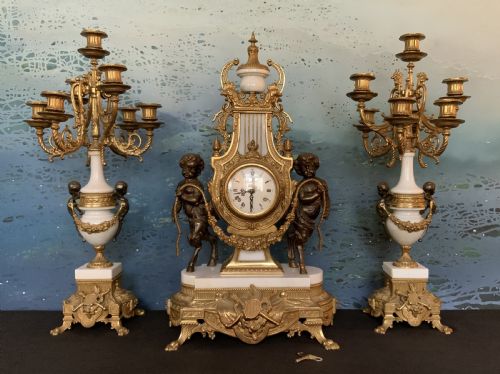


Antique Lyre Clock
An antique lyre clock balances musical form with precision engineering, offering a striking neoclassical silhouette for the mantelpiece.
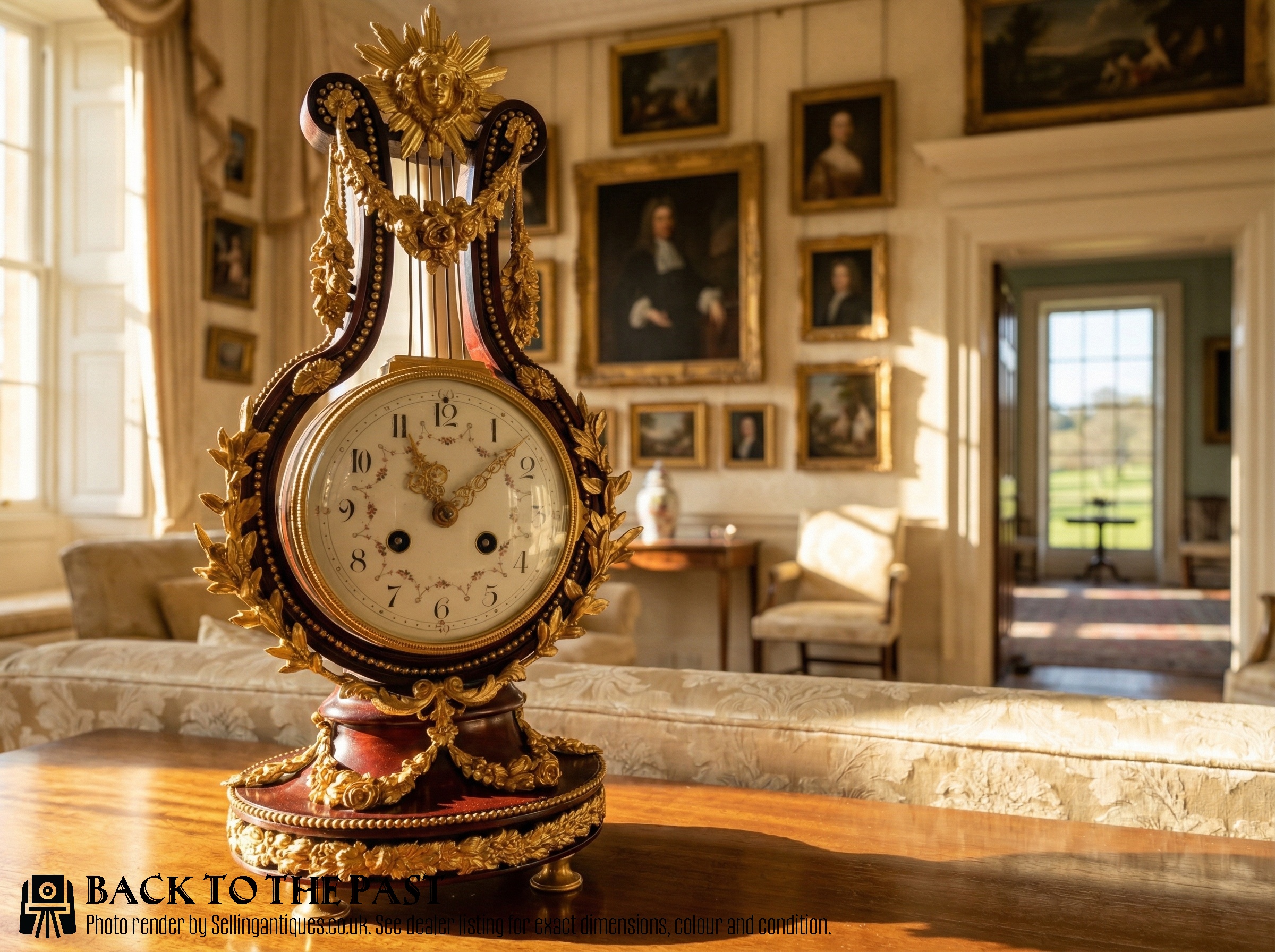
Antique Lyre Clock
When you search for an antique lyre clock, you are looking at timepiece designs modelled after the ancient Greek stringed instrument, distinguished by an open or looped frame that suspends the movement and pendulum.
The versions you are most likely to meet on this page span the nineteenth century and the Regency period, taking the form of mantel clocks or occasionally wall-mounted cartel clocks.
These pieces draw heavily upon Louis XVI, Neoclassical and Victorian styling, frequently appearing in French workshops alongside occasional English interpretations.
Materials and construction
Maker workshops constructed these instruments using cast ormolu, gilt bronze and brass for the sweeping frame, often mounting the mechanism centrally within the upper loop.
Many examples incorporate white enamel dials paired with contrasting bodies fashioned from marble, pink marble, or porcelain such as Bleu de Roi and Sèvres style ceramics.
Certain models employ timber elements including burr walnut and maple, while sophisticated versions utilise glass panels to create a floating mystery clock effect.
The object types recorded across these entries concentrate on mantel clocks, wall-mounted cartel clocks, and multi-piece garniture sets.
Assessing craftsmanship and execution
The distinction between standard production and the top of the range rests upon the crispness of the gilt bronze or ormolu chasing and the depth of the marble or porcelain body.
Finely executed examples integrate complex mechanisms such as chain fusee movements or mystery suspensions, whilst lesser models rely upon standard spring-driven movements without signature detailing.
Lenzkirch·FB Adams London·Maple and Co Paris
The Antique Lyre Clock Glossary
- Ormolu
- Gilded bronze produced by applying a mercury amalgam to the metal base and heating it until the mercury evaporates. This technique leaves a durable, rich golden surface characteristic of fine French horology.
- Mystery clock
- A timepiece where the visual connection between the movement and the hands or pendulum appears obscured or hidden. It creates an optical illusion that often relies on transparent glass dials.
- Cartel clock
- A wall-mounted clock housed in an ornate frame made of wood, metal, or porcelain. These pieces were designed to be hung directly on drawing room walls during the eighteenth and nineteenth centuries.
- Garniture
- A matching set of decorative objects, typically consisting of a central clock flanked by two matching vases or candelabra. They were placed symmetrically on mantelpieces in formal interiors.
- Fusee
- A conical pulley used in spring-driven clocks and watches to equalize the diminishing power of the mainspring as it unwinds. This device ensures consistent timekeeping accuracy.
Antique Lyre Clock: Frequently Asked Questions
What is a lyre clock?
A lyre clock is a decorative timepiece whose case mimics the symmetrical, curved shape of the ancient musical instrument known as the lyre.
The clock face typically sits within the upper loop of the frame, allowing the pendulum to swing visibly through the open central strings or pillars below.
How do mystery lyre clocks work?
Mystery clocks use transparent glass dials or concealed gear trains to make the hands appear to move without any mechanical connection.
This clever optical illusion was achieved by skilled horologists who wanted to astonish viewers with seemingly impossible timekeeping displays.
Where should I place a mantel clock?
These clocks are traditionally sized for placement on a fireplace mantelpiece, drawing the eye as a central decorative focal point in a reception room.
Because many examples form part of a garniture set accompanied by candelabra, they require a stable surface with adequate depth for symmetrical arrangement.
How do I identify a Regency period clock?
Regency timepieces often feature restrained neoclassical proportions, heavy gilt bronze mounts, and precise English movements like chain fusees.
Comparing the metal finish and dial signatures against known London makers helps distinguish these pieces from later continental revivals.