



Antique Livestock Portrait
An antique livestock portrait captures the distinct personality and economic pride of prized farm animals in oils.
Antique Livestock Portrait
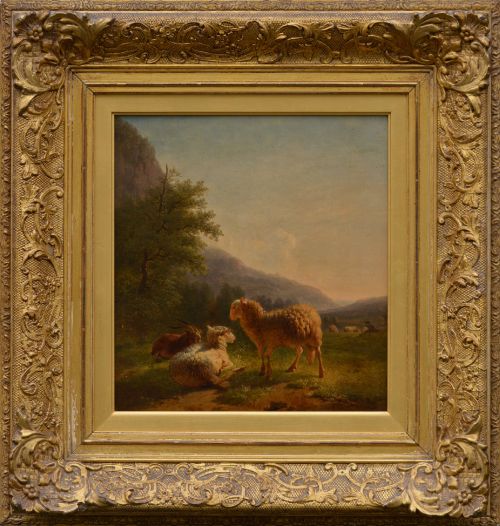
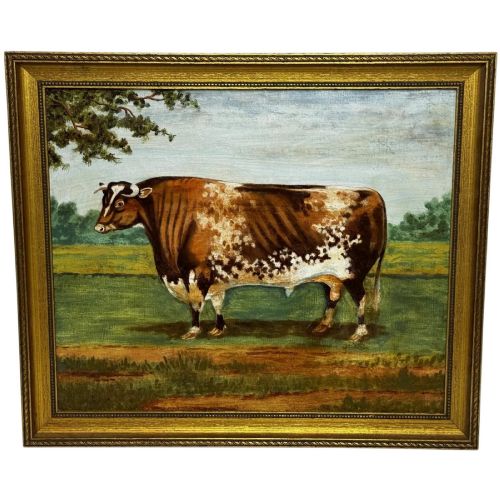
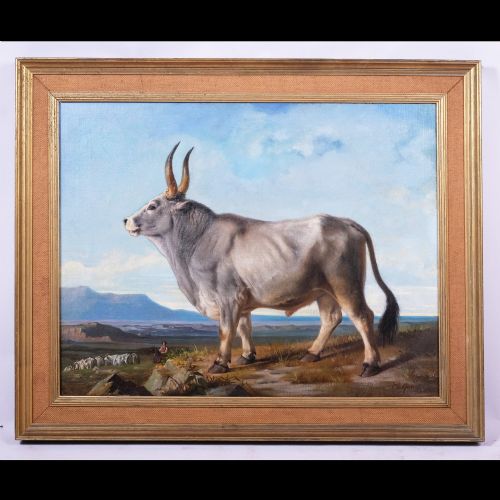
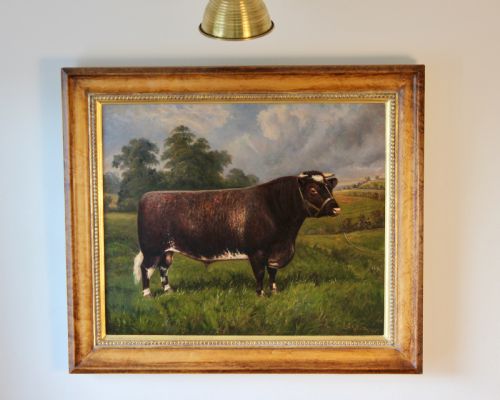
An antique livestock portrait focuses closely on cattle, sheep, and horses, rendered with the careful observation typical of nineteenth century realism and Victorian pastoral art. These works range from intimate depictions of individual prize bulls to expansive scenes featuring Highland cattle and sheep within rural English or Scottish landscapes.
Most examples encountered here date from the Victorian era, particularly the latter half of the nineteenth century, reflecting a period when agricultural wealth and prized breeds were matters of civic pride. The subjects include named animals such as Shorthorn bulls and Hereford cows, often recorded with specific attention to their physical conformation and coat.
How they were made
These works are executed in oil paint upon woven canvas stretched over wooden frames, a combination that allowed artists to build rich layers of texture for animal coats and pastoral skies. The application ranges from smooth, academic blending to heavier impasto that catches the light on fleece or hides.
Framing is an integral part of the physical object, with many surviving in contemporary giltwood frames ornamented with gesso mouldings. The combination of oil on canvas and heavy gilded timber reflects the traditional presentation of nineteenth century fine art.
Several sheep recorded in these canvases appear to possess far more serene expressions than any living animal has a right to maintain.
What varies in quality
Quality rests primarily on the anatomical precision with which the animal is rendered and the handling of light across muscle and fleece. Superior examples combine accurate draughtsmanship with a convincing sense of the animal's weight and presence in the landscape, rather than relying on stiff formulaic poses.
The sophistication of the surrounding landscape and atmospheric depth also distinguishes the work of academic painters from simpler provincial or naive pieces. Brushwork that balances the detailed rendering of fur with looser, atmospheric treatment of skies and pastures marks the upper tier of these works.
Eugène Verboeckhoven·A M Gauci·William Henry Mander·Thomas Sidney Cooper·Heinrich Harder·Charles Jones·Claude Cardon·John W Morris·W A Clark·William Huggins·A Davis
The Antique Livestock Portrait Glossary
- Victorian pastoral
- A genre of nineteenth century painting celebrating rural life, agricultural labour, and domesticated animals in idealized or realistic countryside settings. This style emphasises the harmony between livestock and the British landscape.
- Oil on canvas
- A traditional painting medium consisting of pigments suspended in a drying oil, applied to a prepared fabric support stretched over a wooden frame. This combination allows for rich colour depth and subtle tonal gradation.
- Giltwood
- Wood carved and coated with gold leaf or a gold-coloured metallic finish, commonly used for nineteenth century picture frames. The reflective surface enhances the visual weight of the artwork.
- Gesso
- A plaster-like mixture used as a smooth base on wooden frames before gilding or painting. It is often moulded into decorative relief patterns along the frame edges.
- Impasto
- Paint applied thickly to a canvas so that the strokes stand out from the surface. In these portraits, it is frequently utilised to render the texture of wool or coarse hair.
Antique Livestock Portrait: Frequently Asked Questions
What animals appear in these portraits?
The subjects are predominantly agricultural livestock, with cattle, sheep, and horses forming the vast majority of the compositions. Shorthorn bulls, Highland cattle, and resting sheep feature prominently across the nineteenth century works.
These animals were often recorded as prize specimens for landowners and breeders who wished to document their prized herds and flocks with exact fidelity.
How were these paintings displayed originally?
These works were traditionally hung in the reception rooms, dining rooms, and libraries of country houses and farmsteads. They served as visible symbols of agricultural success and estate management.
The substantial giltwood frames designed for these paintings were intended to project status and importance within a domestic interior.
How do I date a livestock painting?
Dating relies on a combination of canvas preparation, frame style, artist signatures, and stylistic markers associated with the Victorian period. Written inscriptions on the reverse or stretcher bars frequently record the specific year or the name of the animal.
The clothing of figures, agricultural equipment in the background, and the specific fashion of the giltwood frame also provide reliable chronological clues.
Are these works signed by the artist?
Many of the pieces carry artist signatures, initials, or contemporary inscriptions on the front or verso. Signed works by established nineteenth century animal painters often record the specific name of the prize beast or the location.
Unsigned works from the period also appear, ranging from competent regional school paintings to naive depictions created without formal academic attribution.
How should I care for an oil painting?
Preservation requires stable indoor humidity and temperature away from direct sunlight and heat sources to prevent the canvas from slackening and the paint layers from cracking. Gentle dusting with a soft, dry brush is generally sufficient for surface maintenance.
Cleaning and restoration of the oil surface or the gesso frame should be left to a professional conservator to avoid damaging the original pigments.