


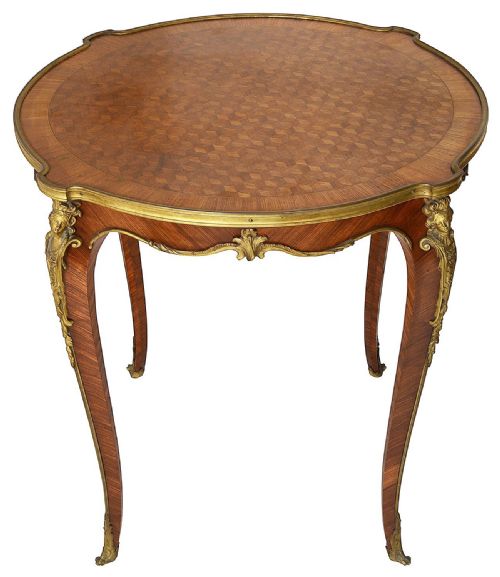


Antique Kingwood Gueridon
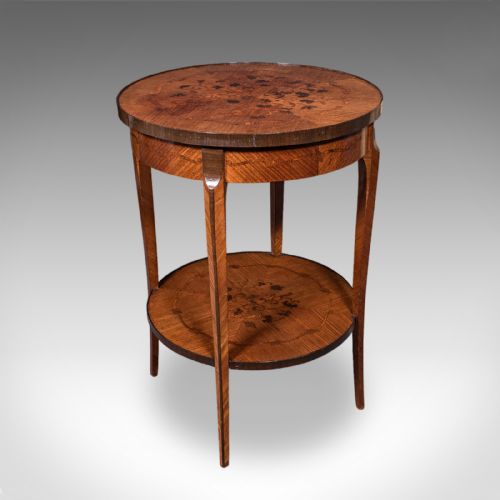
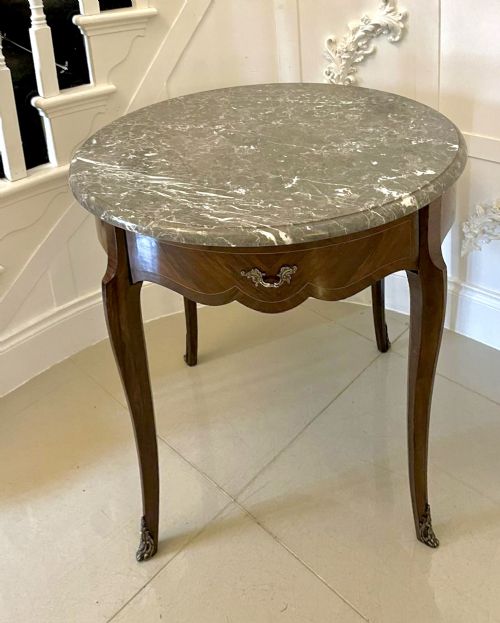
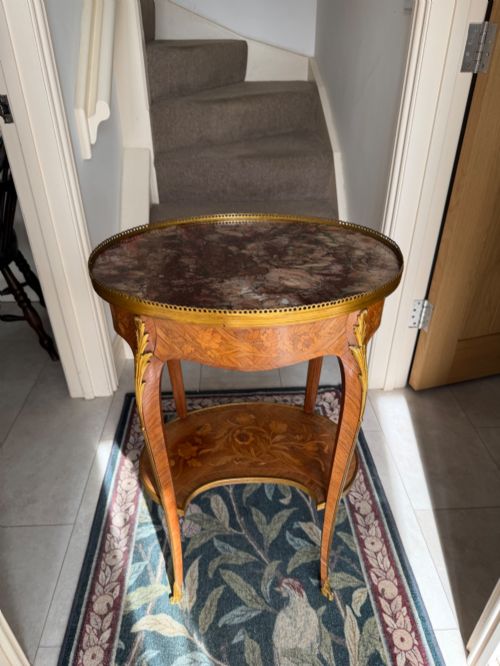
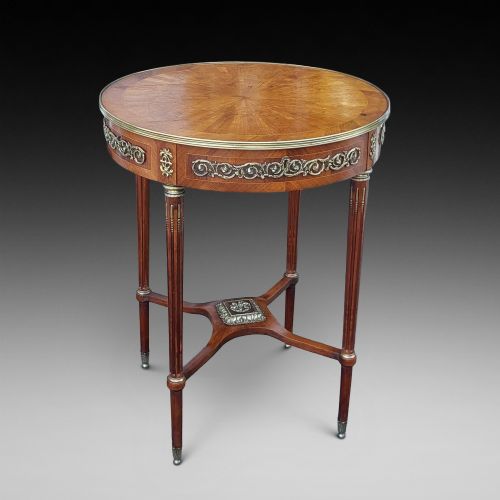
An antique kingwood gueridon brings French elegance to a room, offering a small circular table surface supported by ornate mounts and rich exotic veneers.
Antique Kingwood Gueridon
An antique kingwood gueridon is a small, highly decorative French table designed to hold a lamp, plant, or decorative object in a principal room. These occasional tables, side tables, and pedestals stand on slender legs and often feature circular tops framed in metal.
The pieces on this page span the nineteenth century through the Edwardian period and into the nineteen-twenties, drawing heavily on Louis XV, Louis XVI, and French Empire design vocabularies. Most examples adopt revivalist aesthetics characterised by curved lines, shaped aprons, and freestanding proportions.
Buyers meet variations ranging from two-tier occasional tables to marble-topped centre pieces inset with porcelain plaques. Marquetry and parquetry patterns decorate the timber surfaces across many of these compact furnishings.
How these tables were constructed
Cabinetmakers laid figured kingwood veneers over a stable timber core, often arranging the grain in geometric parquetry or floral marquetry compositions. This dense wood provided a rich, dark background for contrasting inlay work.
Casting and chasing gilt bronze or ormolu mounts added structural embellishment and protection to the edges, legs, and feet of the table. Brass details also appear alongside marble slabs fitted directly into the top surface of the piece.
Several tables here include porcelain plaques, proving that nineteenth-century French cabinetmakers believed every surface deserved a painted cherub.
What separates the best from the rest
The crispness of the cast ormolu mounts and the precision of the bronze chasing dictate the upper tier of quality. Finer workshops employed heavier, more deeply carved metalwork that fitted the contours of the wood seamlessly.
The complexity and execution of the veneer work distinguish superior examples from standard production. Tight, balanced parquetry and intricate floral marquetry require specialist skill that elevates the visual depth of the timber.
Francois Linke
The Antique Kingwood Gueridon Glossary
- Kingwood
- A dense, highly figured Brazilian timber prized for its rich violet-brown colour and dark striping. Cabinetmakers used it extensively as a veneer for high-end French furniture throughout the nineteenth century.
- Gueridon
- A small French occasional table or stand, originally introduced in the seventeenth century and revived in later historicist design movements. These tables typically feature a circular top on a central pillar or slender legs.
- Ormolu
- Gilt bronze applied to furniture as decorative mounts, feet, and edge protection. The technique involves treating metal with a gold-mercury amalgam before firing to create a durable, golden finish.
- Marquetry
- The art of forming decorative patterns and pictures by applying thin pieces of wood veneer to a structural backing. Makers combined kingwood with other timbers to create contrasting floral or geometric designs.
- Parquetry
- A geometric mosaic of wood veneer used to cover tabletops and surfaces. This technique relies on precise cutting of wood blocks to form repeating patterns like cubes or chevrons.
Antique Kingwood Gueridon: Frequently Asked Questions
What is an antique kingwood gueridon used for?
These small tables serve as functional decorative pieces placed beside seating or in corners to hold lamps, clocks, or jardinieres. Their compact footprints make them versatile for adding surface space without crowding a room.
Historically, they functioned as movable stands for light fixtures or display items in formal reception rooms. Today, they bring historic French character to both traditional and contemporary interiors.
How do I identify Louis XV style features?
Louis XV style pieces rely on asymmetrical curves, cabriole legs, and flowing Rococo ornamentation without straight structural lines. The form prioritises organic shapes and naturalistic floral motifs.
Ormolu mounts on these tables typically follow the contours of the aprons and feet with C-scrolls and foliage. This aesthetic avoids rigid symmetry in favour of dynamic movement.
What is the difference between marquetry and parquetry?
Marquetry involves cutting varied wood veneers to create pictorial scenes, such as floral sprays or musical trophies. It requires intricate hand-cutting and shading to achieve a pictorial effect.
Parquetry uses geometric shapes like squares, triangles, and diamonds to build repeating mathematical patterns. Both techniques often appear together on nineteenth-century French tables.
How should I care for a marble top table?
Marble surfaces require regular wiping with a soft, damp cloth and neutral soap to prevent staining from liquids. Acidic substances like citrus juice or wine can etch the polished stone if left unattended.
Avoid placing abrasive objects directly onto the stone to protect the high gloss finish. Periodic sealing helps preserve the marble against accidental spills.
Are Edwardian gueridons different from nineteenth century ones?
Edwardian interpretations often draw closely on earlier French models while incorporating lighter proportions and refined Edwardian craftsmanship. These pieces bridge historical revival styles with early twentieth-century domestic needs.
Materials remain consistent with earlier decades, using kingwood veneers and ormolu mounts. The construction techniques reflect the continued demand for French taste in British and continental homes.