
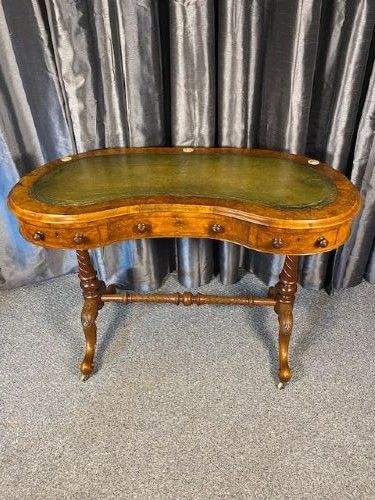
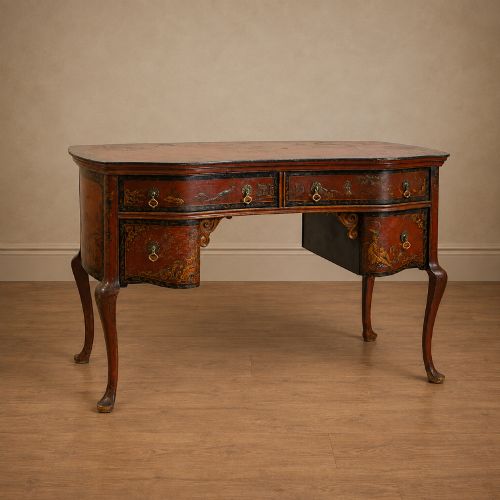
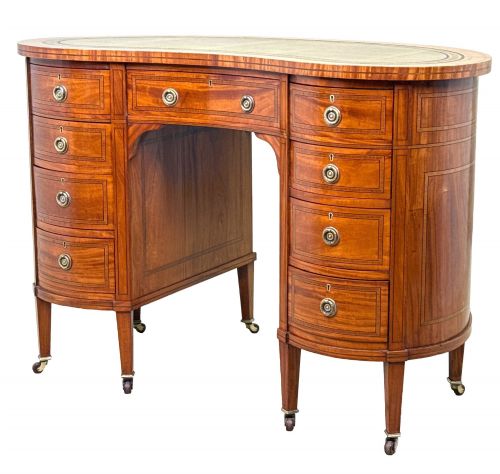
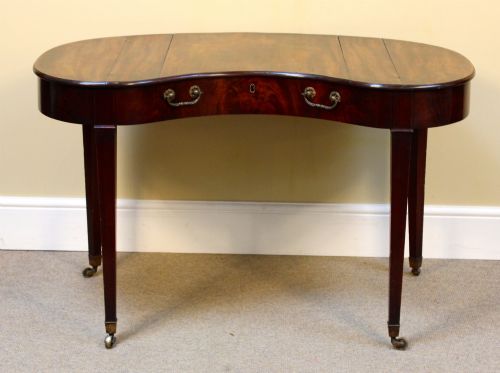

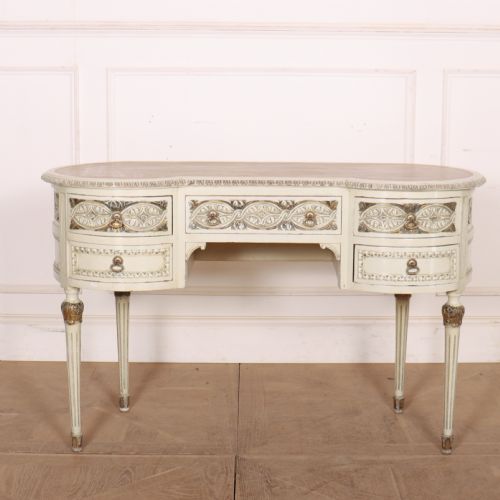


Antique Kidney Dressing Table
An antique kidney dressing table offers a curving, enveloping outline that transforms a bedroom into a private dressing room.
Antique Kidney Dressing Table
An antique kidney dressing table provides a distinctive crescent-shaped surface designed to fit closely against the body, serving primarily as a personal toilette station. The form spans the Victorian and Edwardian eras, appearing alongside closely related kidney desks and writing tables in mahogany, walnut, and satinwood.
Makers frequently incorporated matching mirrors and stools into the ensemble, creating a coordinated suite for the boudoir. Surviving examples demonstrate how cabinetmakers adapted the curved silhouette to both modest dressing rooms and grander bedchambers across the nineteenth and early twentieth centuries.
Materials and construction methods
Cabinetmakers utilised solid and veneered timbers including mahogany, burr walnut, and satinwood, often bending or curving the rails to achieve the signature kidney outline. Fine stringing and satinwood inlay frequently delineate the curved top, paired with brass handles and occasional leather writing surfaces.
Makers constructed these pieces using pedestals or tapering legs to support the weight of the sweeping top. Painted surfaces and Chinoiserie lacquer appear on selected pieces, showing diverse surface finishes within the period.
Listings feature woods such as mahogany, satinwood, burr walnut, and rosewood across Victorian and Edwardian periods.
Assessing construction and decorative quality
Quality rests in the precision of the curved joinery and the selection of timber veneers, such as figured burr walnut or carefully matched satinwood. Superior examples display refined marquetry inlay, finely carved mouldings, and well-executed painted decoration rather than plain surfaces.
The integration of original hardware, such as brass drawer pulls and fitted mirrors, distinguishes higher-grade pieces. Maker attribution through stamps or labels also elevates the standing of certain desks and dressing tables.
Shapland and Petter·Maurice Adams·JAS Shoolbred·Maple and Co·Waring and Gillow
The Antique Kidney Dressing Table Glossary
- Kidney shaped
- A curved, indented furniture silhouette resembling a bean, designed to wrap around the user. This profile appears across dressing tables, writing desks, and side tables from the Victorian period onwards.
- Inlay
- A decorative technique where contrasting woods, brass, or mother-of-pearl are set flush into the primary surface. Edwardian cabinetmakers frequently utilised satinwood inlay on mahogany carcases.
- Pedestal
- A structural support block containing banks of drawers, often positioned beneath each end of the curved top. Twin pedestal dressing tables and desks offer substantial storage capacity.
- Chinoiserie
- A decorative style employing European interpretations of Chinese motifs and lacquered finishes. Late Victorian pieces occasionally feature this technique on curved table tops.
Antique Kidney Dressing Table: Frequently Asked Questions
What is an antique kidney dressing table used for?
These pieces served as dedicated stations for personal grooming and writing in Victorian and Edwardian bedchambers. The curved front allowed the user to sit close to the surface and its associated mirror.
Today, they function as dressing tables, writing desks, or console tables in bedrooms and studies. Their distinctive outline suits placement against a wall or free-standing in a room.
How do I date an antique kidney dressing table?
Dating relies on observing the timber choice, decorative style, and construction methods. Pieces from the mid-nineteenth century often use solid mahogany or walnut, whereas Edwardian examples frequently feature delicate satinwood inlay and Sheraton Revival motifs.
Maker marks, where present, help pinpoint the exact workshop or firm. Stylistic markers such as Chinoiserie lacquer or Art Deco influences also indicate specific periods of manufacture.
Are mirrors and stools usually original?
Many surviving dressing tables retain their fitted mirror backs and matching stools, though these components often became separated over time. Complete suites including the original stool and mirror are recorded in archive sales.
When evaluating a piece, look for consistency in timber ageing and finish between the main table and its matching mirror or supports. Replacement mirrors were frequently added during later restorations.
Where should I place a kidney table?
The curved footprint and finished backs of many examples make them suitable for placement in the centre of a room as well as against a wall. Freestanding placement highlights the sweeping lines of the mahogany or burr walnut carcase.
In modern interiors, they provide a functional surface in bedrooms or dressing rooms while maintaining a compact profile. Pairing them with a low chair or stool ensures comfortable use of the kneehole space.