


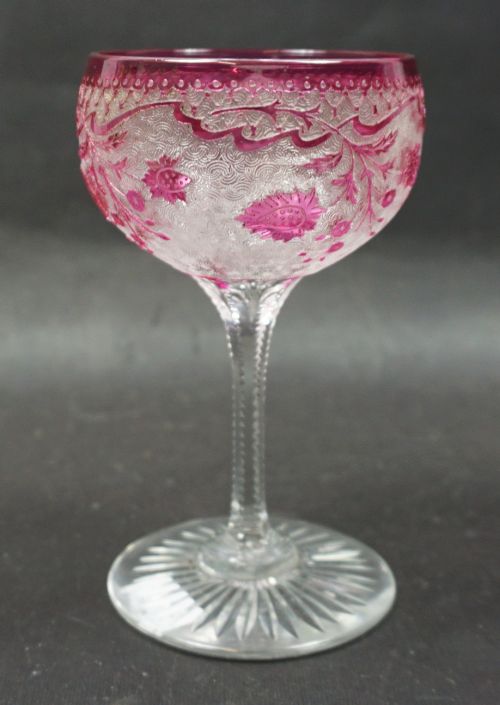





Antique Hock Glass
These antique hock glass pieces bring striking colour and tall, elegant profiles to the table, making them a favourite for traditional dining.
Antique Hock Glass
An antique hock glass is a tall, slender vessel traditionally designed for serving white wine, originating in forms that date from the Victorian period through to the 1930s. The selection on this page centres primarily on distinctive green glass, alongside amber and clear crystal examples.
Most pieces seen here arrive from European makers, spanning Bohemian houses, French workshops and English makers. Forms range from matched sets of six to individual pairs of tall wine glasses and matching decanters.
Makers from Bohemia and France produced these vessels in styles that move from Victorian and Late Victorian design into Art Nouveau, Jugendstil, and Art Deco. Buyers frequently encounter tall roemers and enamelled crystal alongside plain or cut glass silhouettes.
How They Were Made
Glassmakers utilised lead glass and lead crystal to achieve clarity and weight, often casing colour over clear crystal to create overlay glass. Enamel decoration and gold leaf were frequently applied by hand to enrich the surface.
Techniques such as wheel engraving and deep cutting brought pattern and texture to the bowls and stems. Green glass and amber tones were achieved through specific metallic oxide additives during the melting process.
Antique Hock Glass Retail Price Guide 2026
Typical asking prices for hock glass among the pieces listed under this phrase on Sellingantiques today, from the lower quarter to the upper quarter. They describe what is for sale here now, not the wider market.
Listings span from the 1850s Victorian era through to 1930, capturing Art Nouveau, Jugendstil, and Art Deco styles in glass and lead crystal.
What Varies in Quality
The precision of the wheel engraving and the crispness of the cut crystal define the upper tier of production. Hand-painted enamel work and applied gold leaf show varying levels of fine detail and permanence across different workshops.
Proportion and the weight of the lead crystal contribute significantly to the tactile presence of the vessel. Matched sets of tall glasses demonstrate greater consistency in height and hue than assembled groups.
Baccarat·Theresienthal·St Louis Massenet
The Antique Hock Glass Glossary
- Hock glass
- A tall-stemmed wine glass traditionally used for hock or other white wines. The elongated bowl helps direct aromas toward the drinker.
- Roemer
- A traditional Germanic drinking vessel featuring a wide, round bowl resting on a cylindrical stem decorated with applied prunts. These often appear in rich green glass.
- Overlay glass
- A technique where a layer of coloured glass is fused over a clear crystal base. Artisans then cut through the top layer to reveal the contrasting colour beneath.
- Prunt
- A small, applied lump of molten glass fused to the stem of a glass for decoration and a secure grip. They are characteristic of traditional Germanic and Bohemian forms.
- Enamel decoration
- Coloured glass paste applied to the surface of the vessel and fired in a kiln to fuse permanently. It often depicts floral or geometric motifs.
Antique Hock Glass: Frequently Asked Questions
What is an antique hock glass?
An antique hock glass is a tall-stemmed vessel originally used for serving Germanic white wines. They are distinguished by their elongated bowls and vibrant hues.
Most examples date from the Victorian era into the early twentieth century. They remain popular for adding colour to modern dining tables.
How do I identify Bohemian hock glasses?
Bohemian glasses often feature rich green or amber tones, frequently decorated with hand-applied enamel or detailed wheel engraving. Many adopt the traditional roemer form with textured stems.
Regional makers embraced styles ranging from Victorian historicism to Art Nouveau. Their robust lead crystal construction gives them a satisfying weight.
Can I use these glasses daily?
Many people choose to use their antique glassware for special occasions rather than everyday dining. Hand washing in warm, soapy water preserves the delicate enamel and gold leaf.
Careful handling prevents accidental chips on the tall stems. Proper storage in a dedicated cabinet keeps them safe when not in use.