







Antique Herati Runner
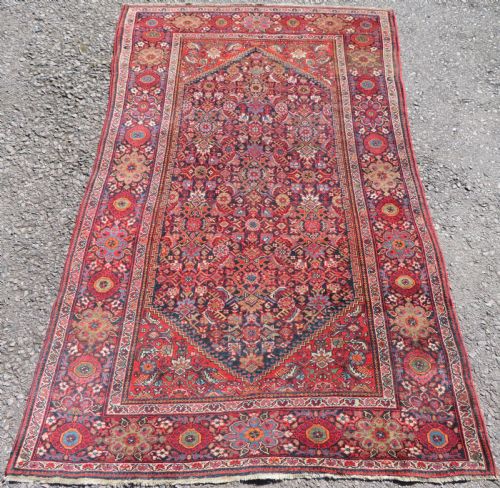
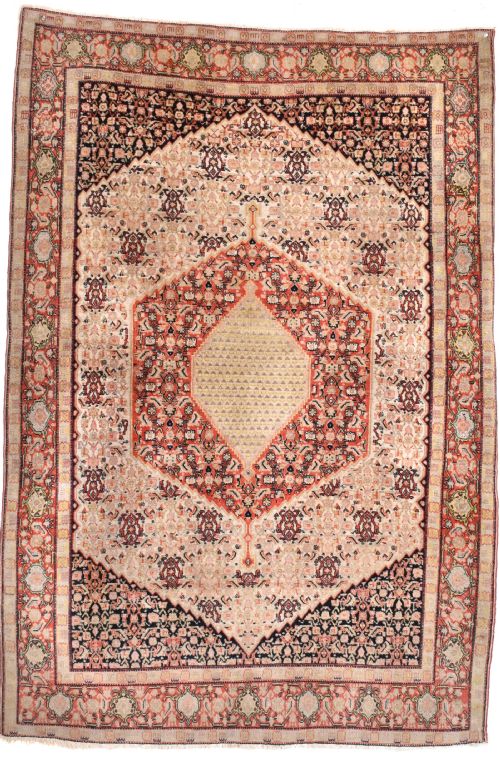
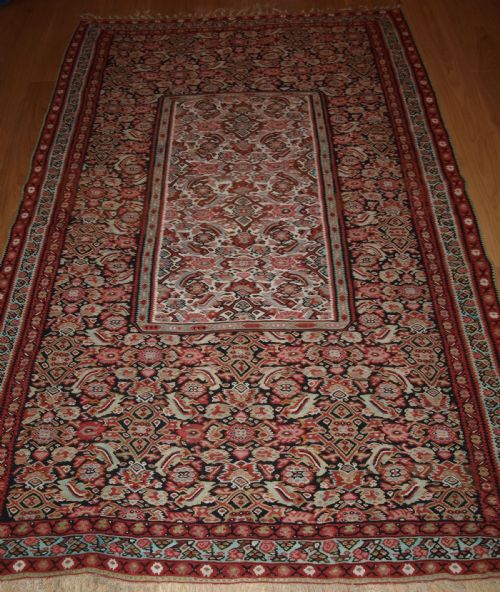
An antique herati runner brings intricate Persian artistry to a hallway, woven with the enduring fish and rosette motif that anchors traditional interiors.
Antique Herati Runner
When you search for an antique herati runner, you are looking at Persian textiles originating from villages and workshops across regions such as Malayer, Ferahan, Bidjar, and Senneh. These elongated formats served narrow spaces like corridors and galleries, featuring the characteristic repetitive pattern of a floral motif framed by curved leaves.
The pieces available span the late nineteenth century through to the early twentieth century, encompassing tribal village weaves and finer city productions. While many listings describe broader rug or kelleh formats, the narrower proportions appear in formats well-suited to linear domestic spaces.
Persian tribal and traditional styles dominate the selection, reflecting distinct regional weaving traditions from Kurdish, Baluch, and Afshar makers. These designs often incorporate repeating lattice or all-over patterns executed in rich, muted palettes appropriate for heavy foot traffic.
How they were made
Weavers constructed these textiles primarily using wool for the pile and cotton for the foundational warps and wefts. The natural resilience of wool provided a durable surface capable of withstanding decades of use in active hallways.
Dyes derived from natural sources imparted deep, stable tones that softened gracefully over generations. Knotting techniques varied between the coarse, dense structures of tribal workshops and the finer, tighter execution found in urban centres.
Antique Herati Runner Retail Price Guide 2026
Typical asking prices for herati runner among the pieces listed under this phrase on Sellingantiques today, from the lower quarter to the upper quarter. They describe what is for sale here now, not the wider market.
The inventory records multiple regional origins including Malayer, Ferahan, Bidjar, and Senneh, alongside Baluch and Afshar tribal traditions.
What varies in quality
The density and precision of the knotting largely determine the refinement of the design work, with tighter structures allowing for sharper delineation of the delicate herati pattern. Foundation materials also play a role, as sturdier cotton warps maintain structural integrity over long spans.
Consistency in natural dyeing and wool preparation dictates how evenly the pile wears down and how harmoniously the colours age. The integrity of the original selvedges and ends separates intact examples from those requiring significant conservation.
The Antique Herati Runner Glossary
- Herati
- A traditional Persian repeating pattern composed of a floral head centred within a diamond lattice, flanked by four curved leaves resembling fish. This ubiquitous motif appears across numerous regional carpet styles.
- Kelleh
- A distinctive rectangular carpet format that is longer than a standard rug but broader than a traditional runner. These pieces typically furnish large reception rooms or expansive galleries.
- Pushti
- A small nomadic mat or cushion cover produced by tribal groups for domestic utility or personal use. Their compact dimensions make them suitable for small wall spaces or chair seats.
- Kilim
- A flat-woven carpet produced without a pile by tightly interweaving warp and weft strands. These textiles offer lightweight versatility and distinct geometric patterning.
- Selvedge
- The tightly bound outer edge of a carpet that prevents the lateral unravelling of the weft threads. Original selvedges indicate a well-preserved textile structure.
Antique Herati Runner: Frequently Asked Questions
Where should I place a runner?
These elongated formats fit naturally in narrow hallways, corridors, and long entryways where linear floor space requires visual warmth.
They also serve effectively alongside long dining tables or beside bedroom furniture, protecting flooring while adding texture.
What is the herati motif?
The pattern consists of a central flower surrounded by a diamond lattice and curved leaves. It represents a foundational design element in Persian textile history.
Weavers repeated this motif across diverse regional traditions to create balanced, harmonious surface layouts.
How do I identify tribal pieces?
Tribal rugs typically display bolder geometric interpretations, thicker wool piles, and slightly irregular dimensions resulting from nomadic production methods. Their designs reflect the specific heritage of regional groups rather than urban workshops.
Village pieces often incorporate charming asymmetries and local colour variations that set them apart from formal city carpets.