


Antique Globe on Stand
An antique globe on stand brings the geography of past centuries into a room, offering a tangible connection to historical exploration.
Antique Globe on Stand
When you search for an antique globe on stand, you encounter instruments created to map the world, ranging from miniature desk versions to large floor-standing library examples. The selections span periods including the eighteenth century, the Victorian era, and the interwar years, reflecting changing cartographic knowledge.
The most common formats on this page are table and desk globes resting on wooden or metal supports, alongside substantial floor-standing pieces. Makers produced terrestrial and celestial versions, mapping the earth and the night sky for education and display.
Origins vary widely across these items, with English, French, German, and Swedish makers represented in the evidence. Scales range from four-inch miniatures up to eighteen-inch library globes.
Materials and Construction Methods
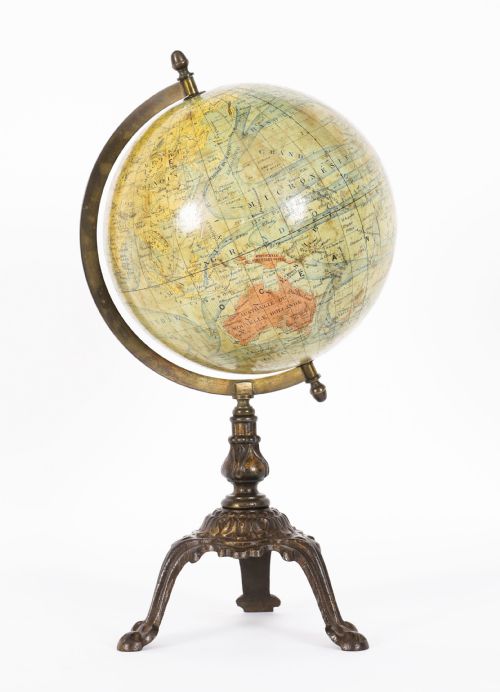
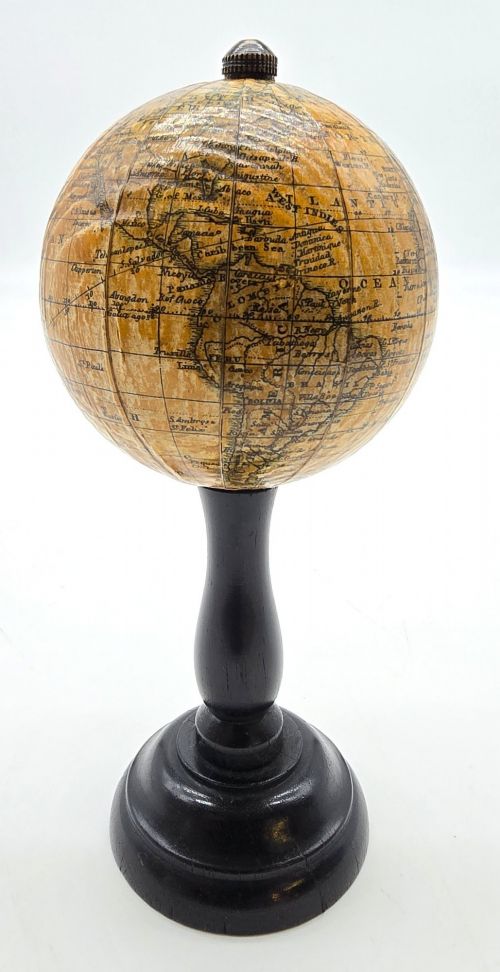
The construction of these pieces relies on printed paper gores applied to spherical spheres made of papier-mâché or plaster, which are then mounted on stands of mahogany, ebonised wood, oak, or metal.
Stands incorporate turned wood, brass rings, and cast iron bases to support the weight of the globe and allow rotation on an axis. Detail work includes hand-coloured cartography on the paper surfaces and polished metal graduation arcs.
Listings feature paper gores applied to spheres of paper mâché, mounted on mahogany, oak, brass, and ebonised wood stands.
Judging Quality in Globes on Stands
Quality in an antique globe on stand depends on the clarity and detail of the cartographic engraving, alongside the richness of the hand-colouring on the paper gores. Finer examples retain their original varnished finishes without extensive craquelure or fading.
The joinery and materials of the supporting stand also dictate standard, where solid mahogany or heavy brass mountings outclass simpler construction. Complete sets, particularly matching pairs of terrestrial and celestial globes, sit at the upper end of the scale.
Lebegue and Cie·G and J Cary·J Forest·Raths Physikalischer·Phillips·Geographia·Blades
The Antique Globe on Stand Glossary
- Gore
- Printed paper strips shaped like lutes that are pasted onto a sphere to form the map of the earth. These segments require precise alignment by the mapmaker.
- Celestial globe
- A sphere mapping the stars and constellations rather than the countries of the earth. These were often paired with terrestrial globes.
- Meridian ring
- The brass or metal ring surrounding the globe that holds it on its axis and allows it to tilt. Graduation marks on this ring measure latitude.
Antique Globe on Stand: Frequently Asked Questions
What is the difference between terrestrial and celestial globes?
Terrestrial globes represent the surface of the earth, detailing continents, oceans, and political borders as known at the time of manufacture. They served practical navigational and educational purposes in homes and libraries.
Celestial globes map the stars, constellations, and astronomical coordinates. They were used alongside terrestrial versions to calculate positions in the night sky.
How do I date an antique globe?
Dating relies primarily on the political boundaries and place names printed on the paper gores. Cartographers updated countries and colonies with each new edition.
Makers' names and publication dates within the cartouche also provide precise manufacturing years, supported by the style of the wooden or brass stand.
Where were these globes placed originally?
Floor-standing library globes were designed for studies, libraries, and grand hallways of large homes. Their substantial size made them focal points for scholars and visitors.
Smaller desk and table globes sat on writing desks, bureaus, and tables in parlours for quick reference during correspondence or reading.
How should I care for an antique paper globe?
Keep the globe away from direct sunlight to prevent the hand-coloured paper gores and varnish from fading and yellowing over time. Stable room temperatures protect the underlying papier-mâché core from warping.
Dust the surface gently with a soft, dry cloth and avoid using any liquid cleaners or polishes on the paper map.