


Antique Floral Dinner Service
These antique floral dinner service sets bring centuries of botanical artistry straight to the dining table.
Antique Floral Dinner Service
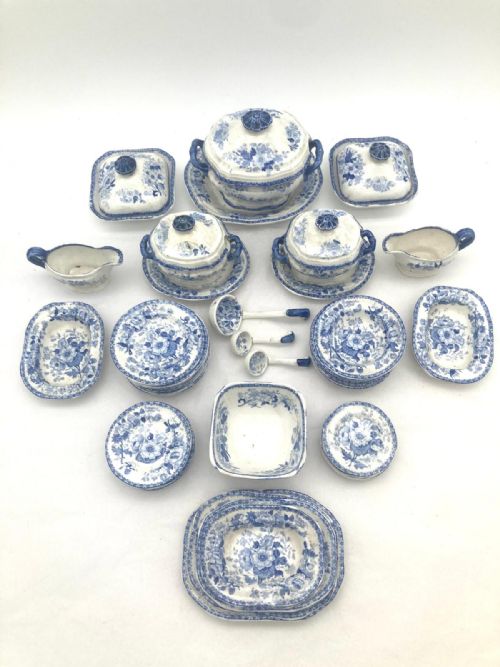
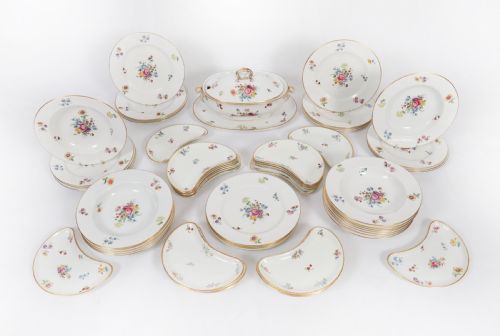
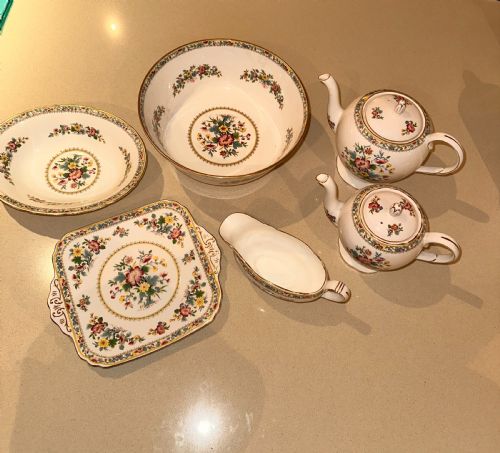
An antique floral dinner service comprises matched sets of plates, platters, and serving vessels decorated with botanical motifs. These collections span the nineteenth and twentieth centuries, taking forms from extensive sixty-piece settings down to miniature children's services and smaller partial tablescapes.
Buyers encounter earthenware, porcelain, ironstone, and creamware ranging across Victorian, Edwardian, and Georgian aesthetics. Traditional English and European workshops produced these services for formal dining, utilising transfer printing and hand-painted techniques to apply floral patterns.
Materials and production methods
Potters shaped ceramic, earthenware, porcelain, and creamware bodies before applying detailed botanical decoration through blue and white transfer printing or direct hand-painting. Skilled artisans executed intricate floral sheet patterns and botanical studies directly onto the ceramic surface.
Many services received fine finishing touches including enamel colours and applied gold leaf or gilt highlights along the rims. A protective glaze sealed the underlying body and decoration, ensuring durability for regular dining use.
The documented styles span Victorian, Edwardian, Georgian, and French Provincial aesthetics with traditional English influences.
Judging quality in table ceramics
Quality separates by the precision of the hand-painting and the clarity of the transfer-printed floral motifs across the entire service. Complete sets maintaining uniform glaze consistency and crisp enamel application command greater appreciation than mixed or heavily worn services.
The sophistication of the ceramic body, from robust ironstone to translucent porcelain and delicate creamware, dictates the refinement of the pieces. Supplementary ornamentation like detailed gilding and rich gold leaf work elevates the distinction of the service.
Minton·Copeland Spode·Wedgwood·Booths·Coalport·Müller Volkstedt MV Co.·Limoges
The Antique Floral Dinner Service Glossary
- Creamware
- A refined earthenware body with a pale yellowish-cream glaze, developed during the eighteenth century. This light ceramic provided an ideal smooth background for botanical transfer printing and painted floral designs.
- Transfer printing
- A mechanical decoration technique where an engraved copper plate transfers a design onto tissue paper, which is then pressed onto the ceramic body. This method allowed consistent reproduction of complex floral sheet patterns.
- Ironstone
- A heavy, durable type of earthenware patented in the nineteenth century to imitate porcelain. It offered superior strength for large dinner services while remaining receptive to rich enamels and gilding.
- Porcelain
- A vitrified ceramic material of high density and whiteness, fired at high temperatures. It yields thin, translucent dinnerware prized for formal dining settings and delicate hand-painted motifs.
- Gilt
- A thin layer of gold or gold-coloured material applied to the rims and handles of ceramic vessels. It adds a decorative metallic border that frames the floral artwork.
Antique Floral Dinner Service: Frequently Asked Questions
How many pieces make a full dinner service?
Full services typically range from large settings exceeding fifty or one hundred pieces to smaller partial services of twenty to sixty items.
These counts include dinner plates, serving platters, and specialised dishes designed for multi-course meals.
Can antique dinner services be used for dining?
Many ceramic services remain robust enough for careful daily use or special occasion dining.
Hand-washed care preserves delicate enamel colours and gold leaf highlights against modern dishwasher heat.
What is a child's dinner service?
Child's services are miniature dinnerware sets produced in the nineteenth century for juvenile dining or nursery use.
These scaled-down pieces feature the same transfer-printed floral patterns and ceramic materials as full-sized adult sets.
How do I distinguish earthenware from porcelain?
Porcelain exhibits a thin, translucent body and a vitrified texture when held up to a strong light.
Earthenware and creamware present an opaque, heavier ceramic body with a softer overall weight and feel.