



Antique Flintlock Musket
An antique flintlock musket represents the pinnacle of early firearms development, offering collectors tangible connections to the military engagements and frontier trade of the eighteenth and nineteenth centuries.

Antique Flintlock Musket
When you search for an antique flintlock musket, you encounter historical long guns spanning the Georgian, Napoleonic, and late eighteenth to nineteenth centuries. These pieces encompass military service arms, frontier carbines, and regional variations such as Afghan jezails and Indo-Persian long guns.
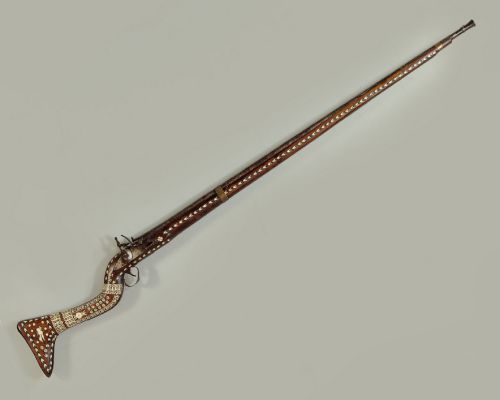
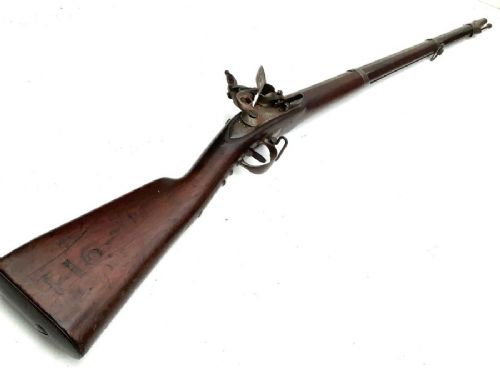
The specimens on this page range from standard British Brown Bess models and French Charleville muskets to heavily decorated Ottoman, Balkan, and North African firearms. Alongside full-length service muskets, you find specialised wall pieces, blunderbusses equipped with sprung bayonets, and carbines.
Military issues from British and French arsenals dominate the formal military sphere, while tribal and regional workshops produced distinct decorative variations. Buyers frequently meet pieces adorned with bone or mother-of-pearl inlay alongside utilitarian iron and steel service arms.
Materials and construction
Makers built these firearms using robust hardwoods such as walnut alongside traditional iron and steel for barrels and lock mechanisms. Brass frequently appears in mountings, trigger guards, and butt plates, providing both structural reinforcement and decorative contrast.
Regional workshops elevated utilitarian arms through intricate embellishment, incorporating bone and mother-of-pearl inlay into wooden stocks. Metal components relied on forged iron and steel, shaped by period blacksmithing and armoury techniques appropriate to European and Eastern traditions.
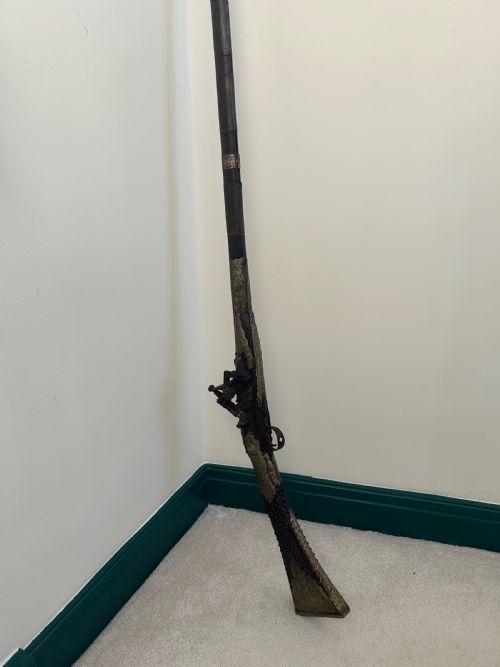
Some nineteenth-century Afghan jezails were built with stocks so sharply curved they tucked under the arm rather than resting against the shoulder.
Assessing quality and authenticity
Quality in an antique flintlock musket depends on the integrity of the lock mechanism, the originality of the wooden stock, and the preservation of maker marks or government acceptance stamps. Crisp action in the flintlock assembly and matching components elevate a piece significantly above examples with replaced or heavily restored parts.
The degree of specialised craftsmanship also dictates standing, distinguishing standard military-issue service arms from bespoke or regionally decorated pieces featuring meticulous bone and mother-of-pearl inlay. Well-preserved barrel markings and untouched surface patina separate superior survivors from heavily worn or altered specimens.
Sargant and Son·East India Company
The Antique Flintlock Musket Glossary
- Flintlock
- An ignition mechanism that uses a piece of flint held in a cock to strike a steel frizzen, creating sparks to ignite the priming powder. This system dominated military and civilian firearms before the invention of percussion caps.
- Brown Bess
- The colloquial name for the standard-pattern smoothbore flintlock musket used by the British Army for over a century. It served extensively during the Napoleonic Wars and the Revolutionary era.
- Jezail
- A type of long-arm common in Afghanistan and surrounding regions, often distinguished by its distinctively curved stock and long barrel. These firearms were frequently utilised in frontier conflicts.
- Blunderbuss
- A muzzle-loading firearm with a flared barrel designed to scatter shot at close range. Naval and coach variations often incorporated a spring-loaded bayonet beneath the muzzle.
- Miquelet
- A form of flintlock mechanism utilising an external mainspring and a combined steel and frizzen, widely used in Spain, Italy, and various Mediterranean and Ottoman territories.
Antique Flintlock Musket: Frequently Asked Questions
How do I identify a British Brown Bess?
A Brown Bess is typically recognised by its distinct overall length, full wooden stock, and brass furniture standard to British military contracts of the Georgian and Napoleonic eras. Markings related to government arsenals or specific makers like Sargant and Son often appear near the breech.
These arms underwent numerous pattern revisions over decades of production, so inspecting barrel proofs and lockplate details helps confirm the exact period of military service.
Were these firearms used in combat?
The majority of military-issue specimens saw active service during major conflicts including the Napoleonic Wars and the Revolutionary period. Government contracts and arsenal stamps indicate they were frontline infantry weapons before retirement.
Regional and tribal arms likewise served in frontier conflicts across the Balkans, North Africa, and the Indo-Persian sphere.
How should I display a flintlock musket?
Displaying a long gun safely requires a secure wall mount or horizontal display case that supports the full weight of the stock and barrel evenly. Keep the piece away from direct sunlight and excessive humidity to preserve the walnut wood and iron components.
Ensure the mounting hardware engages securely with structural wall studs rather than plaster alone.