
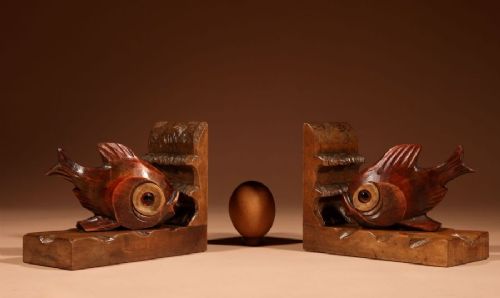


Antique Fish Decor
Antique fish decor brings the riverbank and the ocean into the room through carved wood, oil paint, and delicate paper.
Antique Fish Decor
When buyers search for antique fish decor, they look at a varied group of objects ranging from paintings and bookends to carved wooden animals and desk accessories. The pieces on this page span the nineteenth and twentieth centuries, taking the form of framed watercolours, oil paintings, carved bookends, and decorative boxes.
Most items you meet here date from the Victorian era up to the mid-twentieth century, showing both British and international workmanship. You will find depictions of goldfish, salmon, pike, and flying fish captured in materials such as carved wood, oil paint, watercolour, and glass.
The practical function of these objects varies as much as their appearance, covering everything from desk paperweights and fishing rod rests to fine art for the wall. Each piece reflects a historical fascination with angling, marine life, and coastal scenes.
How they were made
Makers utilised traditional woodworking and carving techniques to shape solid timber into sculptural forms like bookends, fishing rod rests, and flying fish. Artists worked with oil paint on canvas, copper plate panels, and board, alongside watercolours and engravings on paper.
Specialised surface decoration defined many of these items, featuring penwork, lacquering over black paint, and embossed printing. Carvers and painters applied fine detail to capture the natural textures of scales, fins, and feathers.
Listings feature periods from the 19th century and Victorian era up to mid-century modern and 1950.
What varies in quality
Quality in these pieces rests upon the precision of the handwork and the vitality of the depiction. A skilled carver or painter imbues the fish or coastal scene with anatomical accuracy and natural movement, whereas lesser examples remain stiff and formulaic.
The preservation of the original surface, whether oil paint, carved cherry wood, or lacquer, dictates the strength of the piece. Intact frames and unblemished materials elevate the standing of items across both paintings and utilitarian objects.
Edward Matthew Elliott·Jonathan Couch·W.E.Barrington-Browne·Thomas Bush Hardy
The Antique Fish Decor Glossary
- Black Forest
- A style of wood carving originating from central Europe during the nineteenth century. These items typically feature naturalistic animal subjects carved from solid timber with deep relief.
- Penwork
- A decorative technique using fine ink lines applied to a prepared surface to create detailed imagery. This method appears on small items such as snuff boxes.
- Treen
- Small handmade wooden objects for domestic or decorative use. Examples include knitting sheaths and utilitarian desktop items.
- Meiji Period
- A period in Japanese history spanning from 1868 to 1912. Pieces from this era often incorporate meticulous lacquer work and porcelain decoration.
- Newlyn School
- An art colony based in Cornwall during the late nineteenth and early twentieth centuries. Artists here produced plein-air marine paintings and coastal scenes.
Antique Fish Decor: Frequently Asked Questions
What materials are used in antique fish decor?
The pieces utilise a range of materials recorded in the archive and current listings, predominantly wood, paper, glass, canvas, oil paint, and watercolour. Carved wood and soapstone also appear among the three-dimensional objects.
Artists and makers selected these materials to suit both fine art paintings and functional items like bookends and paperweights.
How do I date a piece of antique fish decor?
Dating relies on stylistic evidence, materials, and documented periods such as the Victorian era or the Meiji period. Signatures, inscriptions, and framing methods often provide further chronological clues.
Comparing the construction techniques with known examples helps narrow down the decade of manufacture.
Where were these pieces originally made?
The items originate from various regions including Britain, China, Japan, and the Lake District. British coastal art often stems from artistic hubs like St Ives and Newlyn.
Each region brought distinct local materials and traditional methods to the depiction of marine life.
How should I display fish decor in my home?
Paintings and framed prints suit wall placement in studies, hallways, or living rooms. Three-dimensional items like bookends, paperweights, and carved fish function well on desks, bookshelves, and mantelpieces.
Keeping them away from direct sunlight protects delicate watercolours and oil paint surfaces from fading.