





Antique Embroidered Sampler
These antique embroidered sampler pieces show needlework worked by children and adults across the Georgian, Victorian and earlier centuries.
Antique Embroidered Sampler
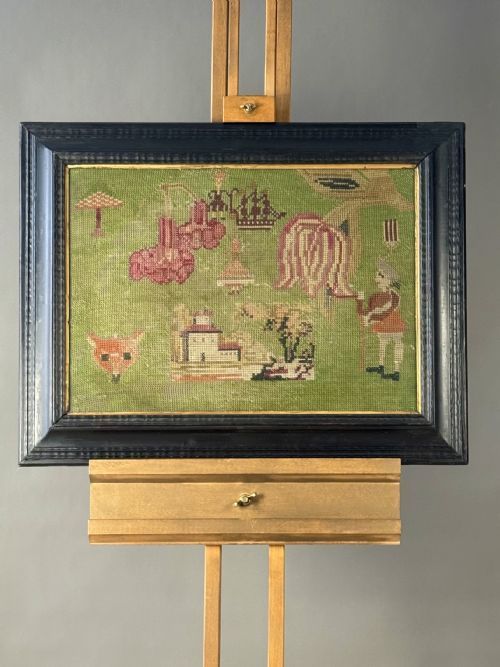
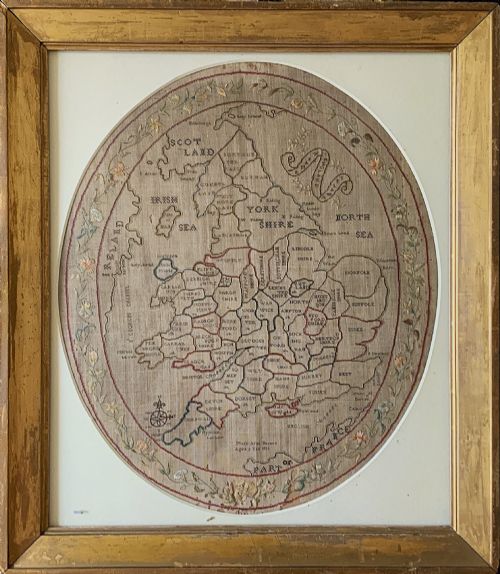
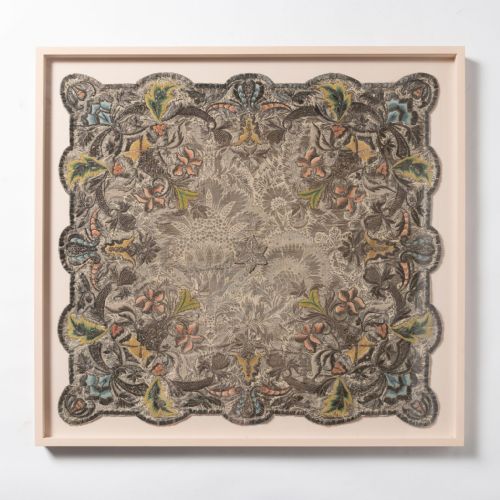
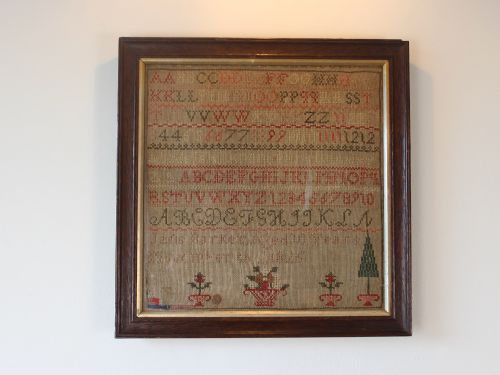
When you search for an antique embroidered sampler, you encounter framed textile art spanning the 17th, 18th and 19th centuries. The selection includes alphabet boards, pictorial panels, religious texts and detailed geographical maps of England and Wales.
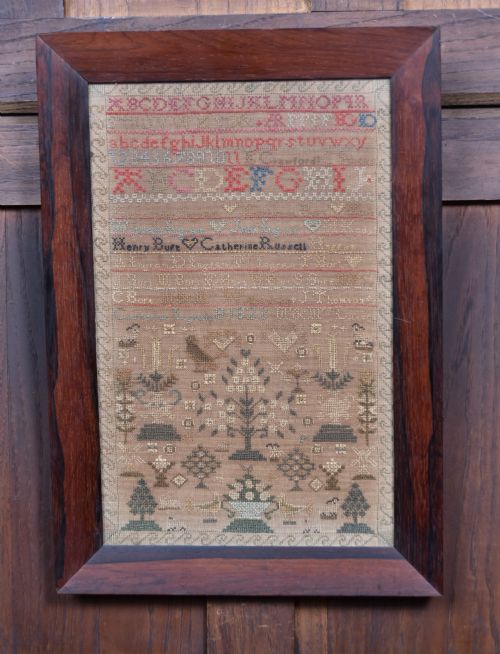
Most examples you meet on this page date from the Georgian and Victorian eras. These works often record the name, age and date of the maker, alongside school names or institutional locations.
Beyond standard alphabets, the listings feature unusual formats such as miniature pieces, firescreens and narrative scenes incorporating stories like Jack and the Beanstalk.
Materials and construction
The foundation of these works is typically woven linen, providing a stable ground for the stitches. Makers utilised silk thread, silk floss and wool to build up the pictorial and textual designs.
Needlework technique relies on counted thread stitches, such as cross stitch and tent stitch, executed by hand. Many survivors retain their original glass and wood frames, which protect the fragile textiles from atmospheric damage.
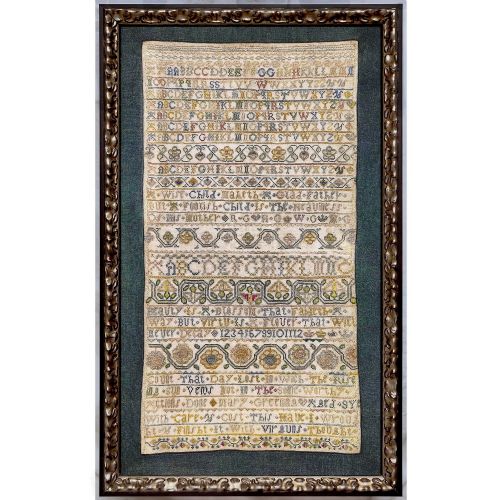
Several makers recorded their exact ages in stitch, immortalising nine-year-old Mary Banion alongside youthful peers.
Assessing quality and execution
The standard of an antique embroidered sampler rests upon the precision of the needlework and the complexity of the design. Finer examples display even tension, intricate pictorial motifs and well-executed lettering rather than basic repeating alphabets.
Historical documentation elevates a piece significantly. Samplers that retain the maker's full name, a specific age, a precise date and a traceable geographic origin offer greater historical interest than unsigned works.
Mary Banion·Mary Greening·Elizabeth Horn·Ann Hodson·Margaret Ann Blackow·Sarah Baker·Mary Mason·Martha Hall·Mary Street·Rachel·Jane Pattinson·Susan Mary Williams·Mary Pinfold·Emma and Hannah Barnes
The Antique Embroidered Sampler Glossary
- Sampler
- A piece of needlework produced as a demonstration or test of skill in various stitches. They frequently display alphabets, numerals and pious verses.
- Band sampler
- An early format featuring horizontal bands of distinct patterns and stitches arranged across a long piece of linen. These date predominantly to the 17th century.
- Map sampler
- A specialised geographical needlework piece illustrating counties, borders and topography. Popular during the Georgian period, they served educational purposes.
- Silk floss
- An untwisted or lightly twisted silk yarn used for embroidery. It provides a high gloss and smooth texture to pictorial elements.
- Needlepoint
- Embroidery stitched on an open-weave canvas or linen ground that completely covers the foundation fabric. It creates a dense, durable surface.
Antique Embroidered Sampler: Frequently Asked Questions
What is an antique embroidered sampler?
An antique embroidered sampler is a historic piece of needlework created to practice or demonstrate stitching proficiency. They typically feature alphabets, numbers, motifs and maker details.
Over centuries, these textiles evolved from functional pattern references into framed decorative pictures and educational map displays.
How do I date an antique sampler?
Many samplers include embroidered dates, maker names and ages that establish when the work was completed. Stylistic clues such as lettering fonts, framing materials and pictorial themes also help identify the period.
Georgian and Victorian examples often follow distinct design conventions that separate them from 17th century band samplers.
How should I display a sampler?
Samplers require careful framing behind protective glass to shield delicate silk and wool threads from dust and physical handling. Hang them away from direct sunlight to prevent the natural dyes from fading.
Maintaining stable indoor humidity levels protects both the historic linen backing and the wooden frames.
Did children make all samplers?
While many surviving pieces were stitched by young girls in schools or at home as part of their education, adult needleworkers also produced complex works. Schoolgirl pieces often record the maker's age to highlight their youthful skill.
Institutional examples sometimes note specific establishments like national schools or academies.