
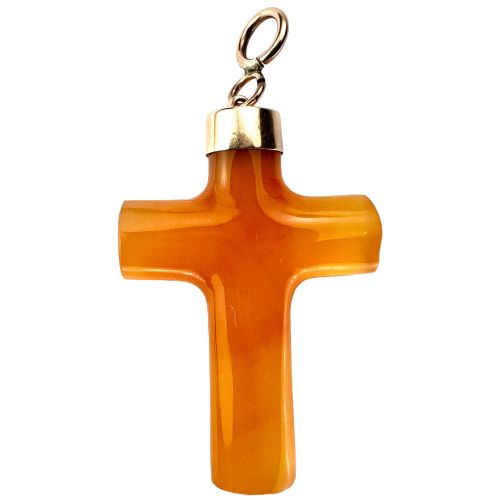


Antique Devotional Pendant
An antique devotional pendant is a small personal talisman worn close to the heart, combining religious devotion with fine metalwork.
Antique Devotional Pendant
An antique devotional pendant takes the form of a small medallion, charm, or cross shaped by religious tradition and personal faith. You will most frequently meet French religious medals depicting the Virgin Mary, the Madonna and Child, or the Sacred Heart, cast or stamped in gold.
The pieces on this page span the Victorian era through the mid-twentieth century, including distinct periods such as the eighteen-nineties and nineteen-tens. Alongside gold religious medals, you will find carved agate crosses and continental silver examples from the nineteen-twenties.
Makers and designers signed many of these medals, while others remain rooted in French ecclesiastical traditions. They function simultaneously as wearable jewellery and as miniature works of devotional art.
How They Were Made
Goldsmiths worked primarily in eighteen-carat yellow and rose gold, occasionally incorporating white gold, silver, or seed pearls. The metal was stamped, engraved, or cast to form detailed oval medals and crosses.
Enamelling techniques such as plique-à-jour appear alongside hand-carved agate and mother-of-pearl mounts. Artisans also utilised delicate seed pearls and diamonds to accent the borders of the central religious figures.
Materials recorded across the inventory include eighteen-carat gold, silver, agate, mother-of-pearl, seed pearls, diamonds, and plique-à-jour enamel.
What Varies in Quality
The distinction between standard pieces and finer examples rests upon the crispness of the engraving and the depth of relief in the figures. Medals signed by known medallists display sharper details in facial expressions and drapery than unsigned workshop output.
Material embellishments elevate certain pieces above simple stamped gold discs. The integration of plique-à-jour enamel, hand-carved agate, or carefully set seed pearls indicates a higher tier of workmanship and artistic ambition.
Emile Monier·Mazzoni·Pageli Perriat·Dropsy·Sellier·Tairac·Pageri Perroud·Perriat·Charl·Arnault·Grün·Monet·Ruffony
The Antique Devotional Pendant Glossary
- Plique-a-jour
- An enamelling technique where the enamel is applied without a backing, allowing light to shine through the transparent colours much like stained glass.
- Medal
- A flat piece of metal stamped or cast with commemorative or religious imagery, often fitted with a loop for suspension as a pendant.
- Sacred Heart
- A Catholic devotion representing the physical heart of Jesus Christ as a symbol of divine love, frequently depicted with flames and thorns.
- Agate
- A variety of chalcedony quartz showing coloured bands or layers, carved into crosses and cabochons in Victorian jewellery.
- Seed pearl
- Very small natural pearls used in Victorian and Edwardian jewellery to outline motifs or create delicate floral patterns.
Antique Devotional Pendant: Frequently Asked Questions
What is an antique devotional pendant?
These items are small personal ornaments worn to express religious faith, typically featuring sacred figures or symbols.
They combine the craftsmanship of historical goldsmithing with spiritual iconography from Catholic and Christian traditions.
How were devotional pendants worn?
People wore these pieces suspended from chains around the neck, keeping the religious image close to the body as a protective amulet or daily reminder of faith.
Some were also attached to charm bracelets or carried as travel medals for protection during journeys.
How do I identify the period of a pendant?
Dating relies on stylistic markers such as the flowing lines of Art Nouveau designs or the specific hallmarks stamped onto the gold.
Makers' names and stylistic shifts from Victorian carving to twentieth-century pressed medals also help establish the date of manufacture.
What subjects appear on these medals?
The most common subjects include the Virgin Mary, the Madonna and Child, Saint Christopher, and the Sacred Heart of Jesus.
Crosses carved from agate or fashioned in silver also appear alongside images of saints such as John the Baptist and Therese.