






Antique Courting Couple
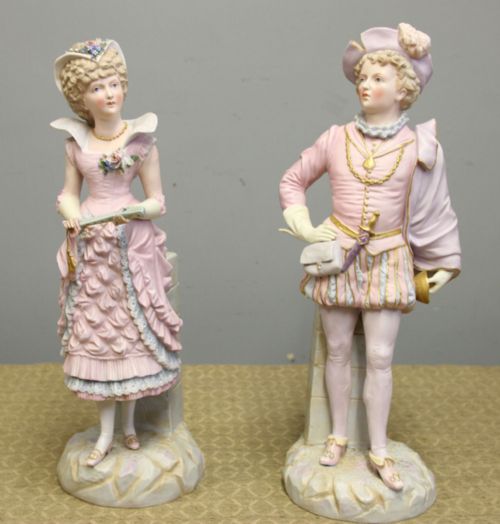
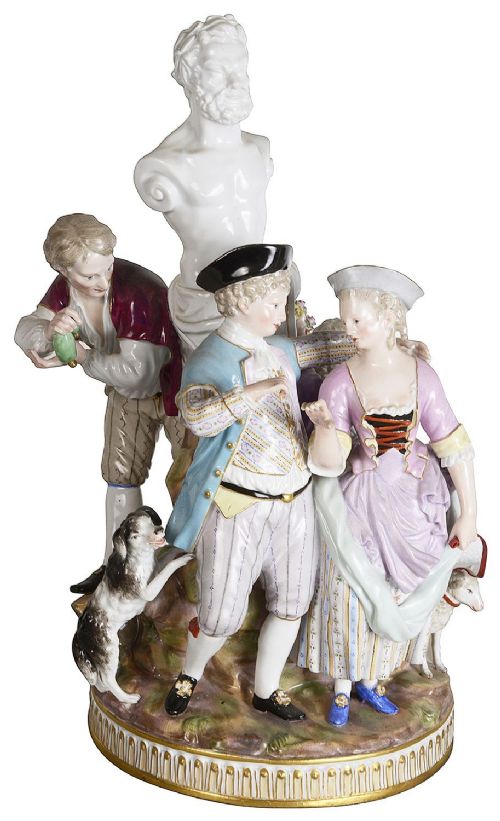
An antique courting couple brings romantic 18th and 19th-century charm to a room through finely modelled porcelain figures and groups.
Antique Courting Couple
An antique courting couple represents romantic pairs modelled in hard-paste porcelain, bisque porcelain, and French faience, originating from periods spanning the 18th century to the Edwardian era. These pieces appear primarily as figurines, porcelain groups, decorative table lamps, and vanity jars mounted in sterling silver with hand-painted plaques.
The inventory on this page showcases a strong presence of 19th-century German and French pieces, including Meissen porcelain groups, Volkstedt figures, and Paris porcelain lace groups. Buyers will also encounter Victorian musical figures and earlier 18th-century Ludwigsburg porcelain groups depicting gallant scenes.
How these figures were made
The creation of these figures relies on hard-paste porcelain and bisque porcelain, shaped into intricate forms such as romantic groups, musical figures, and table lamps. Artisans applied delicate hand-painting techniques, gold leaf accents, and occasionally applied porcelain lace to achieve fine textural detail.
Mounting techniques also appear in the selection, notably in sterling silver mounted cut glass vanity jars that incorporate hand-painted porcelain plaques. Makers such as Meissen, Volkstedt, and Paris potteries utilised specialised moulding and glazing methods characteristic of Rococo Revival and Victorian aesthetics.
Antique Courting Couple Retail Price Guide 2026
Typical asking prices for courting couple among the pieces listed under this phrase on Sellingantiques today, from the lower quarter to the upper quarter. They describe what is for sale here now, not the wider market.
What varies in quality
The sophistication of the hand-painting and the application of gold leaf or porcelain lace dictate the upper tier of the range. Pieces bearing factory marks from established centres like Meissen or Ludwigsburg demonstrate a higher standard of ceramic artistry compared to unmarked or later decorative iterations.
Bourdois & Bloch Paris·Letu & Mauger Paris·Volkstedt·Meissen·Triebner Ens & Co·Ludwigsburg
The Antique Courting Couple Glossary
- Bisque porcelain
- Unglazed white porcelain that has been fired once, producing a matte, marble-like surface texture favoured for detailed Victorian figurines.
- Hard-paste porcelain
- A durable ceramic composition fired at very high temperatures, made from kaolin and petuntse, commonly used in 18th and 19th-century European manufactories.
- Rococo Revival
- A 19th-century design style reviving the asymmetrical scrolls, natural motifs, and romantic motifs of the 18th-century French Rococo movement.
- Faience
- Tin-glazed earthenware produced in France and other European regions, often hand-painted with colourful pastoral or romantic scenes.
- Porcelain lace
- Real lace dipped in liquid porcelain slip and fired in a kiln so that the fabric burns away, leaving a fragile ceramic replica of lace trim on clothing.
Antique Courting Couple: Frequently Asked Questions
What is an antique courting couple figurine?
An antique courting couple figurine depicts a man and a woman in romantic or pastoral interaction, typically dressed in historical attire. These decorative ceramics were produced in Europe from the 18th century onwards.
They capture the aesthetic tastes of periods such as the Victorian and Edwardian eras, often reflecting Rococo Revival styling through elaborate dress and scenic bases.
How do I identify a Meissen courting group?
Meissen courting groups are distinguished by their refined porcelain modelling, detailed hand-painted polychrome decoration, and often the use of gilded accents. Many pieces from this manufactory depict aristocratic figures in elaborate garden settings.
Checking the base for underglaze blue crossed swords marks helps confirm the origin of these pieces, though careful comparison with known stylistic periods is also essential.
Where were these porcelain figures made?
These porcelain figures were manufactured across major European ceramic centres, with significant production in Germany and France. Prominent factories included Meissen, Volkstedt, and Ludwigsburg, alongside Paris workshops.
Different regions employed distinct techniques, such as German hard-paste porcelain moulding or French faience production, shaping the appearance of each romantic group.
How should I display porcelain figures at home?
Porcelain figures and groups benefit from display in stable environments away from direct sunlight and heavy foot traffic to protect delicate elements like lace or protruding limbs. Enclosed cabinets or well-secured mantelpieces offer safe placement.
Because many pieces feature hand-painted details or gold leaf, gentle dusting with a soft, dry brush preserves the surface finish over time.