



Antique Brass Laboratory Equipment
These antique brass laboratory equipment pieces are tactile survivors of past science, offering serious collectors heavy metal forms and precision optics built to endure.
Antique Brass Laboratory Equipment
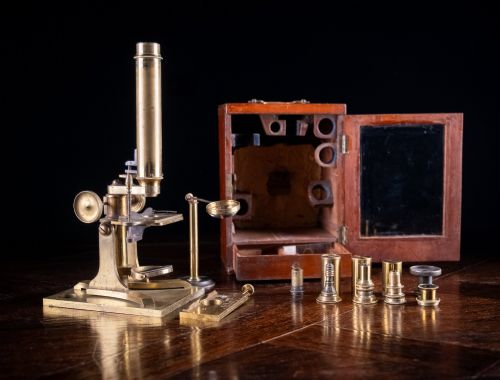
When you search for antique brass laboratory equipment, you are looking at functional apparatus spanning the eighteenth century to the mid-twentieth century. The selection ranges from medical instruments and thread testers to massive electrostatic machines and delicate microscopes.
Victorian examples dominate the listings here, often appearing alongside Edwardian and earlier Georgian pieces. These objects served in classrooms, doctors' surgeries and private research rooms before finding their way into the collector's study.
Most pieces combine polished metal with fitted wooden cases, glass tubes or cast iron bases. They represent the physical apparatus of nineteenth-century physics, optics and early medical demonstration.
How they were made
Makers shaped heavy brass components through casting and machining, joining them with threaded fittings and pin joints to withstand regular laboratory use. These metallic elements were often hand-finished and polished to a bright surface.
Antique Brass Laboratory Equipment Retail Price Guide 2026
Typical asking prices for brass laboratory equipment among the pieces listed under this phrase on Sellingantiques today, from the lower quarter to the upper quarter. They describe what is for sale here now, not the wider market.
Someone once spent an entire afternoon trying to explain a thread tester to a confused cat.
What varies in quality
The standard of execution separates simple educational models from professional laboratory instruments commissioned from notable makers. Superior examples exhibit finer graduations on scales, more robust framing and complex mechanical assemblies.
Original fitted cases, surviving trade papers and documented maker signatures elevate the standing of a piece considerably. Simpler apparatus lacking maker marks relies entirely upon the weight of the casting and the crispness of the turning.
H Hughes and Son·Swift and Son·Heinrich Daniel Ruhmkorff·Physica
The Antique Brass Laboratory Equipment Glossary
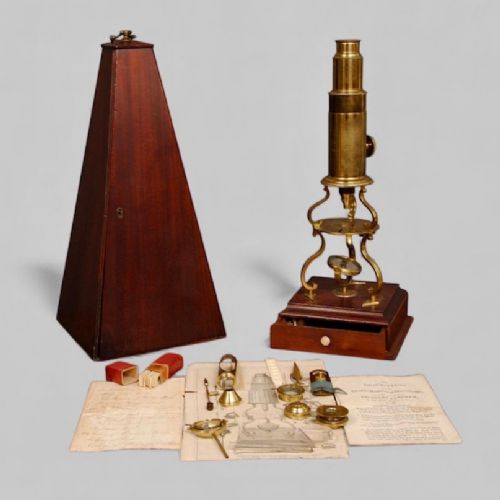
- Culpepper microscope
- An early form of compound microscope supported on three brass pillars over a wooden base, developed during the eighteenth century.
- Geissler tube
- A sealed glass tube used to demonstrate electrical discharge through low-pressure gases, often incorporating a vacuum scale.
- Induction coil
- An electrical device that produces high-voltage alternating currents from a low-voltage direct current source, utilising primary and secondary windings.
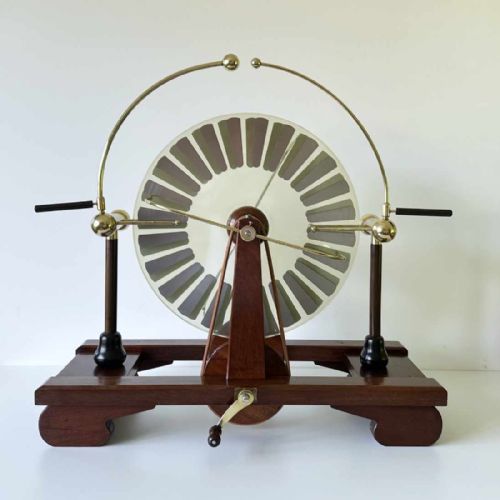
- Wimshurst machine
- An electrostatic generator featuring counter-rotating glass or ebonite discs that collect static charges via metal brushes and combs.
- Pneumothorax instrument
- A specialised medical apparatus designed for introducing gas into the pleural cavity for therapeutic purposes.
Antique Brass Laboratory Equipment: Frequently Asked Questions
What did a Wimshurst machine do?
These large electrostatic devices generated high-voltage sparks for early electrical experiments and demonstrations. They relied on hand-cranked counter-rotating discs to build up static charges.
Collectors prize them for their striking visual presence and intricate brass and glass construction. They stand as monuments to early Victorian electrical exploration.
How do I date a brass microscope?
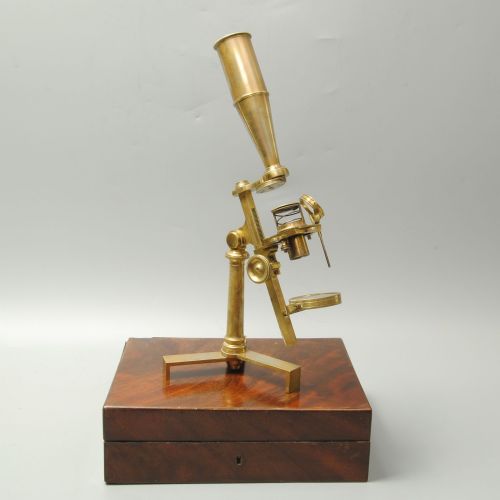
Dating usually relies on the overall form, the shape of the foot, and any accompanying trade papers or signature engravings. Culpepper styles indicate the eighteenth century, while drum shapes and tripod bases point towards the Victorian era.
Maker signatures and wooden case styles also help narrow down the decade of production. Many pieces carry retailer labels that pinpoint their exact period of sale.
Are these scientific instruments still functional?
While many mechanical parts remain operable, most pieces are acquired for display and historical study rather than active laboratory use. Electrical apparatus like induction coils and electrostatic generators require careful handling if tested.
Optics on microscopes typically function well for basic viewing, though modern standards differ greatly. Preservation of original surfaces usually takes precedence over restoration to working order.
Why are mahogany cases important?
Fitted wooden boxes protected delicate brass components from dust, moisture, and impact during transport and storage. They often include specialised compartments for lenses, slides, and accessories.
A matching case with original paper labels or trade documents adds significant context and provenance to the instrument inside.