



Antique Barley Twist Gateleg
These antique barley twist gateleg tables offer clever folding surfaces and sturdy timbers, making them a practical choice for everyday dining.
Antique Barley Twist Gateleg
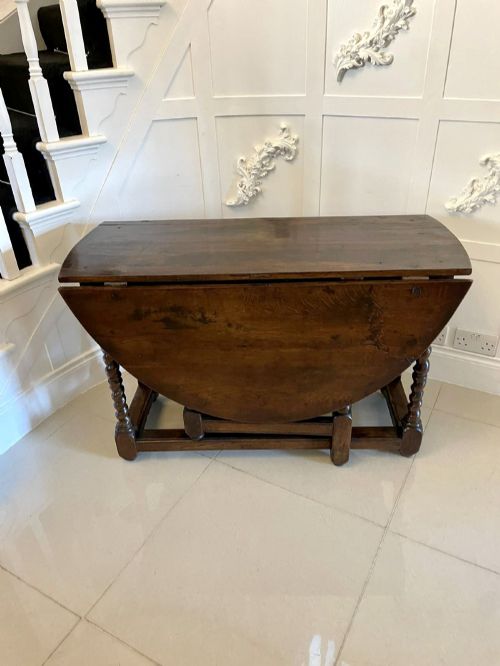
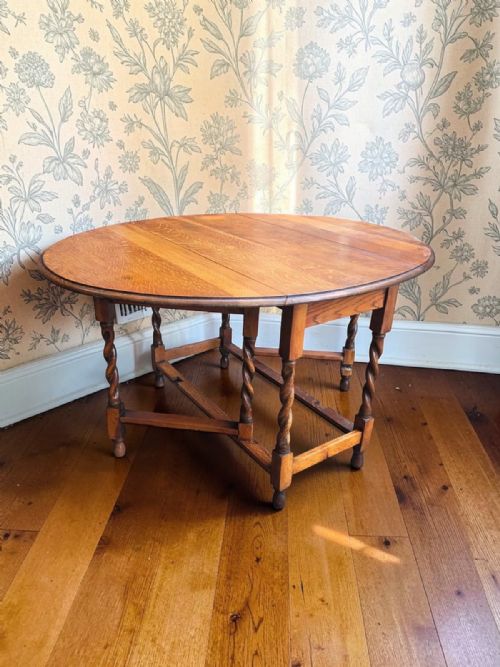
When you search for an antique barley twist gateleg table, you encounter versatile folding furniture designed to expand when needed and fold away compactly. The selection on this page ranges from compact occasional pieces to large dining tables suitable for regular use.
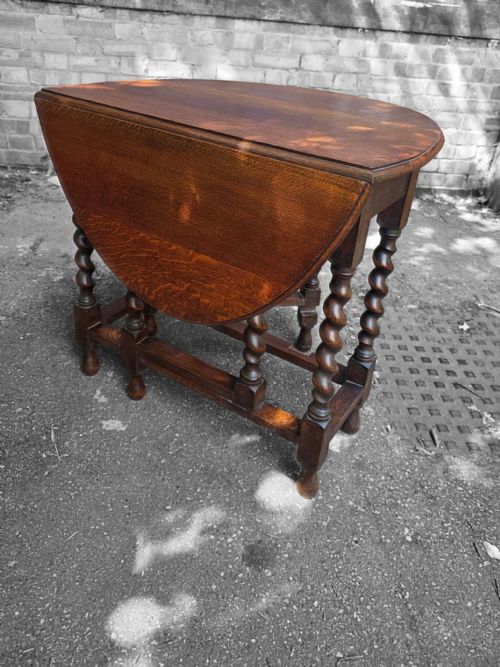
Most examples you meet here date from the early twentieth century or the Edwardian and Victorian eras, though earlier eighteenth and seventeenth-century pieces appear in oak. These tables typically feature oval drop leaves supported by pivoting gate legs that swing out to hold the flaps.
Forms vary from small occasional tables and Sutherland tables to large dining tables. Oak remains the predominant timber, accompanied by walnut, burr walnut, and mahogany.
Materials and construction methods
Makers relied primarily on solid oak for these pieces, shaping structural components and table tops with traditional hand woodworking techniques. Walnut, burr walnut, and mahogany also feature in the construction of specific tables, particularly in Victorian and Edwardian examples.
The characteristic spiral legs are turned on a lathe to create the distinctive twist pattern. Gate legs pivot on wooden or iron hinges to support the drop leaves securely when the table is fully opened.
Antique Barley Twist Gateleg Retail Price Guide 2026
Typical asking prices for barley twist gateleg among the pieces listed under this phrase on Sellingantiques today, from the lower quarter to the upper quarter. They describe what is for sale here now, not the wider market.
Listings span from the seventeenth century through the Victorian, Edwardian, and 1920s periods, executed primarily in oak with occasional walnut and mahogany.
Factors influencing quality and craftsmanship
Quality in these tables depends heavily on the selection of timber and the precision of the turning on the barley twist legs. Finer examples display crisp, well-defined spirals and substantial timber thickness in the top and frame.
The stability of the gate mechanism and the neatness of the hinge joints separate superior pieces from simpler utilitarian versions. Well-executed joints ensure the drop leaves remain level and steady when extended.
The Antique Barley Twist Gateleg Glossary
- Gateleg table
- A table with hinged leaves supported by legs that swing outward like a gate. This design allows the table to fold down into a compact footprint when not in use.
- Barley twist
- A type of furniture turning resembling a twisted rope or spiral column. It became popular in seventeenth-century joinery and saw major revivals in the Victorian and Edwardian periods.
- Drop-leaf table
- A table featuring a fixed centre section and hinged flaps on either side. These flaps raise to increase the surface area and drop down vertically to save space.
- Sutherland table
- A narrow style of drop-leaf table with exceptionally slim folding leaves and small gate legs. It typically includes smaller proportions and dates predominantly to the Victorian era.
- Jacobean Revival
- A nineteenth and twentieth-century style imitating seventeenth-century English furniture characteristics. Pieces in this style often feature dark oak, panelled details, and heavy turned legs.
Antique Barley Twist Gateleg: Frequently Asked Questions
How do I use a gateleg table daily?
Keep the drop leaves folded down against the wall or in a corner to save floor space in smaller rooms. Simply lift the leaves and swing the pivoting gate legs outward into place when you need a larger surface for dining or working.
Ensure the swinging leg locks properly under the leaf to distribute weight evenly. Avoid placing excessive downward pressure on the unsupported outer edges of the open leaves.
How do I date an oak gateleg table?
Look at the construction methods, timber grain, and hardware such as hinges and screws. Seventeenth and eighteenth-century tables show hand-riven timber, pegged joints, and heavy wear patterns.
Tables from the Victorian, Edwardian, and 1920s revival periods often exhibit machine-cut components, standardised screws, and cleaner, more uniform turning on the barley twist legs.
Can these tables fit in modern dining rooms?
Many of these tables work exceptionally well in contemporary homes due to their adaptable footprint. The ability to drop the leaves allows you to adjust the table size according to the number of guests.
Pairing an antique oak or walnut table with modern seating creates a striking contrast. Measure your available floor space with the leaves fully extended before selecting a dining-sized version.