

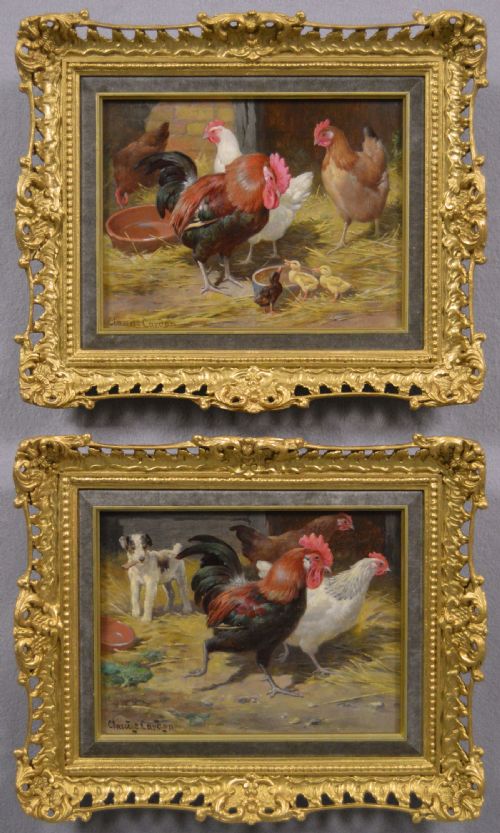




Antique Animal Paintings Pair
These antique animal paintings pair selections bring farmyards, sporting dogs, and Highland cattle straight to your walls in matched sets.
Antique Animal Paintings Pair
When you search for an antique animal paintings pair, you encounter matched works depicting farmyard scenes, sporting dogs, and livestock across the nineteenth century and into the early twentieth century. These sets capture the Victorian and Edwardian fascination with rural life, domestic animals, and sporting subjects rendered in oil and watercolour.
The pairs most frequently met on this page include farmyard studies featuring chickens, horses, and cattle, alongside portraits of terriers and setters. Creators such as Claude Cardon, John Frederick Herring Jnr, and Franz van Severdonck produced these balanced compositions to hang together as a unified display.
Originating from British and Belgian traditions, these works range from detailed rural realism to folk art interpretations. A buyer finds both canvas supports and oil on board formats framed in gilt wood and gesso.
How they were made
Artists painted these works using oil paint applied to canvas, board, or wooden panels, whilst watercolour appeared on paper supports. The medium allowed for rich textures in animal coats and atmospheric depths in farmyard and Highland backgrounds.
Gilt wood and gesso frames enclose the paintings, often designed specifically as a pair to complement the visual weight of each composition. The combination of oil pigment and heavy wooden framing defined the standard production methods for nineteenth-century fine art.
Antique Animal Paintings Pair Retail Price Guide 2026
Typical asking prices for animal paintings pair among the pieces listed under this phrase on Sellingantiques today, from the lower quarter to the upper quarter. They describe what is for sale here now, not the wider market.
Listings feature oil paint, watercolour, and board across Victorian and Edwardian periods.
What varies in quality
Quality rests in the anatomical accuracy of the subjects, the handling of light in the landscape, and the cohesion between the two matched canvases. Stronger works display confident brushwork in the rendering of fur, feathers, and muscular form.
The preservation of the original paint surface and the condition of the gilt wood and gesso frames distinguish finer examples from standard decorative pieces. Pairs that remain together with matching frames and uniform provenance hold greater aesthetic balance.
Claude Cardon·E H Windred·Franz van Severdonck·John Frederick Herring Jnr·Colin Graeme Roe·Robert Watson·W.A. Clark·A. Betts·James Malcolm Stewart·JS Cooper
The Antique Animal Paintings Pair Glossary
- Oil Paint
- A slow-drying paint made from pigment suspended in oil, typically linseed. It allows for rich colour blending and textured application.
- Gesso
- A plaster-like mixture applied to wooden frames to create a smooth surface before gilding. It provides the base for intricate moulded decoration.
- Canvas
- A heavy woven fabric stretched across a wooden frame to serve as a painting surface. It was widely used by nineteenth-century fine artists.
- Gilt Wood
- Wood treated with gold leaf or a gold-coloured metallic finish. It frames and enhances the visual impact of traditional paintings.
Antique Animal Paintings Pair: Frequently Asked Questions
Why were animal paintings created in pairs?
Victorian and Edwardian interior design favoured symmetry, leading artists and commissioners to produce balanced compositions designed to hang side by side on drawing-room walls.
These paired sets often contrasted morning and evening lighting, or featured complementary subjects such as horses and farmyard fowl.
What subjects appear most often in these pairs?
Farmyard scenes featuring chickens, ducks, horses, and cattle dominate the selection, alongside sporting dogs, terriers, and Highland wildlife.
Artists captured both domestic utility and sporting pursuits, reflecting the rural interests of nineteenth-century collectors.
How do I identify a Victorian animal painting?
Victorian works are characterised by realistic anatomical rendering, traditional oil on canvas or board mediums, and heavy gilt wood frames.
Signatures, artist dates, and subject matter focusing on rural realism or sporting dogs typically point to the nineteenth-century period.
How should I hang a matched pair?
Matched pairs look best displayed at eye level with equal spacing between them to maintain the visual symmetry intended by the artist or framer.
Ensure both frames share a similar height and weight to keep the arrangement balanced on your wall.