
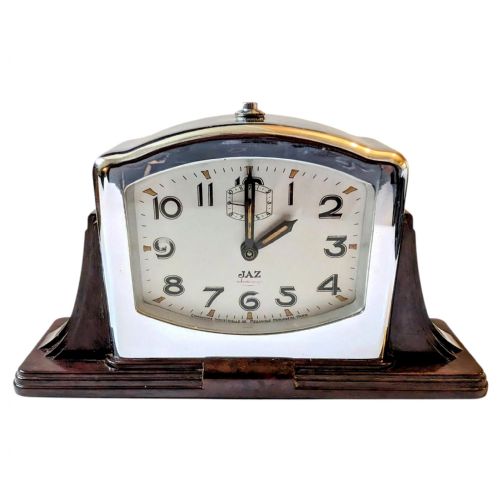
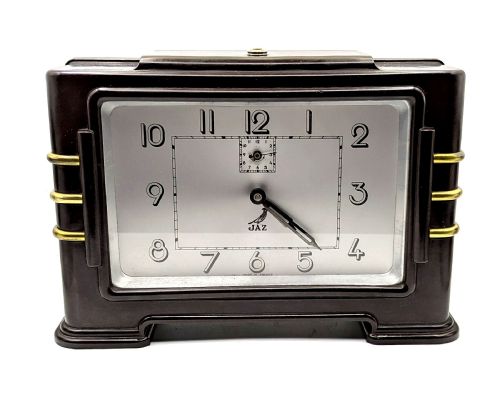


Antique Alarm Table Clock
An antique alarm table clock sits on a desk or bedside, bringing brass, wood, and dialwork from centuries past into daily service.
Antique Alarm Table Clock
An antique alarm table clock combines timekeeping with a mechanical wake-up function, taking forms from early lantern clocks to Art Deco travel pieces. You find English bracket clocks alongside French carriage models and twentieth-century modernist desk units.
The selection ranges across several centuries, capturing the shift from eighteenth-century wooden bracket designs to Victorian brass carriage mechanisms and nineteen-thirties chromium and Bakelite creations. French makers feature strongly alongside English workshops.
These objects served practical daily functions in bedchambers, studies, and offices before the era of electric timepieces. Surviving examples retain their original striking, repeating, or alarm mechanisms housed within decorative cases.
How they were made
Brass, glass, and wood form the primary structure of these clocks, with mahogany and lacquered finishes appearing on eighteenth-century bracket models. Later pieces introduce industrial materials such as chromium plating and Bakelite alongside traditional metal alloys.
Cases utilise bevelled glass panels, gilded bronze, and hand-painted enamel dials, protecting intricate gear trains and verge or platform escapements. Makers employed specialised casting, woodworking, and metal finishing techniques suited to each period style, from Georgian Chinoiserie to Art Deco streamlining.
The selection spans from early eighteenth-century English bracket clocks to nineteen-thirties Art Deco Bakelite and chrome travel pieces.
What varies in quality
The sophistication of the internal movement dictates much of the standing, separating standard timepieces from grand sonnerie, quarter-repeating, and striking mechanisms. Complications like alarm functions integrated with repeating strikes represent higher tiers of horological skill.
Case materials and finishing also define the grade, distinguishing mass-produced commercial units from gilded gorge cases, original leather travel packaging, and hand-lacquered wooden housings by noted makers. The preservation of original components within the movement and case remains paramount.
Antoine Redier·William Barrow·Harrods of London·Blangy Clockmakers·Drocourt·J. F. Bautte Et Cie·John Taylor·James Smith·Chater & Son·Hunt & Roskell·Bayard·Jaz
The Antique Alarm Table Clock Glossary
- Carriage clock
- A portable spring-driven timepiece designed for travel, typically featuring a rectangular brass case with glass panels and a folding handle.
- Verge escapement
- An early type of mechanical escapement utilising a crown wheel and pallets, common in seventeenth and eighteenth-century English clocks.
- Grand sonnerie
- A striking mechanism that chimes the hours and quarters automatically on every quarter hour, often combined with an alarm.
- Bakelite
- An early synthetic plastic utilised extensively in Art Deco clocks during the nineteen-thirties for streamlined cases and bezels.
- Capucine
- A specific French style of striking and alarm table clock characterised by a bell mounted on top and columns at the corners.
Antique Alarm Table Clock: Frequently Asked Questions
How do I set the alarm?
Most carriage and desk models feature a secondary small dial or a central hand on the face that rotates to indicate the desired wake-up time. Winding the alarm train via its own dedicated arbor ensures the hammer strikes the internal bell or gong when the hour arrives.
Older bracket and lantern clocks utilise distinct pin or disc systems on the dial face to trip the alarm mechanism at the correct moment.
Are these clocks suitable for daily use?
These mechanical timepieces function well in daily routines provided they receive regular professional servicing and careful handling. Daily or weekly winding is necessary depending on the movement's power reserve.
Placing them on stable, level surfaces away from direct drafts and extreme temperature fluctuations preserves their delicate escapements and internal gears.
How do I identify a French carriage clock?
French carriage clocks typically present a rectangular brass framework inset with bevelled glass windows that reveal the escapement platform on top. They often include a hinged carrying handle and substantial weight derived from solid brass casting.
Many examples house platform escapements and bear the signatures of notable nineteenth-century makers on their backplates or enamel dials.
What is a grand sonnerie strike?
A grand sonnerie mechanism is an advanced complication that automatically chimes both the current hour and the elapsed quarters every fifteen minutes. This requires a complex arrangement of extra gear trains and hammers within the clock's interior.
Clocks featuring this capability represent the upper tier of horological production during the Victorian and earlier periods.