


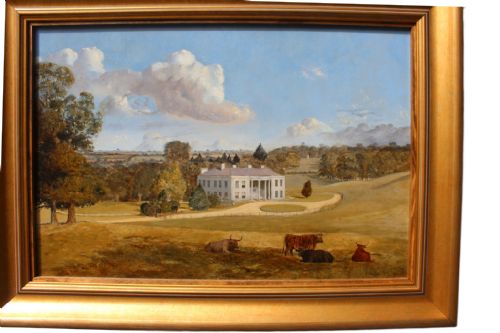


Antique Abbey Art
These antique abbey art pieces capture historic monastic ruins and coastal Yorkshire landmarks in period watercolours and oils.
Antique Abbey Art
When searching for antique abbey art, collectors encounter framed paintings, watercolour works, and wall plaques depicting notable English ecclesiastical ruins and landscapes. The selection spans works from the eighteenth century through the 1930s, capturing subjects such as Whitby, Bolton, Fountains, and Rievaulx abbeys.
Watercolour paintings on paper and oil paintings on canvas or board dominate the available selection. Many pieces originate from the Victorian, Edwardian, and Georgian periods, showcasing regional British topography and historical architecture.
The most common representations feature Whitby Abbey viewed from the harbour, river, or cliffs alongside surrounding Yorkshire scenery. These works frequently combine coastal elements with the distinct silhouettes of ruined stone arches and walls.
Materials and Construction
Artists relied on traditional watercolours and pigment on paper, or oil paint applied to canvas, board, and wood panels. These pigments were brushed by hand, often framed under glass or within period wooden structures.
Wooden supports and canvas substrates provide the foundation for oil compositions, while heavy paper stocks receive water-soluble washes. Supplementary materials include glass coverings and occasional Tunbridge ware elements on decorative wooden wall plaques.
Listings feature paper, canvas, and wood supporting watercolour and oil mediums across Victorian and Edwardian periods.
Evaluating Quality and Execution
Quality rests upon the artist's handling of light, atmospheric perspective, and architectural proportion within the landscape. Finer examples display confident brushwork and accurate topographical rendering of stone structures rather than stiff, formulaic reproduction.
The preservation of the original paint surface and paper integrity dictates distinction across the range. Works retaining stable pigments without excessive fading or damp staining stand at the upper end of the selection.
Alfred George Morgan·William Mellor·George Weatherill·Herbert Royle·Julius Caesar Ibbetson
The Antique Abbey Art Glossary
- Watercolour
- A painting method where fine pigment is suspended in a water-soluble binder and applied to paper. It allows for transparent washes and delicate atmospheric effects.
- Oil on canvas
- A traditional painting medium utilising pigments bound in drying oils spread across woven fabric stretched over a wooden frame. This technique offers rich colour saturation and varied surface texture.
- Tunbridge ware
- Small decorative wooden objects distinguished by intricate mosaic patterns formed from tiny pieces of naturally coloured timbers. It represents a specialised form of British woodworking.
- Gothic Revival
- An architectural and artistic movement reviving medieval Gothic forms, frequently seen in depictions of pointed arches and ruined abbeys. It heavily influences Victorian visual arts.
Antique Abbey Art: Frequently Asked Questions
What periods do these abbey artworks date from?
The available selection spans from the eighteenth century through the early twentieth century. Pieces range from Georgian and Victorian depictions to Edwardian and interwar watercolours.
Most works cluster around the nineteenth century and the turn of the twentieth century, reflecting popular shifts in British landscape painting.
Which abbeys appear most frequently in these paintings?
Whitby Abbey in Yorkshire appears most often, frequently shown alongside the harbour, St Mary's Church, or the surrounding coastline. Other prominent subjects include Bolton Abbey, Fountains Abbey, and Rievaulx Abbey.
Artists also occasionally recorded less common sites such as Newstead Abbey and Selby Abbey.
Are these works framed?
Many paintings and watercolours retain their period frames, which often consist of carved or moulded wood. Some pieces are described as framed paintings or wall plaques designed for immediate display.
Condition and framing styles vary according to the original period of creation and subsequent mounting choices.
How do watercolours differ from oil paintings here?
Watercolour works utilise pigment applied to paper surfaces, typically displayed behind glass to prevent environmental damage. They tend to offer luminous, translucent depictions of light and sky.
Oil paintings utilise thicker paint layers on canvas, board, or wooden panels, providing greater textural depth and richer colour opacity.