



Ancestral Oil Paintings Pair
An ancestral oil paintings pair brings dual portraiture into a room, offering historic character and matched presence on the wall.
Ancestral Oil Paintings Pair
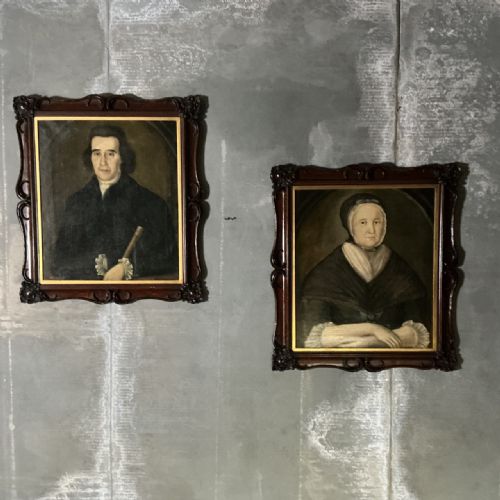
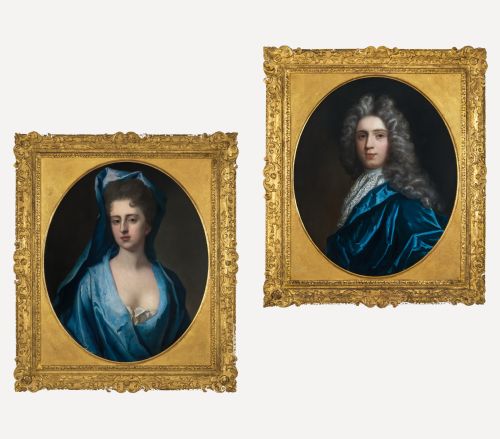
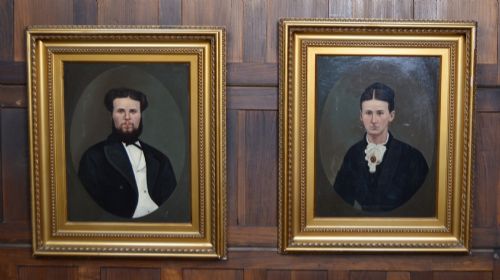
When you search for an ancestral oil paintings pair, you encounter dual likenesses, usually depicting a gentleman and a lady intended to hang together. The pieces seen here span from the 17th century through the Regency era and into the 19th century, capturing subjects from English and Dutch schools.
Most examples on this page are oil on canvas works, often set within original frames of giltwood or gesso. You will find both intimate oval formats and large framed compositions representing families and notable figures.
The subjects range from named historical individuals, such as Sir John Wentworth and Lady Sarah Cowper, to anonymous sitters from Scottish and English portraiture traditions. Each pair reflects the portraiture conventions of its specific period, from Baroque formality to 19th-century realism.
Materials and construction methods
These works are painted in oil paint upon a canvas support, utilising traditional layering techniques developed across centuries. Some later interpretations employ vinyl canvas, reflecting twentieth-century adaptation of older compositional styles.
The accompanying frames are constructed from wood and gesso, finished with gold leaf or giltwood gilding. These frames are integral to the presentation, frequently maintaining their original relationship with the canvas.
Ancestral Oil Paintings Pair Retail Price Guide 2026
Typical asking prices for ancestral oil paintings pair among the pieces listed under this phrase on Sellingantiques today, from the lower quarter to the upper quarter. They describe what is for sale here now, not the wider market.
Some Dutch marriage portraits on vinyl canvas prove that historical duplication has a surprisingly modern sense of mischief.
Factors that distinguish individual examples
Quality in these works rests upon the precision of the brushwork and the psychological depth captured in the sitters' expressions. Earlier examples from the seventeenth century often display sophisticated handling of fabric and light compared to later interpretations.
The preservation of the original giltwood or gesso frame contributes significantly to the integrity of the pair. Matched survival of both canvases and their period frames ensures a more unified historical object.
Michael Dahl·Thomas Murray·Cornelis Van Der Voort
The Ancestral Oil Paintings Pair Glossary
- Giltwood
- Wood carved and coated with gold leaf or gold paint. This material forms the ornate surfaces of many period frames.
- Gesso
- A plaster-like mixture applied to wood frames to create a smooth surface for gilding. It allows for intricate moulded decorative details.
- Baroque
- An artistic style originating in the seventeenth century, known for drama, rich colour, and grand scale. Portraits from this period emphasise status and elaborate costume.
- Regency
- A British historical period spanning the early nineteenth century, noted for specific neoclassical design traits in frames and interior furnishings.
Ancestral Oil Paintings Pair: Frequently Asked Questions
What is an ancestral oil paintings pair?
An ancestral oil paintings pair consists of two related portrait canvases, traditionally depicting a husband and wife or family members meant to hang side by side. They originate from various periods including the seventeenth, eighteenth, and nineteenth centuries.
These paired works share a similar scale, palette, and framing style, designed to create visual balance on a domestic wall.
How were these portraits historically displayed?
Such portraits were hung in the principal reception rooms or galleries of large houses to establish family lineage and social standing. They served as permanent records of ancestry and status.
Today, they function similarly in historic or traditional interiors, providing a focal point above a fireplace or along a hallway.
How do I identify the period of a pair?
Period identification relies upon the costume of the sitters, the style of the hair, and the construction of the canvas and frame. Seventeenth-century works often feature elaborate lace collars and formal drapery, while Regency examples show simpler neoclassical attire.
Framing materials also offer clues, as gesso and giltwood profiles shifted in ornamentation across the Georgian, Regency, and Victorian eras.