





Alpine Mountain Landscape Painting
These alpine mountain landscape painting works capture dramatic peaks, high valleys, and remote glaciers with lasting artistic skill.
Alpine Mountain Landscape Painting
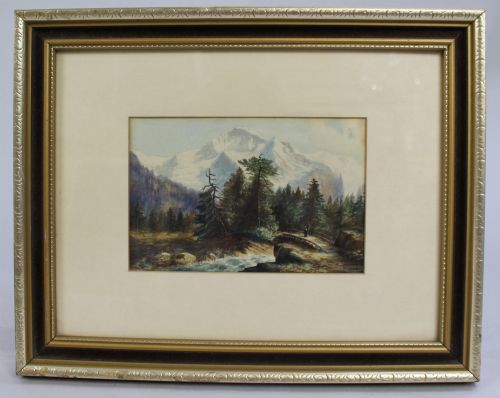
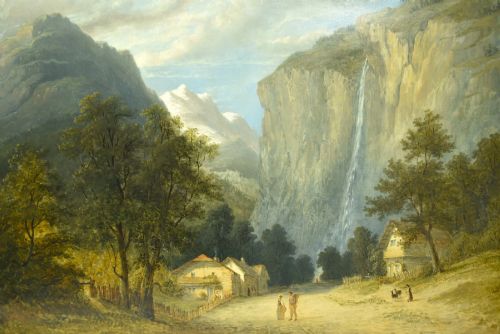
An alpine mountain landscape painting depicts high altitude scenery, ranging from Swiss waterfalls and Austrian lakes to German castles nestled beneath snow-capped summits. These works record the fascination artists held for rugged terrain during the nineteenth and early twentieth centuries.
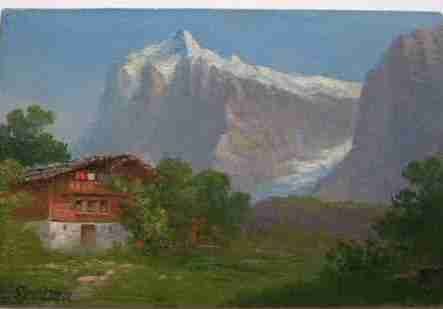
The selections available here include oil paintings on canvas and delicate watercolours on paper. Examples span regional studies, such as views near Lauterbrunnen and Grindelwald, alongside works executed by the nineteenth century German School and British landscape painters.
Buyers will encounter both intimate cabinet watercolours and large scale oil paintings framed in giltwood. Many pieces focus on specific geographic locations, recording glaciers, mountain streams, and fortified architectural landmarks.
How they were made
Artists utilised oil paint on canvas or watercolour on paper to capture shifting light across snow-capped peaks and deep valleys. Pigments were applied to build texture in rock faces and luminous expanses in skies and lakes.
Many of these works are housed in their original giltwood frames, which complement the scale and subject of the canvas. Support materials range from stretched canvas on wood frames to heavy paper sheets suited for watercolour washes.
Alpine Mountain Landscape Painting Retail Price Guide 2026
Typical asking prices for alpine mountain landscape painting among the pieces listed under this phrase on Sellingantiques today, from the lower quarter to the upper quarter. They describe what is for sale here now, not the wider market.
Listings feature works spanning the nineteenth century and the 1930s, utilising canvas, paper, watercolour, oil paint, and giltwood.
What varies in quality
Execution of light and atmospheric perspective distinguishes finer compositions from simpler topographical records. Masterful handling of watercolours on paper allows for luminous skies and transparent shadows, whereas superior oil paintings use varied brushwork to render the weight of stone and ice.
Scale and ambition also define the range, moving from modest paired watercolours to massive canvases depicting panoramic Austrian or Bavarian vistas. The presence of identifiable geographic detail and legible artist signatures adds depth to individual pieces.
Karl Herrle·Noel Harry Leaver·A Michaelis·Hubert Sattler
The Alpine Mountain Landscape Painting Glossary
- Watercolour
- A painting method where fine pigment is suspended in a water-soluble binder, traditionally applied to paper to achieve translucent washes of colour.
- Oil painting
- A technique involving pigments bound in a drying oil, applied to canvas or wood panels to allow rich colour saturation and subtle blending.
- Giltwood
- Timber carved and surfaced with a thin layer of gold leaf, frequently used for traditional picture frames.
- Romanticism
- An artistic movement emphasising emotion, individualism, and awe of untamed nature, which heavily influenced alpine art.
- Impressionist
- A style focusing on the visual impression of the moment, particularly shifting light and colour rather than precise detail.
Alpine Mountain Landscape Painting: Frequently Asked Questions
What subjects appear in these paintings?
The works depict snow-capped mountains, glaciers, mountain streams, and alpine lakes situated in regions such as Switzerland, Austria, and Bavaria. Artists also recorded human elements within these vast terrains, including traditional chalets and Gothic castles.
Views often focus on specific landmarks like Staubbach Falls, the Wetterhorn, or Schloss Hohenschwangau. This combination of rugged topography and recognizable geography defines the genre.
How do watercolours differ from oils here?
Watercolour paintings on paper offer a lighter, more transparent quality, often created as intimate studies or balanced pairs of mountain views. They rely on the white of the paper to generate light through thin washes.
Oil paintings on canvas allow for heavier texture, deeper colour saturation, and larger formats. They are typically used for grand, sweeping vistas of lakes and towering peaks framed in giltwood.
Which periods are represented?
The selection spans the nineteenth and early twentieth centuries, capturing shifts from Romanticism and Victorian taste towards Impressionist approaches. Pieces date from the 1860s through to the 1930s.
Nineteenth-century works frequently emphasise the sublime power of nature, while later examples experiment with looser brushwork and atmospheric light effects.
How should I display these paintings?
These works require wall space suited to their scale, whether it is a modest watercolour or a large oil painting. Proper placement avoids direct sunlight to protect watercolours on paper and oil pigments over time.
Matching the frame to your interior is straightforward, as many retain their period giltwood frames. Ensure proper hanging hardware is used to support the weight of larger canvases.