


Agate Trinket Box
An agate trinket box is a small, tactile container set with patterned stone, prized for its natural mineral banding and fine metalwork.
Agate Trinket Box
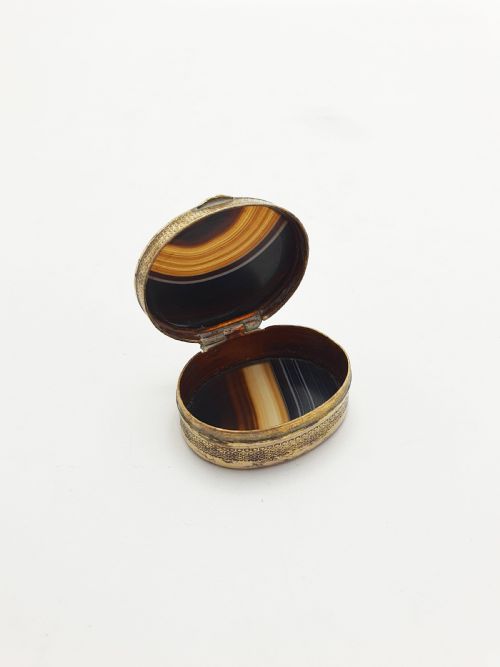
An agate trinket box combines polished chalcedony panels with supportive metal mounts, serving as a pocket-sized container for snuff, pills, or small valuables. When searching for an agate trinket box, buyers encounter various forms such as small snuff boxes, vinaigrettes, pill boxes, and larger dressing table jars.
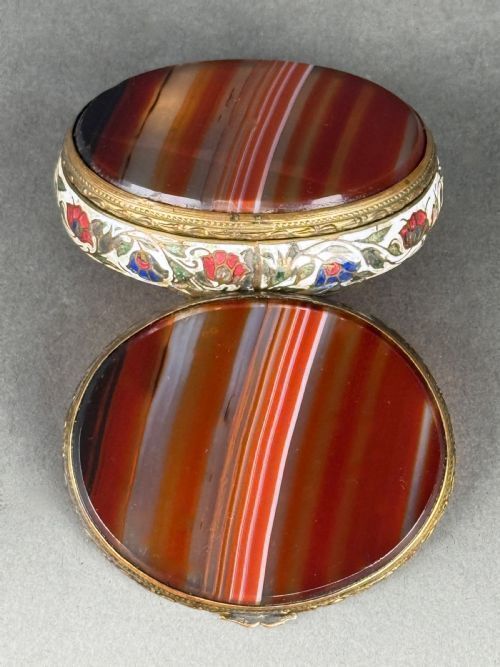
The objects span multiple eras, with examples appearing from the Georgian period, the Victorian era, and the Edwardian years. Scottish and English makers feature prominently alongside nineteenth-century French pieces mounted with champlevé enamel or gilt brass.
Forms range from simple oval and rectangular boxes to desk accessories and lidded jars. Banded varieties, blue stones, and moss agate dominate the selections found in both current listings and the archive.
What varies in quality
Quality depends upon the depth of pattern and clarity within the stone panels, where richly banded or vividly coloured specimens command attention. The smoothness of the lapidary polish across the hardstone surface indicates superior craftsmanship.
The weight and finish of the metal mounts contribute significantly to the standard of the piece, distinguishing heavy cast frames from lighter alternatives. Well-preserved hinges and secure, flush lids demonstrate precise assembly by the original maker.
Some boxes are shaped like miniature steamer trunks, complete with tiny metal straps to hold the stone panels in place.
Hilliard and Thomason
The Agate Trinket Box Glossary
- Agate
- A form of cryptocrystalline quartz displaying distinct colour bands or natural inclusions. It provides the decorative panels for these small containers.
- Vinaigrette
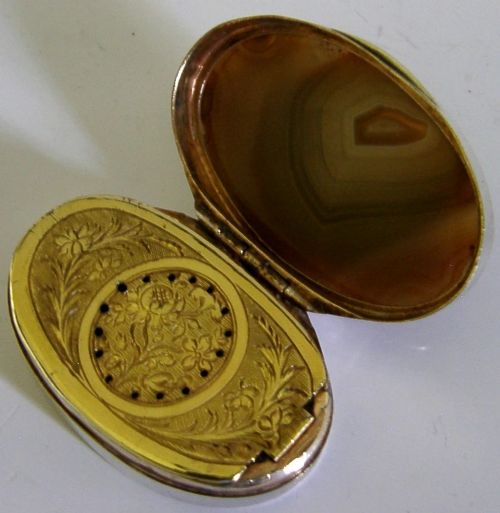
- A small hinged box containing a perforated internal grille. It held a sponge soaked in aromatic vinegar.
- Cabochon
- A gemstone shaped and polished with a smooth convex surface rather than faceted. This cut highlights the natural patterns in hardstones.
- Champlevé enamel
- A technique where troughs are dug into a metal surface and filled with vitreous enamel before firing. It frequently borders stone in French pieces.
- Ormolu
- Gilded bronze or brass utilised for decorative mounts and frames. It provides a rich gold-coloured setting for the stone panels.
Agate Trinket Box: Frequently Asked Questions
What did people put in an agate trinket box?
These small containers originally served practical uses such as holding dry snuff, medicinal pills, or scented vinegar inside perforated vinaigrette inserts. Owners also stored rings, small tokens, and other personal valuables.
Over time, their function shifted toward display and safekeeping for delicate accessories on dressing tables and desks.
How do I date a box?
Dating relies on hallmarks stamped on silver components, stylistic traits of the metal mounts, and construction methods. Georgian and Victorian pieces often show distinct mount profiles and engraving styles.
Comparing the hinge work and framing against dated archive examples helps narrow down the period of manufacture.
Are these boxes made of solid stone?
Most pieces consist of thin polished stone panels fitted into a structural metal skeleton made of silver, brass, or gilt metal. The metal provides necessary strength for the hinges and rims.
Only miniature carved items or thick-walled pieces are formed entirely from a single block of hardstone.
Where were most of these boxes made?
The available pieces originate primarily from British workshops, including Scottish and English makers, alongside nineteenth-century French ateliers. Edinburgh and London silversmiths produced many of the silver-mounted examples.
French makers frequently combined the stones with elaborate gilt brass and enamel work.