



8 Day Travel Clock
When you handle an 8 day travel clock, you hold a piece of portable engineering designed for the heavy luggage of Victorian and Edwardian journeys.
8 Day Travel Clock
An 8 day travel clock is a portable timepiece engineered to run for over a week without rewinding, originating primarily from French and English workshops during the nineteenth and twentieth centuries. When you search this phrase, you meet brass carriage clocks, folding leather cases, and oversized pocket watches.
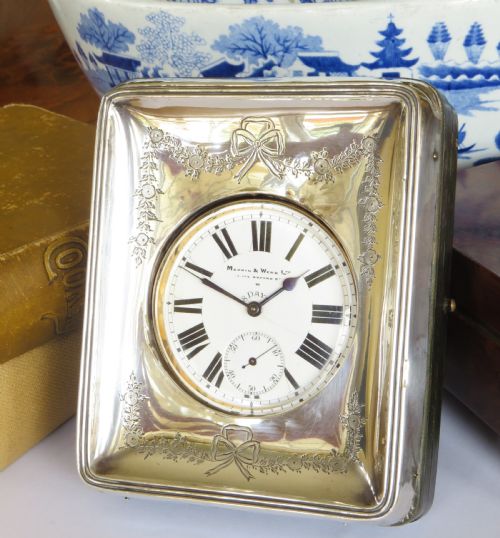
The pieces on this page span the Victorian era, the Edwardian period, and into the Art Deco style of the nineteen thirties. Carriage clocks predominate, housed in brass, gilt brass, or glass cases, alongside folding silver designs and nickel pocket watch formats.
Origins vary between French makers working in Paris and English retailers or watchmakers who imported and retailed movements. These objects reflect a time when travel demanded self-contained mechanical reliability in compact enclosures.
Materials and construction
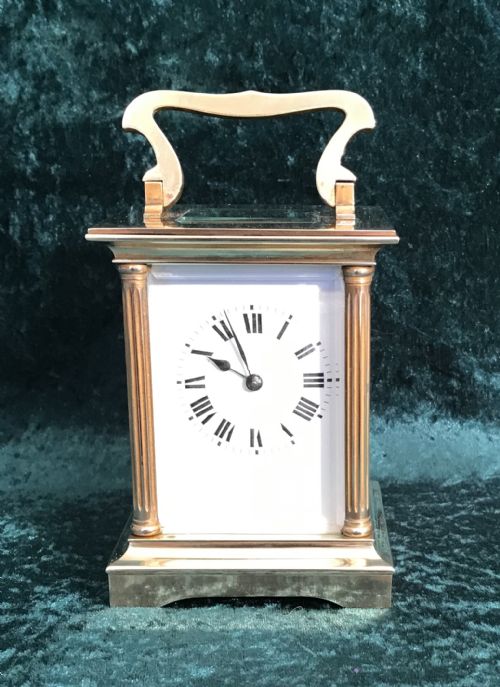
Brass forms the backbone of these pieces, frequently finished with gilt or polished surfaces to create robust yet decorative housings for delicate gear trains. Glass panels enclose the movements, allowing light into the mechanism while protecting the escapement from dust and handling during transit.
Leather provides the outer protection for folding travel versions, safeguarding the silver or metal frames within fitted cases designed for luggage packing. Chrome-plated metal and nickel emerge in later twentieth-century iterations, shifting the material palette towards modern industrial finishes.
Listings span the nineteenth century through to the nineteen sixties, incorporating glass, brass, silver, and chrome-plated metal.
Distinctions in quality
The refinement of the movement dictates the upper tier of these pieces, particularly those featuring striking mechanisms, repeating complications, or alarm functions. Master makers who engraved every visible brass surface achieved a level of execution distinct from plain, utilitarian brass casings.
Case materials also divide the range, moving from standard brass housings to heavy sterling silver folding frames or signed luxury retailer variants. Original leather cases surviving intact alongside the clock elevate the integrity of the piece.
Mappin and Webb·Drocourt Paris·Henri Jacot Paris·Harrods of London·Octava
The 8 Day Travel Clock Glossary
- Gorge case
- A distinct carriage clock case style characterised by stepped mouldings at the top and bottom of the frame.
- Carriage clock
- A small, spring-driven clock designed for travel, featuring a carrying handle and glass viewing panels.
- Striking mechanism
- A secondary gear train within the clock that sounds the hours or quarters on a bell or gong.
- Escapement
- The internal mechanism that controls the release of power from the mainspring to regulate the timekeeping.
- Grande-Sonnerie
- A complex striking train that chimes the hours and quarters automatically on every quarter-hour.
8 Day Travel Clock: Frequently Asked Questions
How do I wind an 8 day travel clock?
Most of these clocks utilise a dedicated key inserted into winding squares on the backplate or dial face to tension the mainspring.
Care must be taken not to over-wind the movement when resistance is met at the end of the power reserve.
Can I use a travel clock daily?
These mechanical timepieces function well for regular use if they receive professional servicing and gentle handling during winding.
Placing them on stable, vibration-free surfaces protects the delicate balance wheel and escapement from premature wear.
How do I date a brass carriage clock?
Stylistic shifts in the brass framing, case proportions, and escapement design offer primary clues to the period of manufacture.
Signatures or maker marks stamped onto the brass backplate provide a more precise reference to the workshop origin.
Why does the clock need a leather case?
Original leather cases protected the glass panels and delicate silver or brass frames from the rigours of nineteenth-century transit.
They shield the metal surfaces from tarnish and cushion the movement against accidental knocks inside luggage.