
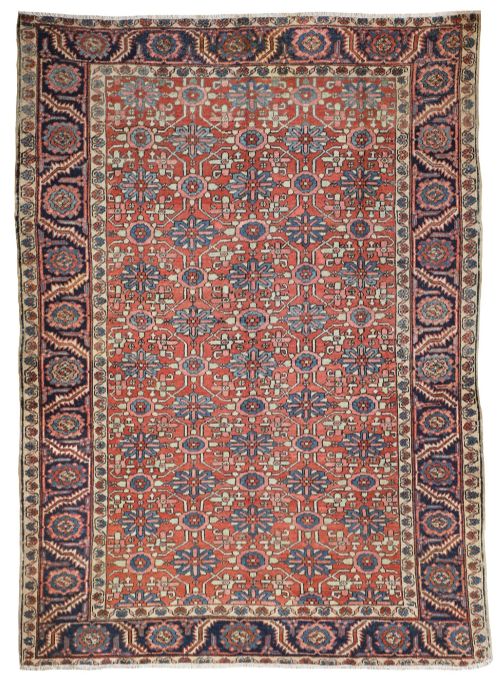


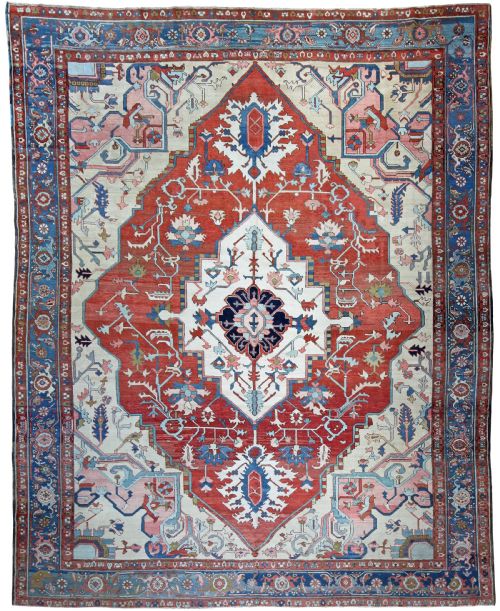
19th Century Serapi Rug
These 19th century serapi rug examples bring grand North-West Persian geometry and robust room-anchoring presence into a room.
19th Century Serapi Rug
When you search for a 19th century serapi rug, you are looking at substantial floor coverings originating from North-West Persia across the decades of the late Victorian era. The selection centres on large carpets and gallery formats created in the Heriz region during the period from 1870 to 1910.
You meet traditional Persian designs featuring large geometric medallions and expansive fields rather than fine curvilinear floral patterns. The weaves span both Serapi and Heriz designations, sharing the same robust aesthetic and room-scale proportions.
How they were made
Weavers constructed these carpets using wool pile knotted onto sturdy cotton foundations. This pairing provided the structural strength required for large format gallery carpets and expansive room-size floor coverings.
The techniques relied on traditional Persian workshop methods that prioritized durability and bold graphic layout. Natural dye traditions delivered the characteristic brick reds, terracotta tones, and contrasting soft blues seen across the period.
Some gallery carpets stretch past four metres in length, ready to swallow up the longest of Victorian hallway footsteps.
What varies in quality
Quality separates ordinary room size carpets from exceptional collector pieces through the clarity of the large medallion and the rhythm of the field design. A superior piece displays precise graphic balance and harmonious dye saturation across the entire wool surface.
The handling of secondary borders and the integrity of the cotton foundation further distinguish top examples. When the wool retains its supple handle and the geometry remains crisp, the carpet holds its visual strength.
The 19th Century Serapi Rug Glossary
- Serapi
- A sub-style of Heriz carpet known for larger scale geometric patterns, open fields, and softer colour palettes. These pieces date from the nineteenth century and originate from North-West Persia.
- Heriz
- A region in North-West Persia renowned for durable carpets featuring bold central medallions and sturdy cotton foundations. The weaving tradition produced robust floor coverings designed for heavy daily use.
- Medallion
- The prominent central ornamental design motif positioned in the middle of the carpet field. In these rugs, it typically takes a large geometric or polygonal form.
- Gallery carpet
- An elongated rectangular carpet format designed specifically for long hallways, corridors, or spacious reception rooms. These pieces offer extended proportions compared to standard square area rugs.
19th Century Serapi Rug: Frequently Asked Questions
What is a serapi rug?
A serapi rug is a nineteenth-century carpet from North-West Persia characterised by large-scale geometric patterns and open fields. These pieces share a close relationship with Heriz carpets.
They offer distinct architectural layouts featuring prominent central medallions and durable wool construction on cotton warps.
How do I date these carpets?
Dating relies on stylistic markers, wool characteristics, and structural analysis pointing to the decades between 1870 and 1910. Comparing medallion geometry helps establish the era.
Changes in dye palettes and weave density across the late Victorian period provide further clues for specific decade attribution.
Where were they made?
These carpets were produced in the North-West region of Persia, specifically in workshops around the town of Heriz. The local tradition utilised regional wool supplies.
Master weavers combined sturdy cotton foundations with durable wool pile to withstand heavy domestic foot traffic.
How do I live with one?
Place these large format carpets in well-trafficked rooms where their robust wool pile and geometric designs can anchor the space. Use a quality underlay to prevent sliding.
Protect the antique textiles from direct prolonged sunlight to preserve the natural terracotta and brick red dye tones.