



19th Century Seating Suite
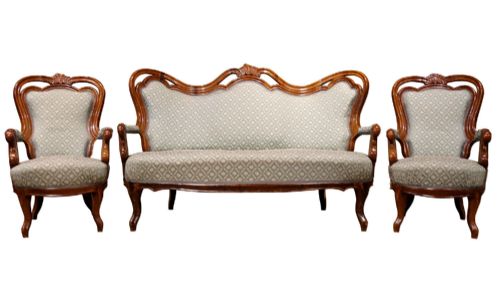
A 19th century seating suite brings matched elegance to a room, offering coordinated sofas and chairs shaped by revival styles.
19th Century Seating Suite
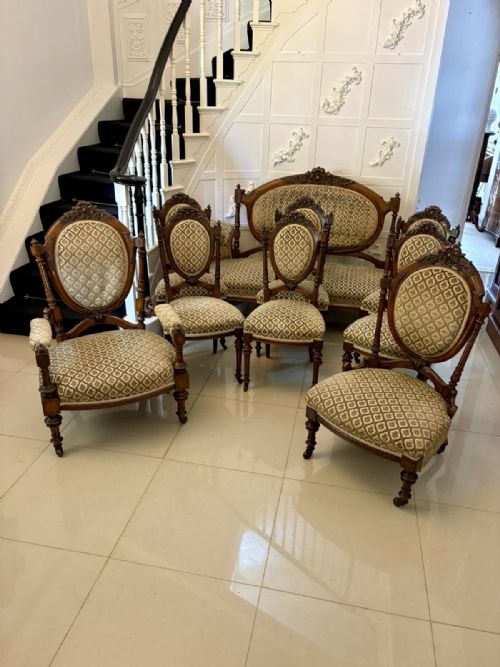
A 19th century seating suite brings together matched or complementary chairs and settees designed to furnish a room with uniform style. The selections on this page span the Victorian era and continental European workshops, running from intimate two-piece groupings to large nine-piece arrangements.
Buyers encounter various configurations, including salon suites with carved walnut frames, dining chair sets in mahogany, and multi-piece settee and armchair combinations. Origins stretch across England, France, and further afield, taking in colonial Indian workshops and Biedermeier cabinets.
The aesthetic vocabulary draws heavily on historic revivals, displaying Rococo, Louis Philippe, Gothic, and Egyptian revival details. Whether arranged in a formal drawing room or utilised around a dining table, these suites deliver period cohesion.
How they were made
Cabinetmakers shaped these frames from dense hardwoods like walnut, mahogany, padauk, and satinwood, often embellishing surfaces with rich burr birch veneers or giltwood finishes. Structural joinery supported intricate hand-carved elements, such as balloon backs, double spoon backs, and classical revival motifs.
Upholstery completed the pieces, utilising durable textiles, rich velvet, and patterned tapestry fabrics secured over supportive internal webbing and stuffing. Brass details and metal mounts occasionally accented the woodwork on continental and French empire examples.
19th Century Seating Suite Retail Price Guide 2026
Typical asking prices for 19th century seating suite among the pieces listed under this phrase on Sellingantiques today, from the lower quarter to the upper quarter. They describe what is for sale here now, not the wider market.
Stools occasionally join the company, proving that nineteenth-century feet required matching upholstery just as much as backs did.
What varies in quality
Quality reveals itself in the crispness of the timber carving and the architectural proportion of the frames, where superior suites display deep, confident hand-detailing rather than shallow mechanical stamping. The selection of cabinet woods, such as figured walnut or richly grained satinwood, dictates the visual weight and elegance of the suite.
The completeness and uniformity of a matching multi-piece suite heavily influence its standing, especially when original upholstery fabrics or period-appropriate tapestry survivals remain intact. Cohesion across every chair and settee in the grouping separates a unified salon ensemble from assembled seating.
The 19th Century Seating Suite Glossary
- Salon suite
- A coordinated grouping of upholstered seating designed for formal reception rooms. These sets typically include a settee paired with matching armchairs and occasional chairs.
- Balloon back
- A rounded, oval chair back shaped like the profile of a hot air balloon. This contour appeared frequently on mid-Victorian dining chairs.
- Spoon back
- An upholstered chair back hollowed into a concave curve that resembles the bowl of a spoon. It provides ergonomic support typical of Victorian seating.
- Giltwood
- Timber coated with a thin layer of gold leaf or gilt pigment. It appears on ornate revival frames intended to catch candlelight.
- Biedermeier
- A Central European style prioritising clean lines, domestic comfort, and visible wood grain over heavy ornamentation. It represents a restrained counterpoint to exuberant revival designs.
19th Century Seating Suite: Frequently Asked Questions
What is included in a seating suite?
A seating suite comprises multiple matching chairs, armchairs, or settees designed to furnish a room together.
Configurations range from small three-piece parlour sets to large dining chair collections and expansive nine-piece salon groupings.
Where were these suites used?
These suites furnished formal reception spaces, drawing rooms, and dining areas in nineteenth-century homes.
Smaller three-piece groupings suited intimate parlours, while larger sets accommodated guests in substantial entertaining spaces.
How do I identify revival styles?
Revival styles borrow decorative vocabulary from earlier periods, such as French Louis XV curves or Egyptian architectural motifs.
Examining the carving style and wood finish helps connect a suite to its specific historical inspiration.
Can these suites be used daily?
These pieces function well in modern interiors when placed in suitable living spaces.
Careful consideration of the upholstery fabric and frame stability ensures comfortable daily use in a contemporary home.