


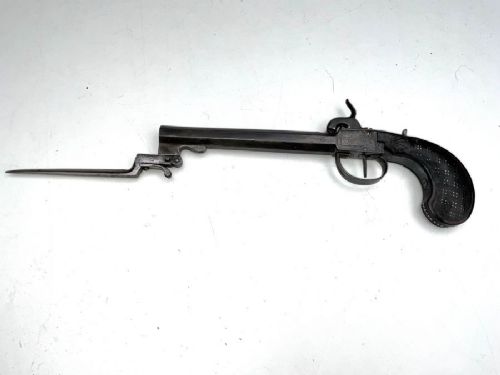


19th Century Percussion Gun
A 19th century percussion gun offers the collector tactile engineering from an era of rapid mechanical transition.
19th Century Percussion Gun
A 19th century percussion gun encompasses revolving and single-shot firearms, muskets, and sporting rifles driven by the percussion cap lock system. These pieces emerge primarily from Victorian, Regency, and Georgian periods, spanning military contracts and civilian self-defence items.
The selections on this page feature pocket pistols, belt pistols with bayonets, and large-bore models suited for both field sports and active service. Originating from British, French, and American makers, these arms demonstrate the evolution from flintlock mechanisms to reliable percussion ignition.
Collectors encounter cased pocket revolvers complete with accessories alongside substantial military carbines and blunderbusses. Each specimen reflects the specific domestic or martial requirements of its decade of manufacture.
Evaluating Quality and Execution
Superior execution shows in crisp, legible maker inscriptions on locks and barrels, alongside matching serial numbers across component parts. The precision of lock geometry and the sharpness of hand-cut engraving on metal surfaces distinguish fine workshop output from standard military issue.
The preservation of original stock finishes, case-hardening colours, and complete accessory kits elevates an example significantly. High-grade specimens retain mechanical crispness in the half-cock and full-cock positions without excessive play in cylinders or barrels.
Copper powder flasks decorated with embossed anthemion and palmette patterns ensure the powder stays dry while looking undeniably botanical.
Colt·Deane Adams And Deane·Manton·Auguste Francotte
The 19th Century Percussion Gun Glossary
- Percussion cap
- A small metal cup containing a priming compound placed on the nipple of a firearm to ignite the main powder charge when struck by the hammer. This innovation superseded the flintlock and functioned reliably in wet weather.
- Pepperpot
- A multi-barrelled firearm where the barrels revolve around a central axis rather than employing a single barrel with a revolving cylinder. This design provided multiple shots before reloading was necessary.
- Blunderbuss
- A muzzle-loading firearm with a flared muzzle designed to scatter lead balls or shot at close range. It saw extensive use by coachmen and officers during the Georgian and Regency eras.
- Socket bayonet
- A blade fitted to the muzzle end of a long gun via a tubular metal socket that locks around the barrel. This allowed infantrymen to convert their rifle or musket into a thrusting weapon.
- Powder flask
- A container fashioned from copper, brass, or leather used to measure and dispense black powder into the muzzle of a gun. Many surviving examples feature decorative embossed motifs such as palmettes and anthemion designs.
19th Century Percussion Gun: Frequently Asked Questions
How do I identify a percussion gun?
Look for a small nipple or cone on the breech where a percussion cap was placed, replacing the earlier flintlock pan and frizzen. The hammer strikes this cap directly to ignite the powder charge.
Most examples date from the nineteenth century and bear maker marks or proof stamps on the barrel flats and lock plates.
Were these guns used in military service?
Many specimens, including Enfield rifles, Colt martial revolvers, and French carbines, were issued to armed forces and saw active deployment in conflicts such as the American Civil War.
Other pieces served civilian purposes, ranging from officers purchasing private-purchase pocket pistols to gentlemen acquiring sporting rifles for the field.
What accessories come with these guns?
Cased sets frequently include copper powder flasks, bullet moulds, nipple wrenches, and cleaning rods tailored to the specific calibre of the firearm. These fitted wooden boxes often retain their original interior compartments.
Some military arms also survive alongside their original socket bayonets and leather or brass accoutrements.
How should I store a percussion firearm?
Keep the piece in a dry, stable environment away from direct heat sources and high humidity to prevent oxidation of the steel and iron components. Storing them within fitted cases or secure display cabinets offers adequate physical protection.
Light application of specialist museum-grade oil helps preserve finished metal surfaces without harming wooden stocks.