
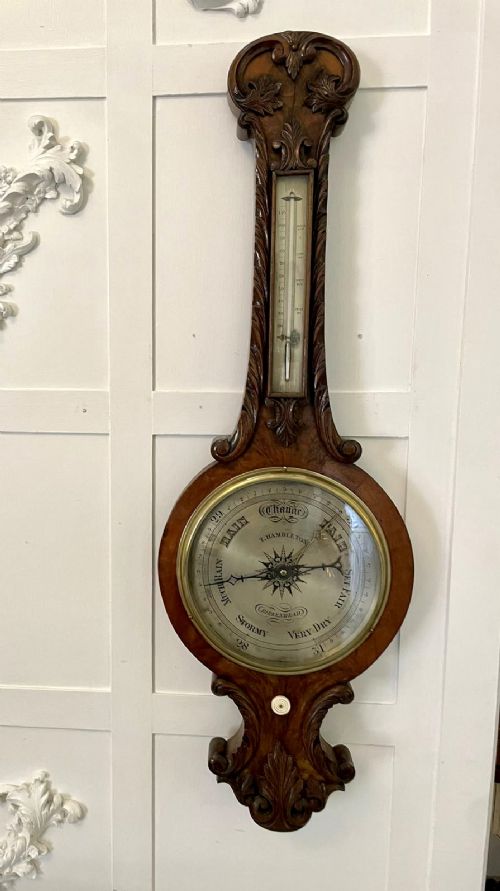
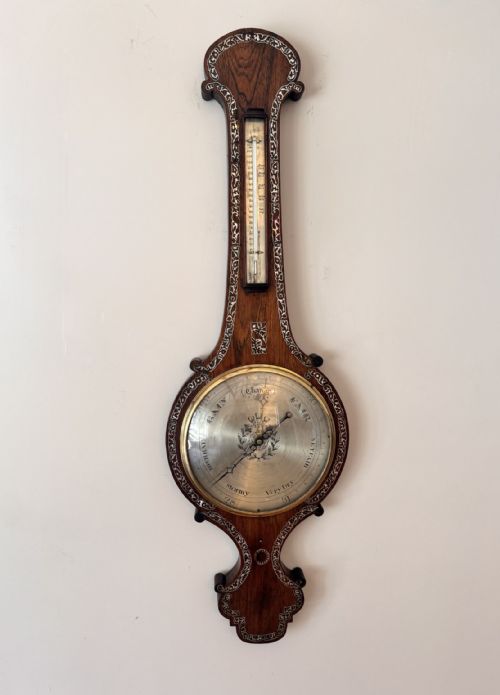


19th Century Mercury Barometer
A 19th century mercury barometer measures atmospheric pressure to forecast weather while serving as a distinguished focal point in a room.
19th Century Mercury Barometer
When you search for a 19th century mercury barometer, you encounter instruments housed in wood cases designed to hang on domestic walls. The selection spans Georgian, Regency, and Victorian periods, with styles encompassing Victorian Gothic, 19th Century Continental, and 19th Century American variants alongside standard British pieces.
The domestic forms split into two principal shapes that appear frequently on this page: the vertical stick barometer and the larger wheel or banjo barometer. Stick barometers present a narrow profile for reading mercury columns directly, whereas banjo barometers incorporate dials, hygrometers, thermometers, and level spirit tubes in an expanded body.
Makers working across London, provincial cities, and international hubs signed their dials, leaving records of regional businesses from Newcastle to Dublin and Milan. Woods such as mahogany, rosewood, burr walnut, honey-oak, and birds eye maple provide the structural backbones for these weather-recording instruments.
How they were made
Cabinetmakers constructed the cases using dense hardwoods like mahogany, rosewood, and burr walnut, often shaping them with bow fronts or carved crests. Veneers were selected for rich grain patterns and applied to secondary timbers, while select examples incorporated ebonised details or intricate mother of pearl inlay and bone dial indicators.
Glass protected the silvered metal dials, thermometer plates, and exposed tubes where liquid mercury moved in response to atmospheric pressure. Brass bezels, indicators, and decorative finials added metallic contrast to the dark timber housings of the stick and wheel instruments.
Nineteenth-century weather watchers relied on these mercury columns while trusting regional makers from Norwich to Milan to forecast the rain.
What varies in quality
The sophistication of the case joinery and the depth of the cabinet work dictate the visual hierarchy of these barometers. Heavily carved Victorian walnut or rosewood models sit alongside simpler Georgian stick formats, where restrained lines rely entirely on timber selection and precise dial engraving.
Signatures inscribed upon the silvered metal dials elevate certain pieces, linking them to known makers and regional retailers across Britain and the Continent. The survival of original glass, intact mercury columns, and secondary fittings like thermometers distinguishes preserved domestic instruments from altered or assembled examples.
Ganthony of London·JB Bergna Newcastle·Prada of High Wycombe·Molton of Norwich·Jenkins Of Old Swindon·L Casatelli of Liverpool·James H Kelly of Glasgow·Roncoroni·Bate·Bianchi Ipswich·Ciresa of Milan·J Groce York·S P Cohen Glasgow·J C Moretti·Corti of Exeter·Malacrida of Dublin·Russell of Liverpool·L Malacrida London·Charles Baker London
The 19th Century Mercury Barometer Glossary
- Stick barometer
- A tall, narrow instrument showing the mercury column directly against a scale without a rotating dial. This form offers a direct reading of atmospheric pressure.
- Wheel barometer
- A banjo-shaped instrument where a concealed float moves a string and pulley to turn a pointer around a circular dial. These often include auxiliary dials such as hygrometers and thermometers.
- Silvered metal
- Brass or copper treated to produce a silver-coloured finish, typically engraved with graduations and maker details for the dial face. This surface requires careful preservation.
- Mother of pearl
- Iridescent shell material used for decorative inlay work in floral or geometric patterns on rosewood and mahogany cases. It provides tonal contrast against dark timbers.
- Vernier
- A small auxiliary scale sliding beside the main barometer scale to allow precise readings of barometric pressure variations. It aids in tracking minor atmospheric shifts.
19th Century Mercury Barometer: Frequently Asked Questions
How does a mercury barometer work?
Atmospheric pressure pushes down on the exposed mercury reservoir, forcing the liquid column up or down the sealed glass tube inside the timber case. The graduated scale translates these height changes into weather forecasts.
Changes in the weather alter the pressure reading over hours or days, allowing the instrument to indicate incoming rain, change, or fair conditions on the dial face.
Where should I hang my barometer?
Select an interior wall away from direct sunlight, central heating radiators, and draughty doors to maintain a stable ambient temperature. Excessive heat can affect the wood case and the enclosed mechanism.
Ensure the wall can support the weight of the timber case, particularly with larger rosewood or mahogany banjo models that carry glass tubes and brass fittings.
Can I move a mercury barometer safely?
Tilting a traditional mercury barometer risks letting air bubbles enter the tube or causing the heavy column to fracture the glass. Professional transport requires locking the mercury down if a screw mechanism is present or tilting the instrument carefully.
Most dealers advise engaging a specialist courier experienced in moving antique barometers containing liquid mercury to prevent internal damage during transit.
What is an Admiral Fitzroy barometer?
Designed in the later nineteenth century following government recommendations, these instruments incorporate Fitzroy storm remarks alongside standard weather scales. They often feature multiple glass tubes and thermometers for detailed meteorological observation.
The expanded information on the dial reflects a period when maritime safety and weather prediction became a widespread public concern across Britain.
How do I date a 19th century barometer?
Case styles, timber choices, and maker signatures provide the primary clues for dating, transitioning from Georgian mahogany stick designs to elaborate Victorian carved walnut banjo forms. Regency models often display distinct stringing and architectural pediments.
Checking the inscribed name on the silvered metal dial against trade records often reveals the active working dates of the maker or retailer.