
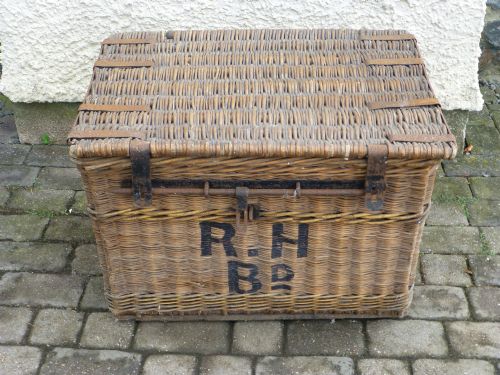
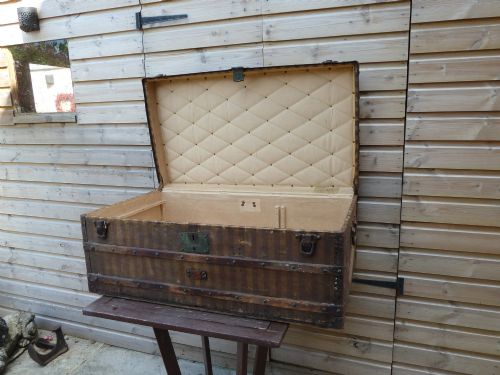
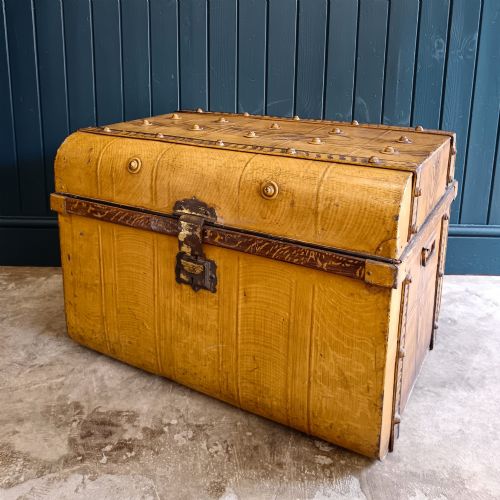
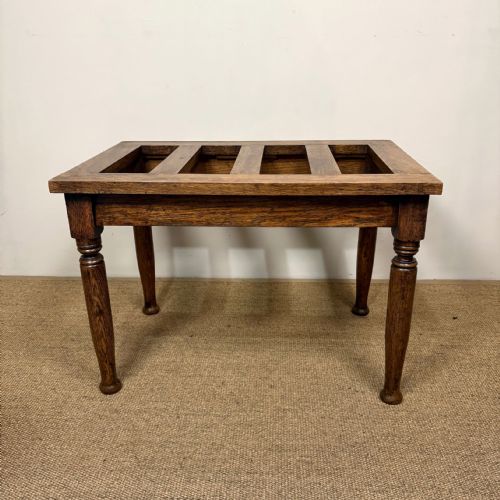


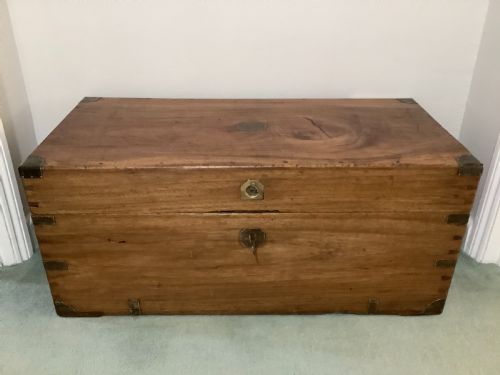

19th Century Luggage
These robust pieces of 19th century luggage built for travel bring practical storage and period character into a modern interior.

19th Century Luggage
When buyers search for 19th century luggage, they encounter two distinct categories: travel trunks designed for long journeys and rigid luggage stands intended for guest rooms. Trunks span simple pine kists, metal steamer trunks, and leather coaching chests, while stands typically present folding frames in mahogany, oak, or satin birch.
The material palette ranges from utilitarian iron and canvas to fine cabinet timbers like mahogany and camphorwood. These objects reflect the heavy transit needs of the Georgian and Victorian eras, originating from British workshops and continental makers alike.
Materials and Construction
Makers constructed these sturdy items using robust timbers such as oak, pine, and mahogany, reinforced with brass corners, iron bands, and heavy leather binding to withstand rough transit.
Interiors often feature zinc linings, canvas linings, or fitted compartments, while exterior surfaces display studwork, painted faux-wood finishes, or natural polished grains.
Listings feature items spanning the Georgian era through to the early 20th century, encompassing brass, mahogany, leather, and pine.
Grade and Distinction
Quality rests on the integrity of the original hardware, the selection of timber, and the presence of maker stamps or retailer plaques. Pieces bearing attribution to known makers or specialised firms demonstrate superior joinery and refined finishing.
Simpler utilitarian chests show robust, functional construction built purely for utility, whereas domestic luggage stands and gentleman's fitted cases often exhibit cabinet-grade timber and careful turning on the legs.
Brown & Lamont·Seabrook of St Pauls·Drew & Sons·C Antrobus·Finnegans of Bond Street·Marsh Jones & Cribb
The 19th Century Luggage Glossary
- Campaign trunk
- A chest designed for military officers on the move, frequently split into modular sections or made from dense camphorwood to resist insects.
- Steamer trunk
- A lower-profile trunk introduced for ocean liner travel in the later decades of the period.
- Luggage stand
- A folding or rigid rack placed in bedrooms to hold suitcases at a convenient height for unpacking.
- Portmanteau
- A large leather travel case that opens into two distinct compartments.
- Kist
- A traditional regional storage chest, commonly constructed from solid pine in Scottish and northern workshops.
19th Century Luggage: Frequently Asked Questions
What is a campaign trunk?
These specialised chests were constructed for military officers on active service overseas. They typically feature recessed brass handles and sturdy corner brackets to endure harsh transport conditions.
Many examples utilise camphorwood to deter insects during long sea voyages, while others incorporate zinc linings to protect contents from dampness.
How were luggage stands used?
Victorian households placed these folding stands in guest bedrooms to hold travelling trunks and suitcases off the floor. This allowed visitors to unpack easily without bending down.
Today, they function well as compact benches, side tables, or tray stands in living spaces and hallways.
How do I identify a steamer trunk?
Steamer trunks emerged later in the period, specifically designed to fit beneath the berths on ocean liners. They feature a distinctly lower profile than traditional coaching chests.
Constructed from wood, metal, and canvas, these trunks often retain travel labels and stencils from historic steamship lines.
What timbers were used for luggage?
Cabinetmakers utilised durable hardwoods such as mahogany, oak, and satin birch for domestic stands and finer gentleman's pieces. Utility trunks relied on pine, beech, and heavy leather.
Metal reinforcement, brass studs, and iron bands protected the vulnerable edges and corners during transit.