

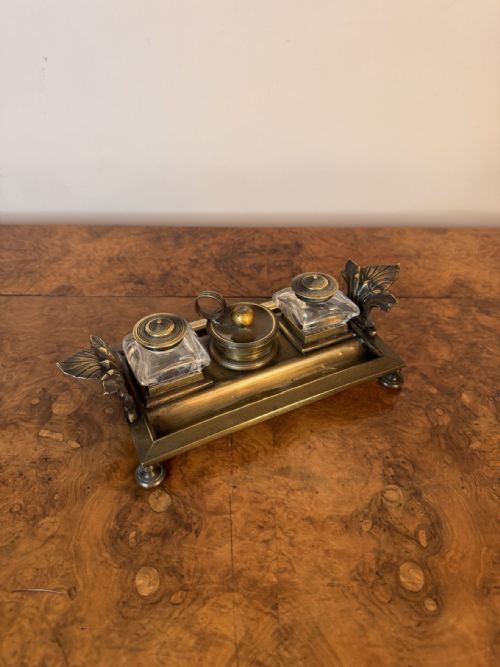



19th Century Double Inkwell
These 19th century double inkwell pieces bring functional writing desks of the Victorian era and continental Europe into modern rooms.
19th Century Double Inkwell
A 19th century double inkwell provides the desk accessories needed for correspondence before the invention of the fountain pen. These inkstands combine two ink reservoirs with space for pens, often mounted on trays made of walnut, brass, or marble.
You are most likely to encounter Victorian and continental European examples on this page, dating from the mid to late 19th century. These pieces range from carved Black Forest wooden bears to grand French ormolu and marble desk sets.
How they were made
Makers utilised cast metals such as brass, ormolu, and patinated bronze to form the structural stands and decorative mounts. These metal elements were frequently combined with carved hardwoods like walnut and ebony, or set upon marble bases.
Craftsmen incorporated ceramic elements including blue and white faience pottery alongside glass reservoirs for the ink. Fine detailing was achieved through intricate hand carving, casting, and gilding.
19th Century Double Inkwell Retail Price Guide 2026
Typical asking prices for 19th century double inkwell among the pieces listed under this phrase on Sellingantiques today, from the lower quarter to the upper quarter. They describe what is for sale here now, not the wider market.
Several pieces on this site feature carved wooden bears peering up from the desk, keeping a permanent watch over the ink.
What varies in quality
The standard of a 19th century double inkwell depends upon the ambition of its design and the crispness of its execution. Heavily cast ormolu, deeply carved wood, and integrated sculptural figures indicate higher tiers of production.
Material combination also distinguishes the range, where simple brass and wood stands sit below elaborate arrangements involving multiple metals, carved stone, and hand-painted ceramics.
Jules Dalou
The 19th Century Double Inkwell Glossary
- Ormolu
- Gilded bronze, usually applied to decorative mounts on furniture and desk accessories. This technique was widely utilised by French makers during the 19th century.
- Faience
- Tinned-glazed earthenware, seen in Dutch Delft desktop pieces. It provides a white surface for hand-painted blue decoration.
- Desk set
- A broader term for a matched collection of writing accessories on a tray, which typically includes one or more inkwells. These sets often incorporate candlestands or pen holders.
- Patinated bronze
- Bronze that has been treated to produce a decorative surface colour rather than relying on bright gilding. It gives the metal a darker, warmer tone.
- Black Forest
- A style of wood carving originating from the mountainous region of Germany and Switzerland, known for realistic animal forms. Bears are a common subject in these inkstands.
19th Century Double Inkwell: Frequently Asked Questions
What is a 19th century double inkwell used for?
These pieces served as the central writing station on a desk, holding two distinct types or colours of ink. One reservoir typically held black ink for general correspondence, while the other held red ink for annotations or bookkeeping.
The stands also provided resting places for dip pens and storage for related desk accessories. They were essential functional items in any Victorian study or office before the widespread adoption of modern fountain pens.
How do I place a double inkwell in a modern room?
A 19th century double inkwell sits comfortably on a modern wooden desk, a sideboard, or a bookshelf as a decorative object. They add a touch of historical character to a workspace without needing to be filled with ink.
Smaller models work well on side tables or mantelpieces where the materials can catch the light. Their varied media, from marble to carved wood, allow them to blend with both traditional and contemporary interiors.
How do I tell French styles apart from Victorian pieces?
French pieces from this era frequently employ gilt ormolu, bronze, and onyx marble with Rococo Revival or Empire styling. They tend to feature elaborate cast ornamentation and sculptural figures.
Victorian pieces often rely on solid walnut, brass, or carved wood such as ebony or Black Forest pine. British designs from the period generally favour domestic timbers and more restrained geometric or Scottish forms.
Why do some inkwells have two different pots?
The two pots allowed the writer to keep two different coloured inks ready for immediate use. Black ink was standard for the body of a letter, while red ink was used for emphasis, corrections, or signatures.
Some designs used one pot for ink and the other for sand, which was sprinkled over fresh writing to blot the excess moisture. This dual setup made the desk stand a complete writing station.