

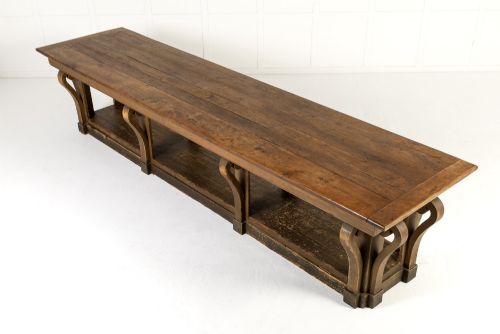
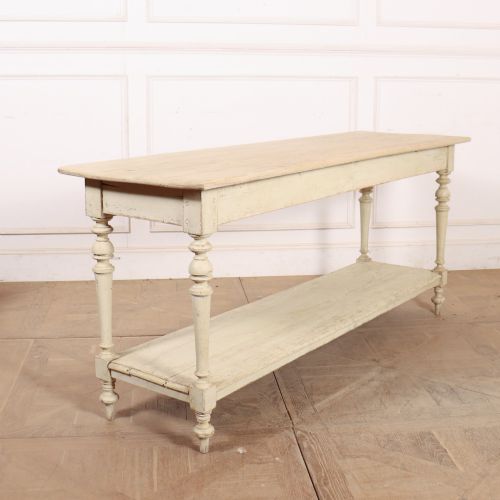
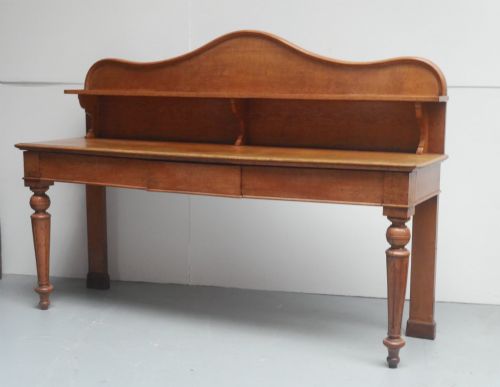


19th Century Counter Table
These 19th century counter table options bring utilitarian strength and period presence to a room, offering wide timber tops and steady frames built for working.
19th Century Counter Table
A 19th century counter table encompasses heavy-duty work surfaces, long drapers tables, and substantial serving furniture designed for commercial or domestic trade. The selections here draw heavily from French provincial workshop pieces and British country houses, favouring honest proportions and deep-set timber surfaces.
Most examples you encounter on this page take the form of long drapers tables built from oak, pine, or walnut, often displaying bleached finishes or old painted surfaces. Alongside these are butchers blocks and serving tables that maintain the same functional gravity required for daily labour.
How they were made
Makers constructed these tables from dense domestic hardwoods like oak and walnut, alongside resilient pine for scrubbed work surfaces. Joinery prioritised unyielding stability, employing thick legs and robust stretcher frames to bear substantial weight without wobble.
Surfaces frequently show the marks of active use, whether through scrubbed pine tops cleaned with water and sand or waxed walnut and mahogany that developed a deep lustre over decades of handling.
19th Century Counter Table Retail Price Guide 2026
Typical asking prices for 19th century counter table among the pieces listed under this phrase on Sellingantiques today, from the lower quarter to the upper quarter. They describe what is for sale here now, not the wider market.
Listings feature oak, pine, walnut, and mahogany, spanning periods from 1850 through the Edwardian era.
What varies in quality
The division between standard workshop utility and superior output rests in the choice of timber and the restraint of subsequent restoration. Untouched original timber surfaces with honest patination command greater interest than heavily sanded replacements.
Proportion and scale dictate the hierarchy of these pieces, where monumental lengths and balanced turning on the legs elevate a functional store fixture into a piece of architectural presence.
Trussant and Cie
The 19th Century Counter Table Glossary
- Drapers table
- A long, narrow commercial table traditionally used for folding and measuring cloth in retail shops. They feature deep timber tops and generous under-counter space.
- Bleached oak
- Oak timber treated to lighten its natural tone, a finish commonly found on French country furniture that highlights the grain while softening the colour.
- Butchers block
- A thick-topped wooden block designed for heavy food preparation. These items rely on end-grain or solid plank construction to absorb constant impact.
- Ormolu
- Gilded bronze ornamentation applied to furniture mounts. This material appears on revival pieces to add decorative contrast to dark woods.
19th Century Counter Table: Frequently Asked Questions
What is a 19th century counter table used for today?
These large tables function exceptionally well as central kitchen islands, dining surfaces, or grand hallway consoles. Their generous proportions provide ample workspace and storage underneath.
In modern interiors, they anchor large open rooms by offering both historical character and heavy-duty utility.
How do I care for a historic wooden work surface?
Maintain the wood by applying natural bees-wax periodically to nourish the dry grain and protect against moisture. Avoid using harsh chemical sprays that strip the aged patina.
Use coasters and mats to prevent heat marks or staining on vulnerable antique finishes while still enjoying daily use.
What distinguishes French country tables from British examples?
French regional tables often utilise fruitwoods or oak with lighter, bleached finishes and softer leg turnings. British country pieces tend to display denser oak or pine with heavier structural framing.
Both traditions prioritise straightforward utility over excessive ornamentation, reflecting their original commercial purposes.
How can I tell the age of these wooden tables?
Age is determined by tool marks left on the underside, timber shrinkage patterns, and the type of joinery used in the frame. Hand-cut joints and naturally oxidized fixings indicate nineteenth-century manufacture.
Wear patterns on the top surface also reveal decades of physical use rather than artificial distressing.