

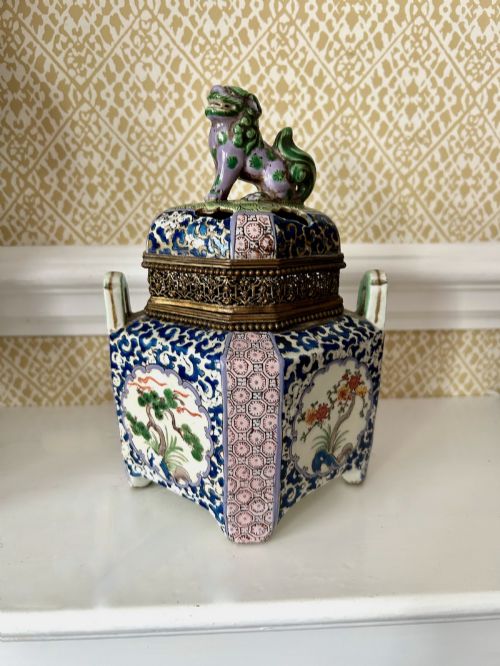


19th Century Bronze Roses
These 19th century bronze roses bring together cast metalwork and hand-painted porcelain to create striking centrepieces for traditional interiors.
19th Century Bronze Roses
When searching for 19th century bronze roses, you encounter decorative objects and functional lamps that combine metal mounts with painted ceramics. The selection on this page centres heavily on porcelain vessels fitted with gilt bronze or ormolu mounts, alongside sculptural representations in bronze.
Many of these pieces draw on Chinese Export and Rose Medallion traditions, often adapted later into European lighting or table ornaments. French taste also appears strongly through Sevres style vessels and Louis XVI Revival candelabra.
Forms range from large lidded urns and table lamps to centrepiece bowls and sculptural vases of roses. The materials span porcelain, gilt bronze, ormolu, brass, enamel, fabric, and white marble, representing styles from Chinoiserie to French Rococo Revival.
Materials and construction
Makers combined hand-painted porcelain bodies with cast metal mounts using pins, screws, and adhesives. The ceramic elements often display polychrome enamel decoration characteristic of Chinese export wares or European factory reproductions.
Metal components utilise bronze and brass, frequently finished with mercury gilding or modern electroplating to create ormolu surfaces. Bases and structural elements sometimes incorporate white marble or additional gilt bronze detailing.
19th Century Bronze Roses Retail Price Guide 2026
Typical asking prices for 19th century bronze roses among the pieces listed under this phrase on Sellingantiques today, from the lower quarter to the upper quarter. They describe what is for sale here now, not the wider market.
Several lamps wear fabric shades that turn bright porcelain vessels into gentle evening reading lights.
Variations in quality
The precision of the metal casting and the crispness of the chasing separate finer mounts from softer, simpler productions. Heavy, well-defined ormolu with sharp leaf and scroll work indicates superior workshop standards.
Porcelain quality depends on the delicacy of the hand-painted enamel details and the preservation of the glaze. Earlier Chinese export pieces and established European manufactories generally display greater artistic control than later derivative styles.
The 19th Century Bronze Roses Glossary
- Ormolu
- A gold-coloured brass alloy used for decorative mounts on furniture, porcelain, and clocks. It was traditionally applied using a mercury amalgam technique before safer electroplating methods became common.
- Rose Medallion
- A nineteenth-century Chinese export porcelain pattern featuring panelled scenes filled with figures, birds, and flowers, dominated by pink enamel tones. This style became immensely popular in Western drawing rooms.
- Famille Rose
- A major palette of Chinese ceramic glazes introduced in the Qing dynasty, distinguished by opaque pink or rose enamel derived from colloidal gold. It allowed for subtle shading and detailed botanical painting.
- Candelabra
- Branched lighting devices designed to hold multiple candles, often incorporating decorative bronze or marble pedestals. In nineteenth-century interiors, they served as ornamental table centrepieces as well as light sources.
- Louis XVI Style
- A neoclassical design revival dating to the nineteenth century that favours symmetrical lines, classical motifs, and restrained ornamentation. It frequently employs gilt bronze mounts alongside porcelain and marble.
19th Century Bronze Roses: Frequently Asked Questions
Are these lamps original conversions?
Many nineteenth-century vases and urns were adapted into table lamps later in their lifespan, while others were produced specifically for lighting with wired mounts.
Examining the wiring access points and the relationship between the porcelain body and the bronze hardware helps determine the timeline of the conversion.
How do I clean gilt bronze mounts?
Gilt bronze and ormolu surfaces require gentle dusting with a soft brush to prevent accumulation of dirt in the chased recesses.
Harsh metal polishes strip away the gold layer, so conservation experts recommend using only a dry microfibre cloth or mild soapy water for stubborn marks.
What is the difference between ormolu and brass?
Ormolu refers specifically to gilded metal mounts finished to resemble solid gold, whereas brass is a standard copper and zinc alloy with a natural metallic yellow colour.
Nineteenth-century makers used ormolu to elevate the status of decorative objects and complement painted porcelain.
How do I identify Rose Medallion porcelain?
Rose Medallion ceramics feature distinct alternating panels of figures and birds set against dense flower and butterfly backgrounds, tied together by pink enamel highlights.
Most examples date from the nineteenth century when export production to Europe and America reached its peak.