
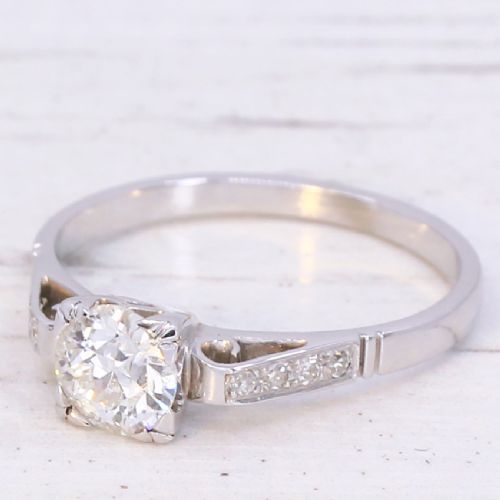
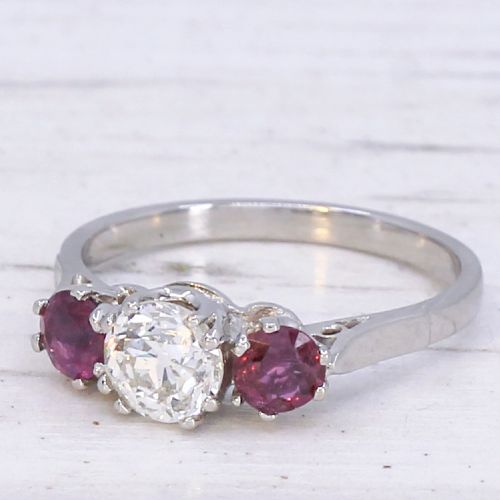


1940s White Gold Jewellery
These pieces of 1940s white gold jewellery bring together period stones and precious metal settings that collectors prize for enduring character.
1940s White Gold Jewellery
When searching for 1940s white gold jewellery, buyers encounter rings, earrings, watches, necklaces, and pendants shaped by Art Deco, Retro, and Mid-Century styles. The selection centres heavily on rings, particularly diamond engagement rings and gemstone clusters set around the year 1940.
The objects span varied gold purities alongside platinum, combining structured geometric layouts with softer floral and twirl motifs. Pieces frequently integrate coloured stones such as rubies, emeralds, sapphires, zircons, tourmalines, and pearls alongside diamonds.
How they were made
The materials recorded in these pieces rely on 9ct gold, 14ct white gold, 18ct white gold, and platinum as foundations for intricate gemstone settings. Stones are cut in traditional old styles, allowing old cut diamonds to sit alongside natural rubies, emeralds, sapphires, tourmalines, and blue zircons.
Metalwork incorporates structural cluster designs, coronet mountings, and articulated tank cocktail forms, securing pearls on clasps and framing watches with precious metals.
Some rings carry enough metal and stones to double as miniature rolling fortifications.
What varies in quality
Quality rests on the scale and clarity of the central stones, from substantial diamond carats down to smaller accent gems, paired with the purity of the white gold or platinum housing. Heavier carat weights in coloured stones like Burmese rubies or sapphires elevate the significance of a piece.
The precision of the setting work, whether in an elaborate Art Deco cluster or a fluid Retro twirl, dictates the overall refinement of the construction.
The 1940s White Gold Jewellery Glossary
- Old cut diamond
- A diamond cut with a small table, high crown, and open culet, typical of stones from this period. These stones catch candle or ambient light with a softer, distinctive shimmer.
- White gold
- An alloy of gold mixed with white metals such as palladium or silver. It provides a durable, silvery backdrop for diamonds and coloured gemstones.
- Cluster ring
- A ring design featuring a central stone surrounded by a border of smaller gems. This layout maximises visual impact and light reflection.
- Tank ring
- A bold, architectural jewellery style originating in the mid-century period. The chunky metalwork mimics the tracks and forms of military machinery.
- Coronet cluster
- A raised crown-like mounting that elevates the central gemstone above the finger. This technique allows light to enter the stone from multiple angles.
1940s White Gold Jewellery: Frequently Asked Questions
What defines 1940s white gold jewellery?
These pieces combine period metal alloys with platinum, diamonds, and coloured gemstones in rings, necklaces, and watches. Styles bridge late Art Deco geometry with chunky Retro and mid-century forms.
Craftsmanship from this era relies heavily on old cut diamonds and secure prong or cluster settings designed to highlight both the metal and the stones.
How do I wear these pieces?
Rings and pendants suit daily wear provided the settings are checked periodically by a professional. Delicate items like pearl necklaces require careful handling away from cosmetics and moisture.
Cocktail rings and drop earrings work well as statement items for evening occasions, pairing naturally with period or modern attire.
How do I tell Art Deco from Retro styles?
Art Deco pieces lean towards strict symmetry, linear geometry, and sharp angles. Platinum and white gold provide cool, precise backdrops for pavé-set diamonds.
Retro designs often incorporate heavier, sculptural gold work, floral motifs, and three-dimensional curves influenced by wartime and post-war aesthetics.
What stones are common in this jewellery?
Diamonds form the backbone of these pieces, frequently cut as old cut stones in engagement and cluster rings. Burmese rubies, sapphires, emeralds, blue zircons, and tourmalines also appear regularly.
Pearls and garnets are utilised in specific configurations like double strand necklaces with floral clasps.