
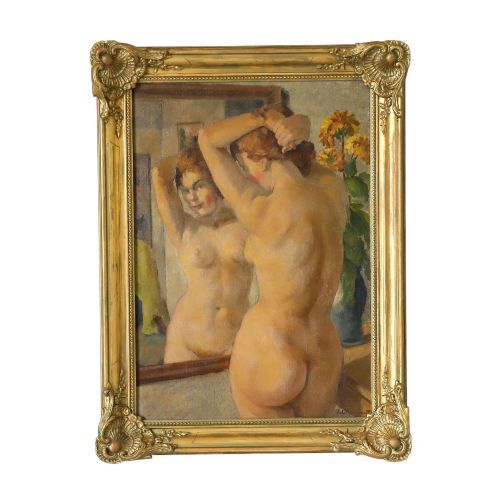


1940s Oil Canvas Portrait
A 1940s oil canvas portrait brings mid-century character and individual expression into a room, capturing figures, animals, and domestic scenes through layered pigment.
1940s Oil Canvas Portrait
When you search for a 1940s oil canvas portrait, you are looking at mid-century paintings executed in oil paint upon stretched canvas supports, originating primarily from the nineteen-thirties through the nineteen-fifties. These works span European and American studios, encompassing British sporting art, Swedish modernism, realism, surrealism, and early new figuration.
You are most likely to meet portraits of horses, dogs, children, and adults, often housed within their original wood or gilt frames. Subjects range from named showjumpers and family pets to abstract figures and psychological studies like the Black Madonna or the Queen of Spades.
How they were made
These works were created using oil paint applied to woven canvas stretched over wooden frames, sometimes accompanied by decorative wood frames. Artists worked with brush and palette knife to build texture, depth, and luminosity across the canvas surface.
Techniques vary from tight 1940s realism to looser mid-century expressionism and avant-garde new figuration, depending on whether the artist trained in British sporting traditions, continental surrealism, or American modernist circles.
Listings feature works spanning the 1930s to the 1950s, executed in oil on canvas and housed in wood or gilt frames.
What varies in quality
Quality rests upon the strength of the composition, the handling of the medium, and the expressive capture of the subject. A superior canvas demonstrates confident brushwork and tonal balance rather than stiff academic imitation.
The integration of the painting with its period frame also alters the visual success of the piece, as does the clarity of provenance linking the work to a recorded artist.
Philippe de Rougemont·M. E. Hankinson·Molly Maurice Latham·John Gilroy
The 1940s Oil Canvas Portrait Glossary
- Oil paint
- A slow-drying paint made by mixing pigments with oils, commonly linseed. It allows artists to blend colours smoothly and build rich surface textures on canvas.
- Canvas
- A heavy woven fabric used as a surface for painting, typically stretched tightly over a wooden frame before application of the ground and pigments.
- Gilt
- A thin layer of gold leaf or gold paint applied to wood frames. It provides a reflective border that complements the warm tones of an oil painting.
- Realism
- An artistic movement focused on depicting everyday subjects and people truthfully without artificiality. In this period, it balances photographic accuracy with painterly brushwork.
1940s Oil Canvas Portrait: Frequently Asked Questions
How do I date a 1940s portrait?
Dating relies upon artist signatures, exhibition labels, clothing styles, and framing techniques characteristic of the decade. Many works bear direct dates or registration details inscribed on the reverse of the canvas or stretcher bars.
Comparison with documented works by the same hand provides further verification of the exact period of execution.
Where should I hang an oil portrait?
These portraits suit living rooms, studies, and hallways where stable wall space avoids direct, harsh sunlight. Pairing the painting with traditional or mid-century interior spaces helps anchor its historical character.
Keep the canvas away from extreme temperature fluctuations and damp environments to protect both the oil pigments and the wooden stretcher.
Why choose an avant-garde portrait?
Avant-garde and surrealist portraits from this era offer a psychological depth and experimental colour palette distinct from traditional academic portraiture. They introduce bold narrative elements and striking modernism into domestic interiors.
Such works reflect the turbulent artistic shifts occurring internationally during the nineteen-forties.