
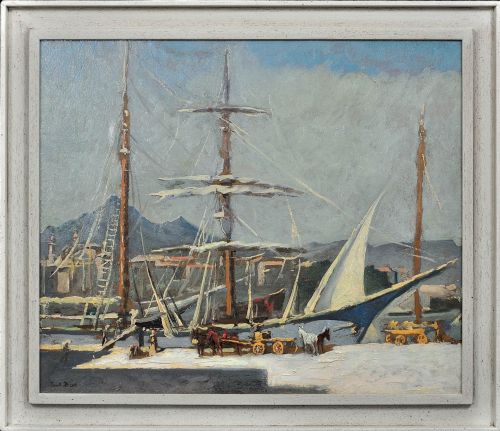


1930s Oil Landscape
When you search for a 1930s oil landscape, you encounter works capturing the light, mood and topography of the interwar decades.
1930s Oil Landscape
A 1930s oil landscape records rural and coastal scenes from the interwar period, often rendered in post-impressionist or realist modes. Buyers seeking this phrase find depictions of English farmyards, West Country ponies, French coastal ports and Mediterranean settings.
The works appearing here span regional British views alongside French provincial scenes and scenes from further afield. These paintings capture plein air observations and studio interpretations created during the 1930s.
Framed examples dominate the selection, bringing period presentation alongside the canvas or board surface. They offer a direct window into the artistic responses of the decade to nature, rural labour and light.
How they were made
Painters of this period utilised oil paint applied to either stretched canvas or prepared wooden board. These substrates received brushwork ranging from thin plein air washes to heavier impasto applications.
Many works incorporate wooden frames, sometimes finished with gilt details that complement the palette of the composition. The physical support often bears the texture of the weave or the grain of the panel beneath the paint layer.
Listings feature works executed in oil on canvas and oil on board, spanning periods from 1910 through 1950 with a concentration in the 1930s.
What varies in quality
Quality rests on the confidence of the brushwork and the clarity of light within the composition. Stronger examples demonstrate a sure command of tonal relationships and atmospheric perspective.
The distinction between ordinary and exceptional pieces lies in the vitality of the handling and the cohesion of the palette. Works displaying distinct individual observation stand apart from more formulaic topographical records.
Paul Bret·Margaret Maitland Howard·Charles Walter Simpson·Gustave Vidal·William JB Jenkins·Frank Percy Wild·Claude Jousset·Donald Wood
The 1930s Oil Landscape Glossary
- Oil on Canvas
- Pigment mixed with drying oil applied to a woven fabric stretched across a wooden frame. This surface allows for varied brush textures and responds well to conservation.
- Oil on Board
- Pigment applied directly to a rigid wooden panel or board. This format often supports swift plein air sketching.
- Post-Impressionism
- An art movement extending beyond impressionism that prioritised symbolic content, expressive brushwork and structural design over pure optical realism.
- Plein Air
- Painting executed outdoors to capture direct observations of natural light and weather. This method defines many interwar landscape studies.
1930s Oil Landscape: Frequently Asked Questions
How do I identify a 1930s oil landscape?
Look for stylistic cues characteristic of interwar art, such as post-impressionist brushwork, modernist palettes or realist framing of rural subjects. Pigments, canvas types and framing styles often corroborate the period.
Examining the reverse of the canvas or board may reveal artist signatures, studio stamps, exhibition labels or period inscriptions that help confirm the date.
Where were these paintings typically created?
These landscapes originate from various European art communities and rural locations, including the West Country of England, Yorkshire, Provence, Brittany and the Côte d'Azur. Artists painted both on location and within regional studios.
Many reflect the travels of painters seeking specific qualities of light in coastal ports, agricultural valleys and pastoral river settings.
Should I choose canvas or board?
Canvas provides flexibility and traditional spring under the brush, frequently found in larger exhibition pieces. Board offers a rigid surface well suited for smaller, direct studies executed outdoors.
Both supports were common during the decade, so the choice depends largely on the scale and finish of the individual artwork.
How should I frame and display them?
Many works retain period frames that suit their aesthetic, though simple mouldings can also support the presentation without competing with the painted surface. Display them away from direct sunlight and excessive humidity to protect the oil paint and wooden supports.
Proper wall placement ensures stable environmental conditions, preserving both the canvas and any original gilt framing.