
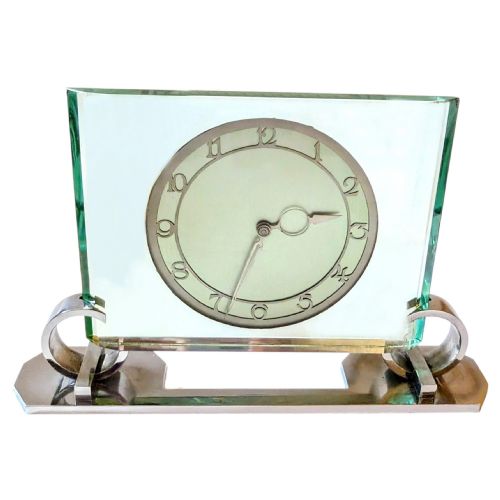
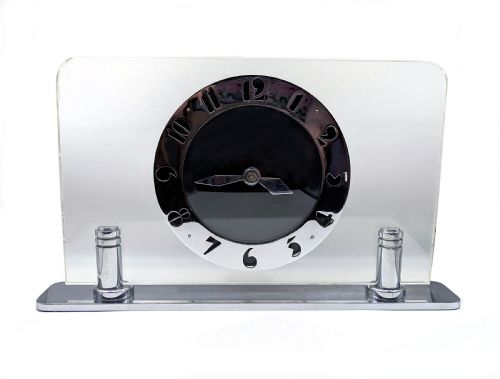


1930s Glass Mantel Clock
A 1930s glass mantel clock brings striking Art Deco geometry and clean transparency to a room.
1930s Glass Mantel Clock
When searching for a 1930s glass mantel clock, collectors encounter distinctive timepieces defined by the bold lines of the Art Deco style. These objects serve both practical timekeeping and decorative roles on mantelpieces, desks, and shelves.
The pieces listed on this page originate predominantly from the 1930 period, showcasing the era's fascination with modernism and industrial innovation. Forms range from straightforward upright mantel clocks to complex mystery clocks and combined clock-and-lamp units.
Makers and designers of the decade utilised translucent, mirrored, and coloured glass to catch the light from every angle. This creates a floating visual effect, especially in designs where the movement appears suspended within clear or tinted panels.
How they were made
Makers constructed these clocks by combining heavy glass bodies with metal fittings in chrome, brass, and occasional bakelite. The glass components often feature thick bevelled edges, peach or blue mirror glass, and vibrant opaline or uranium formulations.
Mechanical movements, including wind-up mechanisms, eight-day workings, and electric systems, sit encased behind or within the glass housing. Dial faces integrate metal numerals and hands styled in strict geometric lettering typical of the modernist aesthetic.
Listings span the 1920 and 1930 periods, uniting glass, chrome, brass, and marble into distinct Art Deco forms.
What varies in quality
Quality in these timepieces rests upon the sophistication of the movement and the integrity of the glass housing. Signed works by notable makers demonstrate superior craftsmanship in both the precision of the clockwork and the finish of the metal mounts.
The visual ambition of the design further distinguishes standard examples from exceptional ones. Elaborate mirror glass constructions, chiming Westminster mechanisms, and unusual transparent electric configurations represent the highest standard of period production.
Smiths Clockmakers·Mappin & Webb·P.M.Favre·Jaeger-LeCoultre·GEC
The 1930s Glass Mantel Clock Glossary
- Mystery clock
- A timepiece where the hands appear to move without any visible mechanical connection to the movement. This optical illusion was achieved through transparent glass dials.
- Opaline glass
- A semi-opaque glass with a delicate milky appearance, often tinted in soft shades. It diffuses light gently across the body of the clock.
- Mirror glass
- Silvered glass panes utilised to reflect surrounding interior details and amplify light. Peach and blue tinted variations are characteristic of the decade.
- Bulle clock
- An electromagnetic clock driven by a pendulum moving through a magnetic field. These represent the innovative electrical experiments of the era.
1930s Glass Mantel Clock: Frequently Asked Questions
How do electric glass clocks work?
These pieces utilise early electric or battery-driven movements housed discreetly within the glass and metal structure. They reflect the period's growing reliance on household electricity.
Wiring and internal components vary by maker, so contemporary buyers should inspect the electrical setup to ensure it meets modern safety standards.
Where should I place a glass mantel clock?
Position your clock on a sturdy mantelpiece, sideboard, or desk where adequate light can pass through the glass panels. Placing them near a light source enhances the transparency and coloured mirror effects.
Avoid high-traffic edges where vibrations might cause the heavy glass body to shift or fall.
How do I wind an eight-day clock?
Use the designated key to gently turn the winding arbors on the dial face until you feel firm resistance. Do not overwind, as this can strain the internal spring mechanisms.
Eight-day movements require attention roughly once a week to maintain accurate timekeeping across the mechanical gear train.
How do I distinguish mystery clocks from standard models?
Mystery clocks feature transparent glass dials where the hands seem to float without gears connecting them to the central housing. Standard models display a solid or semi-opaque dial face with visible backing.
Examining the edges of the glass reveals the clever concealed framework that transmits power invisibly to the hands.