
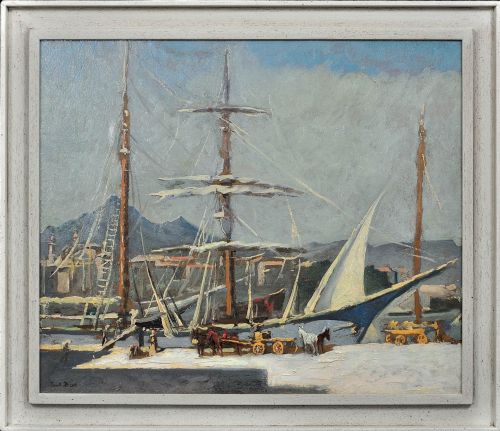


1930s Coastal Painting
These 1930s coastal painting works capture maritime life and shorelines with direct brushwork, offering an authentic window into interwar seaside scenes.
1930s Coastal Painting
A 1930s coastal painting captures harbours, beaches, and maritime views created during the 1930 period. The selection on this page focuses heavily on French and British scenes, ranging from the Côte d'Azur to Yorkshire ports.
Buyers encounter subjects such as fishing ports, moored boats, and cliffside lighthouses rendered in oil or watercolour. These works reflect regional European coastal life through the artistic lens of the early twentieth century.
Most pieces take the form of framed original artworks on canvas, paper, or board. They document specific locations like Palermo, Cannes, Concarneau, Whitby, and Scarborough.
What varies in quality
Quality rests in the fidelity of light study, brush control, and the artist's ability to render atmosphere. Stronger works convey the particular warmth of sunny climes or the rugged textures of northern sea walls with distinct handling.
The degree of preservation in the canvas, board, and framing materials influences the overall presentation. Framed artwork maintains greater visual integrity when the surrounding wood frame complements the period aesthetic.
The documented styles span 20th century realism, post-impressionism, and art deco.
Paul Bret·Paul Delvaux·Gustave Vidal·Rowland Henry Hill·Fred Lawson·Donald Wood
The 1930s Coastal Painting Glossary
- Oil on canvas
- A painting medium where pigments are bound with drying oil and applied to stretched woven fabric. This combination allows for rich colour blending and textured brushwork.
- Watercolour
- A paint consisting of pigment suspended in a water-based solution, typically applied to paper. It produces luminous, transparent washes suited to coastal light.
- Post-Impressionism
- An art movement extending beyond impressionism that prioritised symbolic content, expressive brushwork, and structural form over naturalistic colour representation.
- Art Deco
- A design style of the interwar period characterised by sleek geometric forms and stylised depictions. It influences the decorative composition of certain coastal water landscapes from this decade.
- Maritime
- Pertaining to the sea, ships, and harbours. This category includes depictions of port activities, fishing vessels, and coastal architecture.
1930s Coastal Painting: Frequently Asked Questions
Where were these coastal scenes painted?
The works originate from various European locations, featuring specific harbours and seaside spots in France, Italy, and Britain. Common settings include Mediterranean ports like Cannes and Palermo alongside Yorkshire coastal towns such as Whitby and Scarborough.
Artists frequently travelled to established fishing ports and coastal resorts to record local maritime life and distinctive regional architecture.
How do I care for a watercolour painting?
Watercolour works on paper require protection from direct sunlight to prevent fading of the pigments. Keeping them behind glass in a stable environment avoids moisture damage to the paper support.
Positioning the framed artwork away from damp exterior walls ensures the paper and wood frame remain preserved over time.
What is the difference between oil on canvas and oil on board?
Oil on canvas involves applying paint to a stretched fabric surface, which yields a flexible support with subtle textural give under the brush. Oil on board uses a rigid wooden or composite panel substrate.
Both methods were common during the interwar period, but board supports offer a completely rigid backing that requires less tension maintenance than stretched canvas.
How do I identify a post-impressionist coastal work?
Post-impressionist works display visible, expressive brushstrokes and an emphasis on light and shadow rather than photographic realism. Artists working in this manner focused on capturing the mood and atmosphere of the scene.
Such pieces often use simplified forms and deliberate colour choices to convey the heat or chill of a specific coastal environment.