
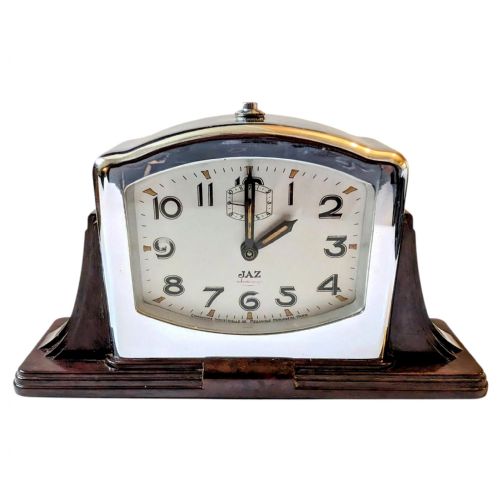
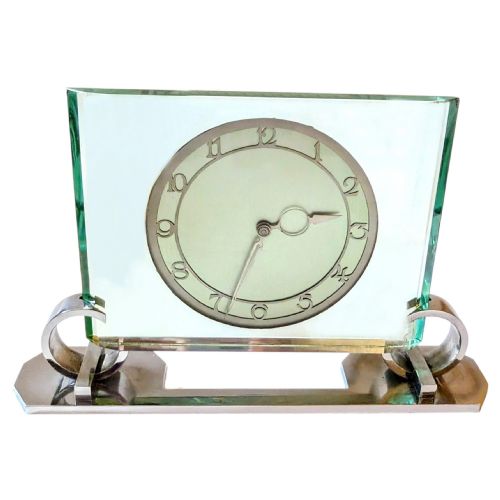
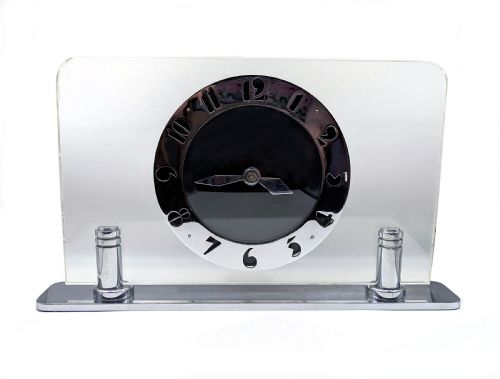
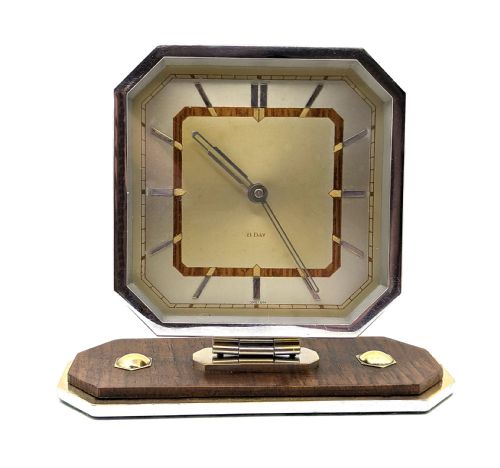
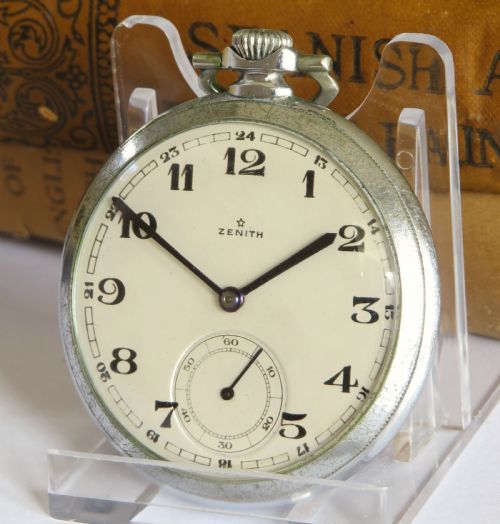


1930s Chrome Timepiece
These 1930s chrome timepieces capture the sleek modernist energy of the interwar period, offering buyers a functional centrepiece with striking geometric appeal.
1930s Chrome Timepiece
A 1930s chrome timepiece encompasses desk clocks, mantel clocks, travel alarms, wall clocks, and wristwatches shaped by the dominant Art Deco style of the period. These objects span English and continental origins, frequently combining metal housings with contrasting materials like glass, marble, and wood.
On this page, desk clocks and mantel clocks dominate the selection, often featuring wind-up or eight-day movements housed in polished metal cases. Pieces by makers such as Smiths, Mappin & Webb, and Asprey illustrate the variety of domestic and travel timekeepers from this era.
How they were made
Makers utilised chrome-plating over base metals to achieve a bright, durable finish that resisted tarnishing while satisfying the modernist demand for industrial sheen. Cases frequently incorporated contrasting inserts of bakelite, coloured glass, marble, or walnut to add depth to the geometric silhouettes.
Listings feature periods from the 1920s and 1930s, encompassing desk clocks, mantel clocks, wall clocks, and wristwatches.
What varies in quality
Quality rests in the precision of the modernist case architecture and the provenance of the maker, with retailer-signed pieces from firms like Harrods or Asprey reflecting higher production standards. The integration of luxury supplementary materials such as opaline glass, blue mirror panels, or sculpted bronze garnitures elevates certain examples above standard utility models.
Mechanical completeness and the retention of original movements dictate desirability among collectors. Examples featuring specialised eight-day movements or signed clockmaker mechanisms hold greater substance than generic anonymous alternatives.
Smiths Clockmakers·Mappin & Webb·Harrods of London·Blangy Clockmakers·Asprey
The 1930s Chrome Timepiece Glossary
- Art Deco
- A design style prevalent during the interwar decades, characterised by sleek geometric lines, stylised motifs, and modern industrial materials.
- Bakelite
- An early synthetic plastic utilised for clock bezels, bases, and cases, valued for its smooth moulding and rich colour tones.
- Garniture
- A set consisting of a central clock flanked by matching decorative objects, such as side vases or sculptural figures.
- Mystery clock
- A timepiece where the hands appear to move without any visible mechanical connection to the movement, creating an illusion of floating time.
- Skyscraper
- A tall, stepped architectural form applied to desk clock cases to mimic the vertical profile of modern city architecture.
1930s Chrome Timepiece: Frequently Asked Questions
What is an eight day clock?
An eight day clock is a timepiece engineered to run for eight days on a single winding before requiring attention again. This mechanism offered domestic convenience to users in the interwar period by reducing the frequency of winding.
Such movements appear frequently in desk and mantel formats across English and European production.
How do I identify Art Deco style?
Art Deco design relies on geometric symmetry, clean vertical lines, and streamlined forms derived from industrial architecture. In timepieces, this translates to stepped cases, bold numeric dials, and polished metallic surfaces.
Materials like chrome, glass, and bakelite reinforce this crisp, modern aesthetic.
Where were these clocks made?
These timepieces originated across workshops and factories in England, France, and Germany during the interwar decades. Major department stores and luxury jewellers often retailed these items under their own London or continental names.
French manufacturers particularly contributed distinctive glass and marble desk designs.
How do I care for a mechanical clock?
Mechanical timepieces require regular manual winding and careful placement away from moisture and extreme temperature fluctuations. Periodic servicing by a qualified professional keeps the internal springs and gears operating smoothly.
Avoiding over-winding preserves the tension in the mainsprings of vintage movements.