
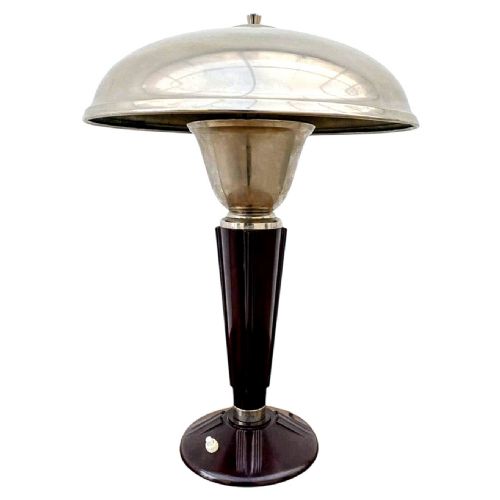


1930s Bakelite Lamp
A 1930s bakelite lamp brings genuine Art Deco style and industrial warmth to a modern interior through robust early plastics and striking geometric forms.

1930s Bakelite Lamp
When you search for a 1930s bakelite lamp, you are looking at early electrical lighting that harnesses the modern synthetic materials of the interwar period. These objects span desk lamps, table lamps, and wall lights created during the height of the Art Deco movement.
The versions you are most likely to meet on this page originate from the 1930 period, showcasing the streamlined silhouettes and functional designs characteristic of twentieth-century domestic lighting.
Makers such as Eileen Grey and E. Cole produced notable examples, alongside distinctive two-tone liquorice allsorts designs and Jumo desk lamps. These pieces combine sculptural presence with practical illumination for desk or wall placement.
How they were made
Makers utilised moulded bakelite and catalin phenolic plastic to form the bodies and shades, often pairing the dark or coloured synthetic resin with contrasting chrome, nickel, and metal hardware.
Glass elements, including frosted glass and clear panels, diffuse the light and complement the smooth surfaces of the moulded plastic components.
One cheerful variation known as liquorice allsorts brings a playful splash of contrasting two-tone colour to serious Art Deco geometry.
What varies in quality
The distinction between standard production pieces and superior examples lies in the complexity of the moulding, the inclusion of desirable metal accents like chrome, and the presence of documented maker attribution.
Richer visual impact emerges in pieces that successfully combine contrasting materials, such as two-tone plastic combinations and frosted glass shades, creating a more finished and deliberate aesthetic.
Eileen Grey·E. Cole·Jumo
The 1930s Bakelite Lamp Glossary
- Bakelite
- An early thermosetting phenol formaldehyde resin that allowed manufacturers to mould durable, heat-resistant objects in various dark colours. It forms the primary body material for interwar desk and table lighting.
- Catalin
- A cast phenolic resin closely related to bakelite that permitted vibrant translucent colours and marbling effects. It provides a brighter finish on select decorative lamps.
- Streamline
- An aerodynamic design style popular in the 1930s that emphasised curved contours, horizontal lines, and smooth surfaces. This aesthetic heavily influenced desk lamp silhouettes.
- Phenolic
- A broad class of synthetic polymers derived from phenol and formaldehyde. This chemistry underpins the hard plastic mouldings found across these pieces.
1930s Bakelite Lamp: Frequently Asked Questions
What is a 1930s bakelite lamp?
A 1930s bakelite lamp is an early electrical light fixture made using synthetic phenol formaldehyde resins, typically styled in the Art Deco aesthetic. These pieces include desk lamps, table lamps, and wall lights.
They represent the early adoption of plastics in domestic interiors, combining industrial innovation with distinctive geometric or streamlined forms.
How do I identify an Art Deco lamp?
Art Deco lamps feature geometric lines, streamlined contours, and a combination of modern synthetic materials like bakelite with metal accents such as chrome or nickel. They often incorporate frosted glass elements.
Look for symmetrical forms and smooth moulded surfaces characteristic of interwar design.
Where were these lamps used?
These lamps functioned primarily as task lighting on office desks, bedside table illumination, or decorative wall sconces in domestic spaces. Their robust plastic construction suited functional daily use.
Wall lights were typically mounted in pairs to provide balanced illumination in hallways or living rooms.
Are catalin and bakelite different?
While both are phenolic resins, bakelite was generally opaque and produced in darker tones through compression moulding. Catalin was cast and allowed for brighter colours and translucent finishes.
Both materials offer the durability and distinctive tactile quality associated with early twentieth-century plastics.