


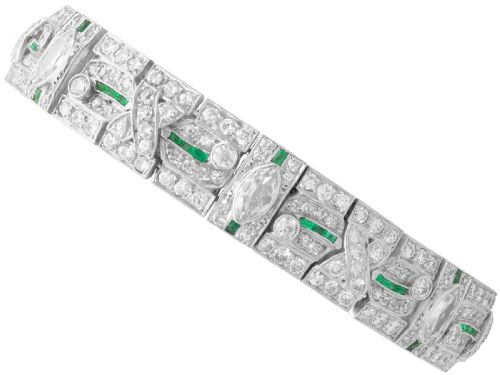


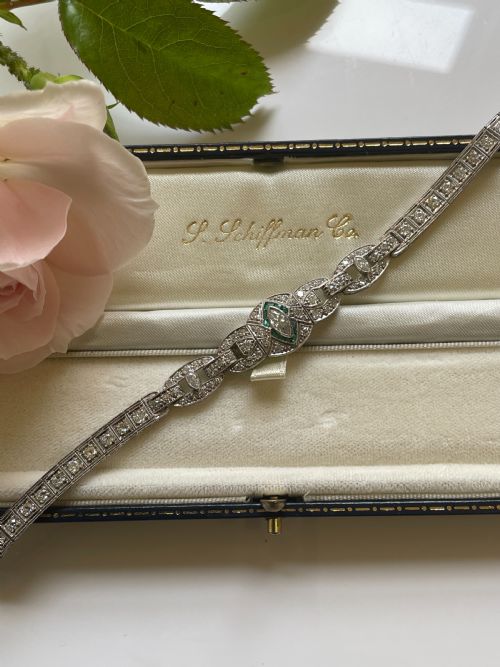

1920s Diamond Platinum Bracelet
These 1920s diamond platinum bracelet pieces bring the sharp geometry and bright white metal of the period straight to the wrist.
1920s Diamond Platinum Bracelet
When you search for a 1920s diamond platinum bracelet, you are looking at items defined by the Art Deco style, which dominated the jewellery of the era. Most examples seen here date from around 1920 to 1930, capturing a specific moment in design history.
The dominant form is the line bracelet or flexible tennis bracelet, alongside intricate cocktail watches and wide strap bracelets. These pieces combine substantial diamond carats with delicate metalwork.
Platinum is the principal metal used across the selection, often paired with small accents of white gold, yellow gold, or 18ct gold. Accompanying gemstones such as emeralds and sapphires appear frequently alongside the central diamonds.
Materials and construction
The construction relies heavily on platinum, chosen for its strength and ability to hold small stones securely in delicate settings. White gold and yellow gold also appear as structural or accent metals in specific pieces.
Old cut diamonds provide the primary sparkle, mounted alongside calibrated sapphires and emeralds in geometric arrangements. Mesh work and articulated links give these heavy gem-set pieces flexibility around the wrist.
Listings feature platinum and gold alongside diamond, emerald, sapphire, and glass materials across the 1920 and 1930 periods.
What separates the best examples
The quality of a 1920s diamond platinum bracelet rests on the precision of its geometric piercing and the uniformity of the stone cutting. Better pieces maintain tight, seamless articulation across every link without stiffness.
The calibre of the supporting gemstones, such as matched emeralds or sapphires, alongside the clarity and weight of the diamonds, distinguishes finer examples. Maker marks and French control stamps add documentary weight to superior pieces.
The 1920s Diamond Platinum Bracelet Glossary
- Art Deco
- A design style from the 1920s and 1930s characterised by symmetry, geometric lines, and stylised motifs. This aesthetic dictates the look of virtually every piece in this category.
- Platinum
- A dense, durable, and naturally white precious metal favoured in interwar jewellery for its strength in fine settings. It allows for minimal metal visibility around stones.
- Old cut diamond
- A diamond cut prior to the modern round brilliant standard, typically featuring a smaller table and a higher crown. These stones produce a softer, candlelit sparkle.
- Line bracelet
- A flexible bracelet featuring a continuous line of gemstones, often referred to today as a tennis bracelet. In this era, they relied on platinum channel or prong settings.
- Cocktail watch
- A timepiece disguised as a jewelled bracelet, popular for evening wear during the 1920s and 1930s. These items merge functional watch movements with heavy diamond and platinum decoration.
1920s Diamond Platinum Bracelet: Frequently Asked Questions
How do I wear a 1920s bracelet?
These flexible line bracelets and wide strap pieces suit evening wear and formal occasions, echoing their original purpose. Their secure platinum links and low profile also allow for careful daily wear.
Pair them simply to let the geometric work and old cut diamonds stand out. Avoid wearing them alongside abrasive metal bangles that might scratch the platinum surface.
Are sapphires and emeralds common?
Coloured gemstones appear regularly alongside the diamonds in these interwar designs, often providing stark contrast to the white platinum. Emeralds and sapphires are the primary stones used for this purpose.
They are typically set in calibrated rows or geometric blocks. This practice dates the piece firmly to the Art Deco period.
How do I date these pieces?
The listings span the 1920 and 1930 decades, identified primarily through Art Deco design markers and material choices. Platinum dominance strongly points to this interwar window.
French pieces often carry Eagle head control marks that assist with dating. Stylistic shifts from linear symmetry to softer floral motifs help separate early examples from later ones.
What is an old cut diamond?
Old cut diamonds are stones shaped by hand before modern automated cutting machines existed in the mid-twentieth century. They feature smaller tables and deep pavilions that catch ambient light differently than modern stones.
This cut gives interwar jewellery its characteristic warm, deep sparkle under evening lighting. The facets are visibly broader and fewer in number.