
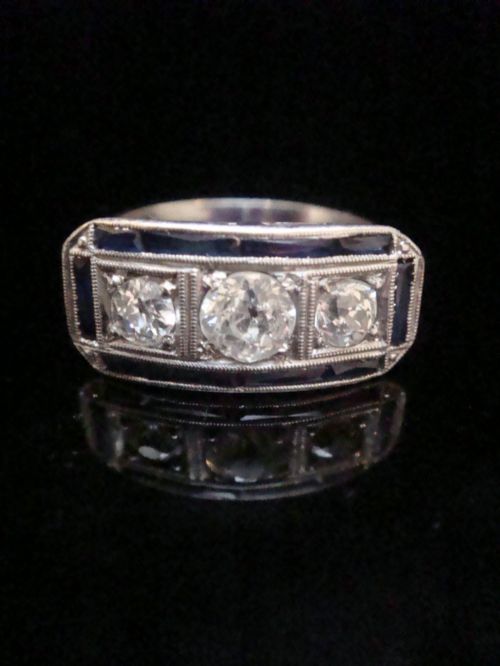


1920s Diamond Panel Ring
A 1920s diamond panel ring delivers the geometric clarity of the Art Deco era directly to the finger.
1920s Diamond Panel Ring
When you search for a 1920s diamond panel ring, you encounter jewels shaped by the geometric restraint of the Art Deco style. These rings feature flat, extended faces designed to display multiple stones across the back of the hand.
The versions most commonly met on this page span the 1920 and 1930 periods. They appear as platinum or 18ct gold settings configured into plaque, cluster, and elongated panel formats.
Many examples incorporate calibre cut sapphires, rubies, or emeralds alongside the central diamonds. This combination creates stark colour contrast typical of the interwar decades.
How they were made
Makers utilised platinum predominantly for its strength, allowing jewellers to pierce and mill metal into delicate openwork frames without losing structural integrity. Gold, including 18ct white gold and standard 18ct gold, provides warmth and structural support in alternative mountings.
Stones are typically shaped as old cut, transitional cut, or baguette diamonds, set alongside calibré sapphires, rubies, and emeralds. These gems are held within precise millegrain borders and channel settings that define the edges of the geometric face.
The periods represented across these pieces are strictly limited to 1920 and 1930 within the Art Deco style.
What varies in quality
The standard of workmanship rests in the crispness of the piercing and the regularity of the millegrain beadwork along the metal edges. Higher quality work maintains absolute symmetry across complex geometric motifs without softening the corners of the platinum plaque.
Stone selection dictates the upper tier of the range, particularly where old cut diamonds and calibrated sapphires or emeralds match precisely in depth and colour saturation. The integration of the basket beneath the panel also determines build quality, showing careful hand-finishing rather than mass production.
The 1920s Diamond Panel Ring Glossary
- Panel ring
- A ring featuring a flat, wide face designed to cover the finger horizontally or vertically. This format serves as the primary canvas for geometric stone arrangements.
- Plaque ring
- A jewel constructed with a flat, pierced metal plate covered in small gemstones. The design resembles a miniature architectural frieze.
- Millegrain
- A decorative technique involving tiny raised metal beads along the edge of a setting. This border softens the transition between metal and stone.
- Old cut
- A diamond facet configuration predating modern brilliant cut standards, characterised by a smaller table and a higher crown. These stones produce broad flashes of light under low illumination.
- Baguette cut
- A step-cut diamond shaped into a narrow rectangle with straight parallel sides. It provides linear contrast to round stones within Art Deco layouts.
1920s Diamond Panel Ring: Frequently Asked Questions
Are these rings suitable for daily wear?
Platinum and gold settings from this period are robust, but the flat panel design requires care around hard surfaces to protect the millegrain edges.
Regular checks by a jeweller ensure the tiny claw and channel settings remain secure around the diamonds and coloured stones.
How do I identify a 1920s piece?
Look for the characteristic geometric motifs, platinum construction, and stone cuts such as old cut or transitional diamonds typical of the Art Deco era.
Maker marks and metal stamps inside the band provide further chronological context, though many carry standard period alloy hallmarks.
What is the difference between a cluster and a panel?
A cluster ring groups stones around a prominent central focal point in a rounded or floral arrangement. A panel ring spreads stones across a flat, rigid geometric shape that sits flush along the finger.
Panel designs emphasise linear architecture, whereas clusters focus on concentric stone distribution.
Can these rings be resized?
Resizing depends on the construction of the shank and whether the geometric pattern extends around the full band. Simple gold or platinum shanks adjust easily, but elaborate shoulders require specialist intervention.
Consulting a specialist prevents distortion to the delicate side gallery and stone settings during adjustment.