




18th Century Marquetry Console
An 18th century marquetry console brings intricate floral and geometric woodwork into a room, offering both decorative presence and a functional surface.
18th Century Marquetry Console
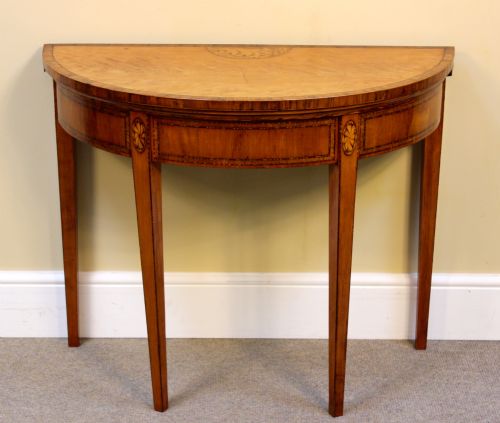
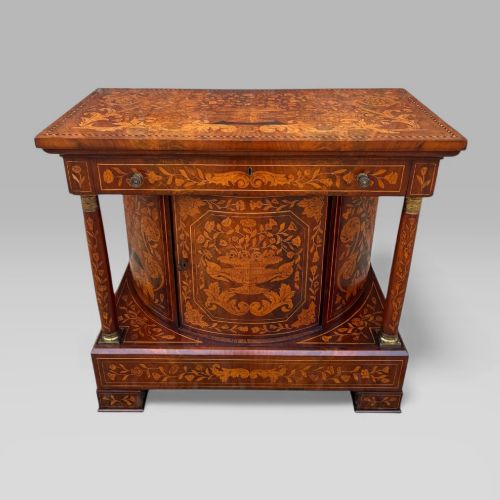
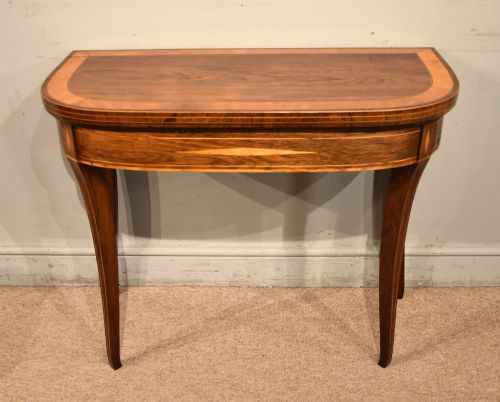
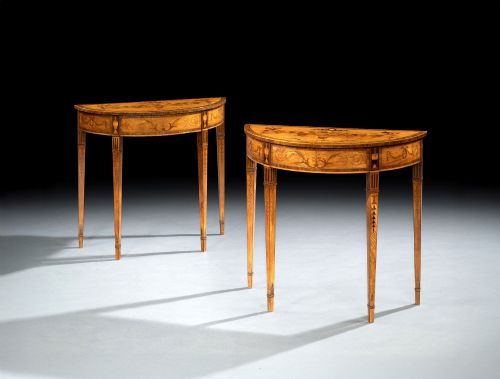
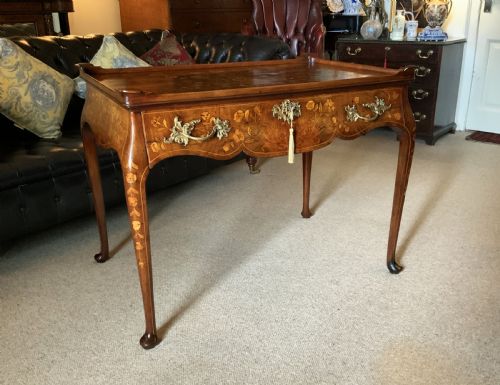
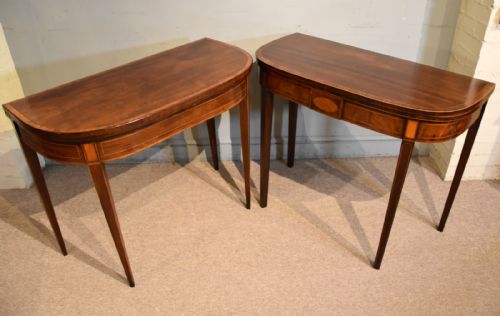
The 18th century marquetry console appears across several distinct forms in the evidence, including card tables, games tables, and demi-lune side tables. These pieces combine architectural support with elaborate surface decoration, frequently taking the form of wall tables or pier tables designed to sit flush against a wall.
Most examples originate from English and Dutch workshops, spanning periods from George III and Sheraton styles to Dutch Baroque and Rococo designs. Makers utilised forms such as foldover tops and serpentine fronts, allowing a single piece to function as a compact side table or expand for entertainment.
Materials and Technique
Cabinet makers constructed carcass frames from foundational timbers like mahogany, walnut, and padoukwood, providing structural stability for the upper surfaces. Over these timbers, craftsmen applied intricate veneers using fruitwood, satinwood, boxwood, and rosewood to build up contrasting colour palettes.
Marquetry and inlay techniques involved cutting thin sections of diverse woods to form pictorial scenes of flowers, birds, and neoclassical motifs. Metal elements such as brass occasionally complemented the woodwork, while specialised items incorporated silver tops or giltwood components.
18th Century Marquetry Console Retail Price Guide 2026
Typical asking prices for 18th century marquetry console among the pieces listed under this phrase on Sellingantiques today, from the lower quarter to the upper quarter. They describe what is for sale here now, not the wider market.
Listings feature woods including satinwood, mahogany, walnut, fruitwood, rosewood, and boxwood.
Quality and Execution
The distinction between tiers of execution rests on the precision of the timber matching and the complexity of the inlaid designs. Finer examples display meticulous grain selection and crisp contrast between woods like satinwood and fruitwood, whereas simpler pieces rely on basic geometric stringing.
Structural integrity of the folding mechanisms on card and games tables also marks the grade of the piece. Superior construction ensures the hinged leaves align flush when closed and remain level under weight when opened for use.
The 18th Century Marquetry Console Glossary
- Marquetry
- A decorative technique where small pieces of wood veneer are assembled to form pictorial or geometric patterns on a surface. This method allows artisans to depict complex scenes using natural wood tones.
- Demi-lune
- A half-moon shape characteristic of side and card tables designed to stand flat against a wall. These tables often feature foldover tops supported by pivoting legs.
- Satinwood
- A durable, lustrous timber native to India and the West Indies, valued for its golden yellow sheen. It frequently forms the background veneer in detailed marquetry panels.
- Serpentine
- A curved furniture front characterised by a convex centre flanked by concave sides. This undulating profile requires advanced woodworking skill to execute cleanly.
- Padoukwood
- A dense, heavy timber ranging in colour from bright red to a deeper brownish-red. Cabinet makers utilised this material for its rich tone and durability.
18th Century Marquetry Console: Frequently Asked Questions
How were these tables used?
These tables served primarily as decorative side or pier tables in formal rooms, providing a surface for ornaments or lighting.
Many variants also functioned as card or games tables, featuring foldover tops that opened to reveal baize-lined surfaces for evening entertainment.
How do I care for antique marquetry?
Keep the wood away from direct sunlight and excessive heat sources to prevent the delicate veneers from drying out and lifting.
Apply traditional wax polishes sparingly and buff gently with a soft cloth to maintain the natural lustre of the timber.
What defines a demi-lune shape?
A demi-lune shape describes a semicircular or half-moon furniture design that sits neatly against flat walls to save floor space.
This profile is particularly common among English card and side tables from the George III and Sheraton periods.
How do I tell Dutch and English styles apart?
Dutch pieces frequently display dense, pictorial floral marquetry in walnut, often associated with Baroque or Rococo aesthetics.
English examples tend to favour satinwood grounds with restrained neoclassical geometry, urns, or ribbon motifs in the Sheraton tradition.