
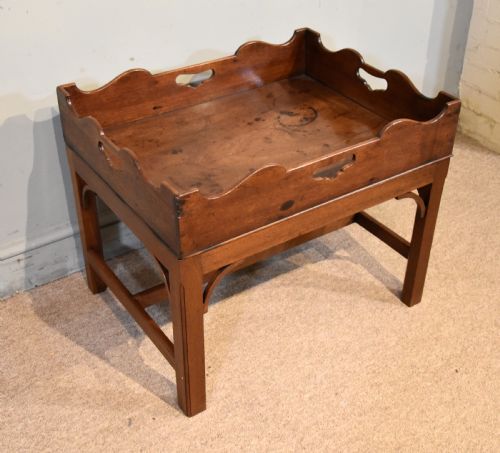


18th Century Butler Tray
An 18th century butler tray combines practical portability with Georgian elegance, offering a versatile surface that transforms easily from a server to a low occasional table.
18th Century Butler Tray
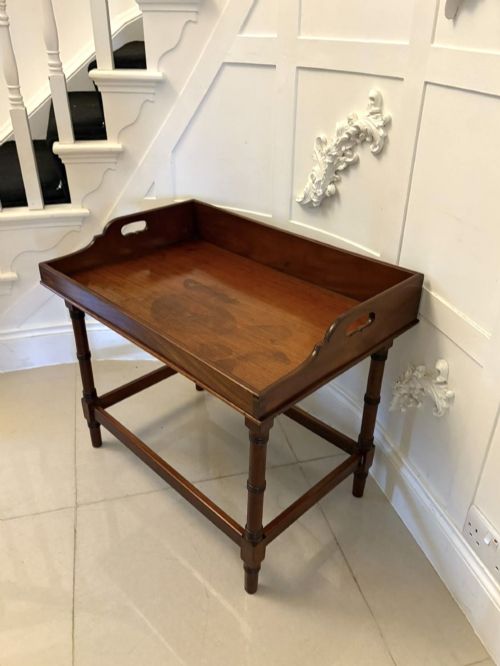
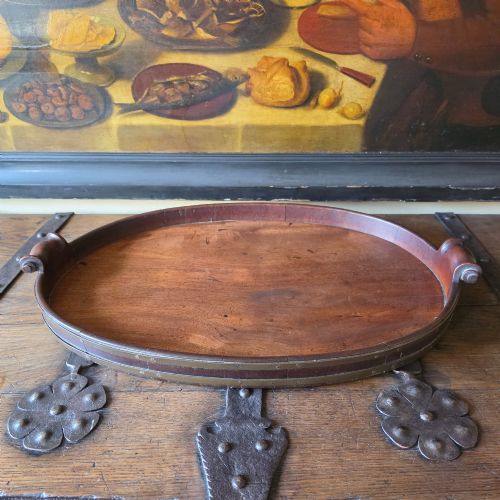
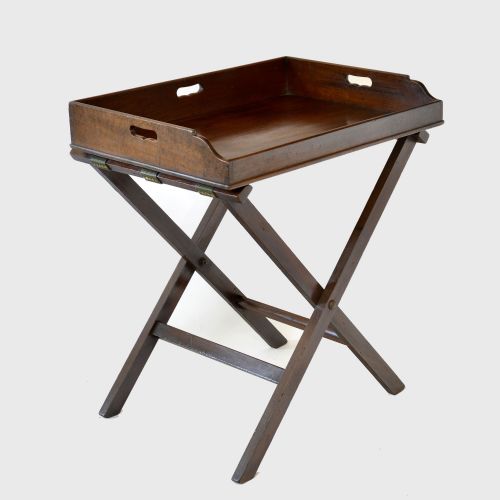
When you search for an 18th century butler tray, you encounter a specialised form of serving tray designed to lift off its folding stand for carrying meals and glassware. The pieces on this page span the Georgian and 19th century periods, encompassing serving trays, oval trays, cutlery trays, and complete tray tables.
The most common formats you meet here are mahogany butler's trays mounted on collapsible stands, alongside stationary lamp tables and galleried oval trays. These items function equally well as side tables or portable serving pieces in a modern interior.
How they were made
Cabinetmakers constructed these pieces primarily in solid mahogany, frequently utilising satinwood inlay, brass hinges, and fabric webbing for structural detail. Wood grain was carefully selected to highlight rich surfaces and patination.
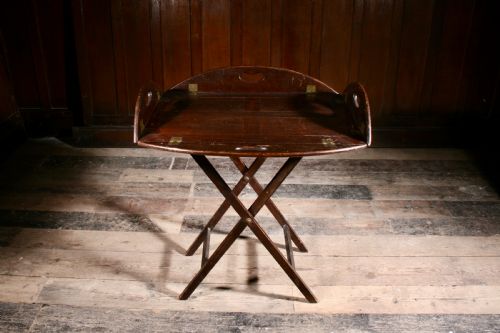
The stands were built to fold flat for efficient storage, while the tray tops featured raised galleries or cutout handles to secure contents during transport. Bone and baize details appear occasionally in related serving equipment like cheese truckles.
Materials appearing across these items include solid mahogany, brass hardware, baize lining, and decorative satinwood inlay.
What varies in quality
The distinction between ordinary and superior examples rests in the crispness of the woodwork, the depth of the timber's patina, and the retention of original stands. Pieces retaining their matching period stands command greater appreciation among collectors.
Subtle decorative choices, such as delicate satinwood stringing or finely shaped gallery edges, elevate simpler serving vessels into refined pieces of occasional furniture. Surface finish integrity and original brass or wooden hardware further define the hierarchy of quality.
The 18th Century Butler Tray Glossary
- Butler tray
- A portable wooden tray with hinged or cutout sides designed for carrying food and drink, frequently paired with a folding wooden stand. This form dates back to the Georgian era.
- Gallery
- A raised wooden border surrounding the perimeter of a tray to prevent items from sliding off during transport. These borders can be pierced, shaped, or plain.
- Patina
- The lustrous surface sheen developed on old wood through decades of handling, polishing, and natural ageing. A rich patina indicates long use and careful maintenance.
- Truckle
- A small low stand or wheeled trolley, often associated with specialised serving pieces like cheese stands or crescent-shaped stilton holders. They represent inventive dining room accessories of the eighteenth century.
- Inlay
- A decorative technique where contrasting woods, such as satinwood, are inserted into recessed cavities within the primary mahogany surface to create geometric or linear patterns.
18th Century Butler Tray: Frequently Asked Questions
What is an 18th century butler tray used for?
These pieces originally served for carrying dishes and drinks from the kitchen to the dining room, with the tray lifting off its base for easy transport. Today, they function wonderfully as compact coffee tables or side tables in a living space.
The folding stand allows the entire assembly to be moved or stored with minimal effort, maintaining the versatile character intended by Georgian cabinetmakers.
How do I identify a Georgian butler tray?
Look for dense mahogany construction, hand-cut dovetails where applicable, and traditional cutout carrying handles built directly into the tray walls. Many authentic examples also feature folding X-frame stands.
The proportions and timber weight differ noticeably from later Victorian reproductions, displaying the characteristic restraint of the Georgian style.
Are butler trays sturdy enough for daily use?
Solid mahogany construction and robust folding stands make these trays remarkably durable for everyday placement of lamps, books, or drinks. The joints were engineered to bear weight while remaining portable.
Care should be taken to protect the antique wood finish from excessive moisture or heat by using appropriate coasters and pads.
What is the difference between a tray and a tray table?
A tray is a standalone vessel intended for carrying items, whereas a tray table combines that removable top with a dedicated folding or fixed base. Many pieces found today include both components together as a complete unit.
The presence of an original matching stand significantly enhances the historical completeness of the object.