

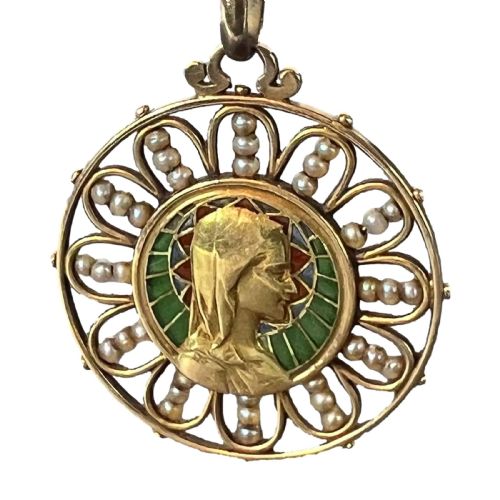


18k Gold Enamel Pendant
An 18k gold enamel pendant brings together high-karat metalwork and glass colour, offering miniature devotional imagery, tokens of affection, or personal charms.
18k Gold Enamel Pendant
When you search for an 18k gold enamel pendant, you encounter pieces spanning from the Victorian era through the Art Deco period and the 1930s. The selection ranges from devotional French medals and heraldic shields to whimsical gambling cards, dice, and love tokens in 18K yellow gold.
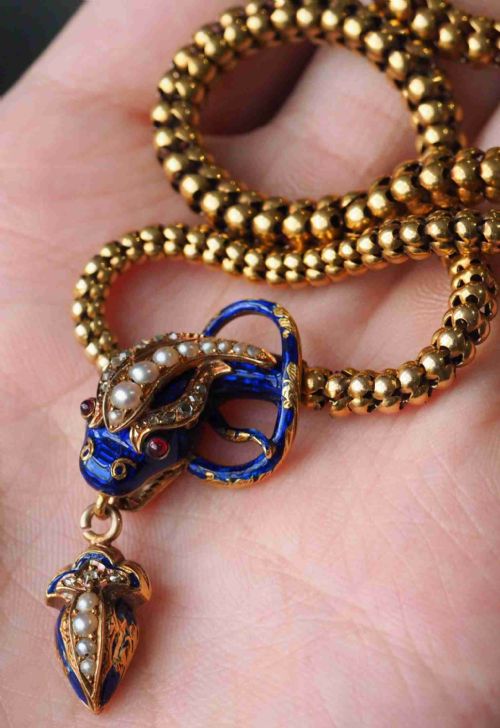
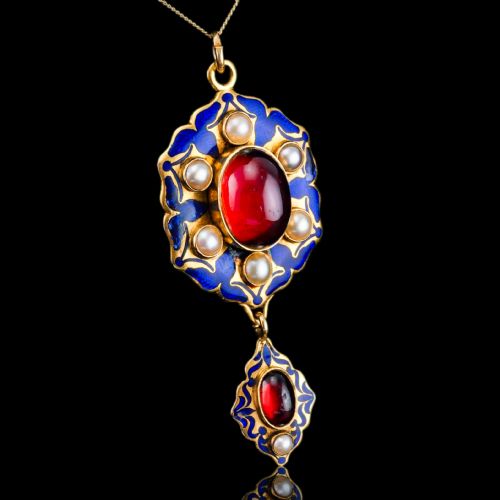
Victorian examples often feature snakes, floral pansies, or Renaissance Revival Holbeinesque designs set with garnets, diamonds, and pearls alongside blue enamel. Later twentieth-century items lean toward French Art Deco motifs, including origami birds, microscopic dice, and enamel thermometers or love magnets.
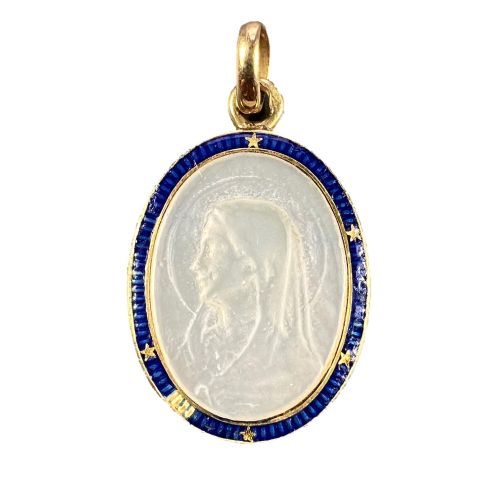
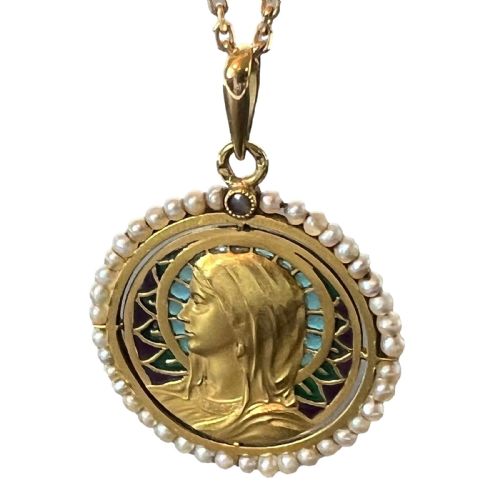
Devotional subjects dominate the offerings, particularly depictions of the Virgin Mary, the Madonna and Child, and various saints. These are frequently worked in translucent plique-à-jour enamel that catches the light like stained glass.
Materials and construction
The foundational metalwork relies on 18K yellow gold, shaped into medals, crosses, hearts, and figural charms. Makers fused vitreous enamel powders to the gold surface through high-temperature firing, creating durable glossy coatings in red, blue, white, and multicoloured hues.
Plique-à-jour technique appears frequently, suspending enamel within open gold wire cells without a backplate to let illumination pass straight through. Jewellers accented these enamel and gold bodies with seed pearls, mother-of-pearl, rose-cut diamonds, rubies, and garnets.
Wearable love thermometers and miniature dice offer mid-century proof that historical jewellers had a wonderfully playful sense of humour.
Assessing quality and execution
Quality rests primarily on the fineness and complexity of the enamel work, particularly in translucent plique-à-jour pieces where uniform cell structure and crystal clarity determine visual success. Finer examples display meticulous hand-painted details on devotional faces or crisp geometric lines in Art Deco subjects.
The integration of secondary materials also dictates distinction, separating simple stamped medals from items set with well-matched seed pearls, rose-cut diamonds, and substantial 18K yellow gold castings. Preserved surface integrity across delicate glass enamels marks the higher tiers of surviving pieces.
Sellier·Chiappe·Merrin
The 18k Gold Enamel Pendant Glossary
- Plique-à-jour
- An enamelling technique where enamel is applied in open cells without a backing, resembling miniature stained glass. This lets light pass directly through the translucent coloured glass.
- Vitreous enamel
- A material made by fusing powdered glass to a metallic substrate through firing at high temperatures. The resulting surface provides permanent, glossy coloration on gold jewellery.
- Holbeinesque
- A Victorian revival style of jewellery inspired by sixteenth-century court designs attributed to Hans Holbein. These pieces typically incorporate heavy goldwork, enamel, and dangling pearls or gemstones.
- Seed pearl
- A very small, naturally occurring pearl often used in Victorian jewellery for borders and floral motifs. They are typically half-drilled and secured with tiny pegs onto the gold base.
18k Gold Enamel Pendant: Frequently Asked Questions
What periods do these pendants cover?
The listings span from the late nineteenth century through the Victorian period, Edwardian era, and into the Art Deco movements of the 1920s and 1930s. You find late-Victorian pieces from the 1880s alongside French and Italian mid-century military and novelty items.
Victorian items tend to focus on symbolic flora, serpents, and commemorative mourning or remembrance themes. The later twentieth-century pieces often take the form of playful charms, such as gambling cards, dice, and zodiac signs.
How do plique-à-jour pieces differ?
Plique-à-jour enamel lacks a solid metal backing behind the coloured glass, allowing light to shine straight through the design like a cathedral window. This technique requires exceptional skill from the metalsmith to suspend the enamel safely within the 18K gold wire framework.
Opaque or champlevé enamels, by contrast, sit within sunken recesses carved directly into the solid gold base. These heavier opaque styles appear frequently on devotional medals depicting the Virgin Mary.
What subjects were popular?
Devotional imagery is exceptionally common, featuring the Virgin Mary, Madonna and Child, and specific city coats of arms like Paris. These religious medals were often worn daily as personal protective tokens or markers of faith.
Secular subjects include love tokens, lucky charms such as aces and dice, and animal motifs like snakes and birds. Victorian examples frequently utilise symbolic flora like pansies for remembrance.
How should I wear an enamel pendant?
These pendants suspend easily from fine or medium 18K yellow gold chains, matching the metal standard of the charms themselves. Their compact size suits daily wear, though care should be taken to avoid impact against harder items.
Because glass enamel can chip under sharp knocks, it is sensible to store them individually away from other necklaces. They pair well with both contemporary neck chains and period antique gold chains.