


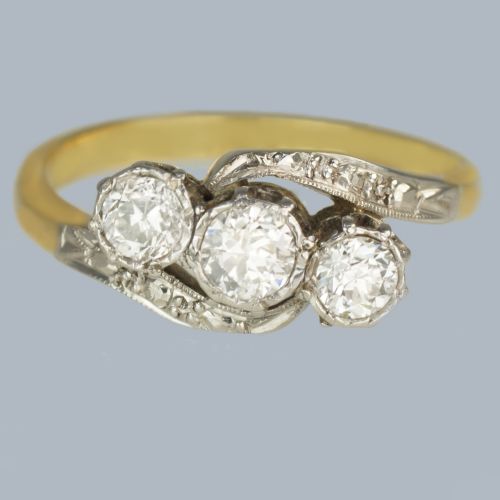
18ct Gold Twist Ring
An 18ct gold twist ring offers a fluid, organic line across the finger, pairing precious metal with diamonds, sapphires and opals.
18ct Gold Twist Ring
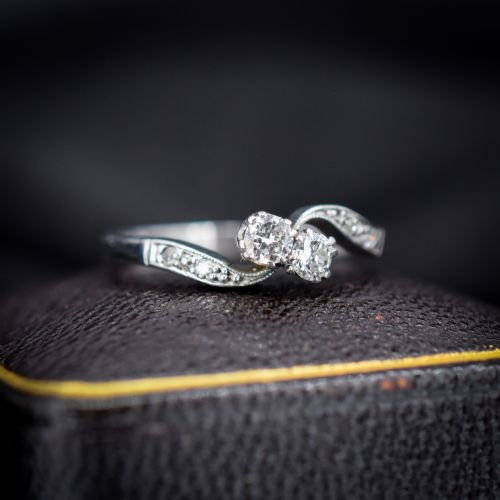
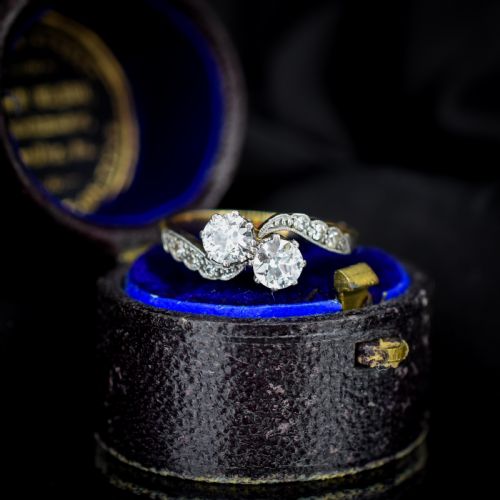
An 18ct gold twist ring brings together precious metals and gemstones in a distinctive swirling or crossover shank. Pieces span the Victorian, Edwardian, Art Deco and Mid-Century periods, evolving from organic floral motifs to geometric lines. The versions most commonly met on this page are Edwardian two-stone 'Toi et Moi' configurations and Art Deco diamond and sapphire bypass designs.
The form relies on bands that curve, cross or spiral around the finger to hold stones securely. Jewellers combined yellow gold, white gold and platinum settings to mount brilliant, old cut or rose cut diamonds alongside coloured gems. These rings served historically as engagement tokens, remembrance pieces and fashionable everyday wear.
Materials and construction
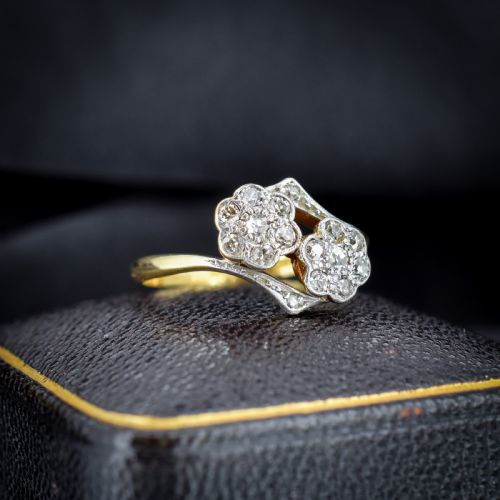
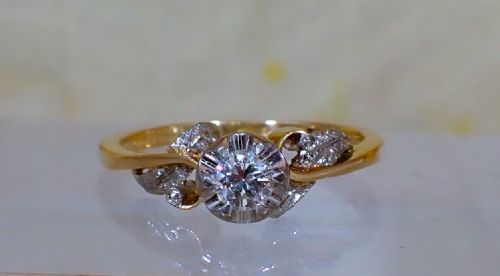
Goldsmiths utilised 18ct yellow and white gold alongside platinum to fabricate the underlying twisted and crossover shanks. Platinum mounts were frequently used during the Edwardian and Art Deco eras to hold small diamonds securely while presenting a bright, white surface. Shanks were hand-formed, cast or drawn into rope, ribbon and bypass configurations.
Gemstones including diamonds, sapphires, rubies, emeralds, pearls and opals were integrated into the winding designs using claw, bezel or star settings. The combination of metals created structural contrast, allowing yellow gold bands to support platinum-topped stone clusters and shoulders.
One vintage French piece reinterprets the twist motif entirely as a pair of fluted spiral hoop earrings.
Assessing quality and craftsmanship
Quality rests in the precision of the metalwork where the bands intersect and twist around the finger. Finer examples maintain crisp lines in the crossover without thinning excessively at the thinnest point of the shank. The harmony between the central stones and the fluid contour of the gold determines the aesthetic success of the piece.
Gemstone selection dictates the upper tier of the range, marked by well-matched diamond cuts, vibrant sapphires and secure flush or claw settings. Maker attention is evident in how cleanly the platinum top plates integrate with the 18ct gold body of the ring.
The 18ct Gold Twist Ring Glossary
- Twist ring
- A ring featuring a band that curves, spirals or crosses over itself along the finger. This design creates a dynamic profile that often frames central gemstones.
- Toi et Moi
- A French term meaning you and me, describing a ring featuring two main gemstones set side by side in a crossover or twist shank. This configuration gained popularity during the Edwardian and Victorian eras.
- Bypass ring
- A style where the ends of the shank pass each other rather than meeting centrally. It shares visual traits with twist designs through its overlapping lines.
- Trilogy ring
- A piece set with three stones representing past, present and future. In this inventory, trilogy designs frequently incorporate twist or crossover shanks.
- Old cut
- A diamond cutting style prevalent in antique and Edwardian jewellery, characterised by a smaller table, higher crown and open culet. These stones catch candlelight differently than modern brilliant cuts.
18ct Gold Twist Ring: Frequently Asked Questions
What periods do these rings come from?
The pieces span from the late nineteenth century through the Edwardian, Art Deco and Mid-Century decades. Victorian and Edwardian examples often feature organic floral or pearl motifs.
Later pieces from the Art Deco and 1930s adopt geometric lines, white gold and platinum settings, while 1950s and 1960s rings showcase bolder cocktail styles.
How do I wear a twist ring daily?
These rings suit everyday wear provided the setting heights and gemstone hardness match your routine. Diamond and sapphire versions withstand daily use well.
Softer gems like opals and pearls require greater care to avoid impact and moisture damage during regular wear.
What is a Toi et Moi ring?
A Toi et Moi ring pairs two primary gemstones symbolising two lives entwined. The stones sit closely together within a curving or crossover shank.
This form often pairs diamonds with sapphires, rubies or pearls in Edwardian and antique formats.
Are platinum and white gold used together?
Yes, many Edwardian and Art Deco pieces combine 18ct yellow gold shanks with platinum settings. Platinum provided a secure, bright white metal to showcase diamonds.
This two-tone construction remains a hallmark of early twentieth-century fine jewellery manufacture.